
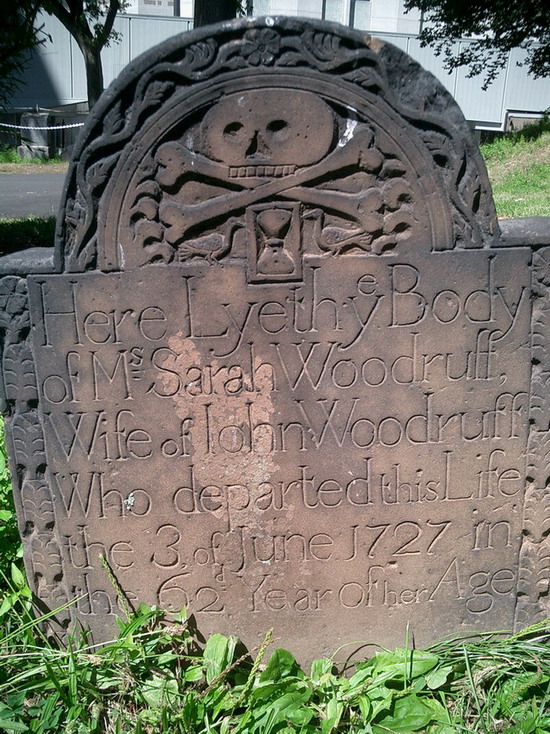
This week’s writing prompt is Tombstone, the following week is Symbol. I decided to write about the interesting gravestone of Sarah Cooper Woodruff. It is pictured above. The combination of the cross bones effigy with an hourglass flanked by doves is a rarely seen arrangement. These symbols on tombstones from this time period are unique.
Sarah was born 17 March 1666 in Springfield, Hampden County, Massachusetts. The daughter of Timothy Cooper and Elizabeth Munson. She married 25 October 1683 in Jamaica, Queens County, New York, to John Woodruff. She died 3 June 1727 in Elizabeth, Union County, New Jersey. She is buried in the First Presbyterian Churchyard in Elizabeth.

Her brown sandstone grave marker was carved by a craftsman whose name is not known. He was only known as The Old Elizabethtown Soul Carver I. He was active during the 1720’s-30’s. His work is distinguished by highly detailed mortality imagery. This includes the use of skull-with-crossbones soul effigies. Her gravestone shows the Puritanical emphasis on the brevity and fragility of life on earth. The harsh Puritan imagery often included skulls and crossed bones. They also included winged death’s heads and the accouterments of the grave, like the casket or coffin. Burial instruments, like the pick and ax, were also common. Nevertheless, the combination of the cross bones effigy together with an hourglass flanked by doves, is a rarely seen arrangement of symbols. Birds have universally been used to represent spirituality since ancient times. In medieval Europe, the dove represented the Holy Spirit and peace, often appearing in religious art and literature. The peacock, with its resplendent feathers, was a symbol of immortality and resurrection, often found in Christian iconography. In Colonial America, a bird in vines symbolized the soul partaking of celestial food. The dove was a Christian icon of constancy and devotion. To the Puritans the vine also represented fruitfulness, the vine providing refreshment and gladness. The hourglass served as a stark reminder of the shortness of life and the inevitability of death. (1, 2, 3, 4, & 5)

References:
- The Profound Symbolism of Birds Across Cultures, Wayne Clark. July 08, 2024.
- Sarah Cooper Woodruff, Find-A-Grave.com.
- 5 Reasons the Puritans Were So Joyful, Joel R. Beeke. March 30, 2019.
- The Symbolism of the Winged Hourglass on 18th-Century Tombstones, Devant La Mort. April 03, 2024.
- Winged Soul Effigy, gravleyspeaking (WordPress blog). July 11, 2014
If you’d like to learn more about the 52 Ancestors in 52 Weeks project, please visit here:
Or join the Facebook group Generations Cafe.
If you use any information from my blog posts as a reference or source, please give credit. Give a link back to my work that you are referencing. Unless otherwise noted, my work is © Anna A. Kasper 2011-2026. All rights reserved. Thank you.


 Anna's Musings & Writings
Pingback: My Ancestor Maria Thomas Badie, Gifted Two Silver Communion Beakers to The Dutch Reformed Church of Breuckelen (Brooklyn, New York) in 1684. 52 Ancestors March Theme: Females. Week 10: Worship. | Anna's Musings & Writings