I am writing this a few days early. I am sure the writing prompt Lost Contact can obviously relate to losing contact with a family member. Although the definition of and how we use the weekly prompts is always open to our individual interpretations. I decided to write about how we, as descendants and researchers, had lost contact with the true origins of my Borodell ancestors, the real family history, the real story. It got bogged down with fanciful stories that eventually were taken as truth.
I am thrilled that a genealogical researcher named Travis Dodge Miscia took on the task of parsing truth from fiction. His results were recently published in the summer of 2024. You can find it in The Cumbrian Origins and Puritan Connections of Ann (Borodell) Denison and Margaret (Borodell) (Shepard) Mitchell, NEHGS (New England Historic Genealogical Society) Vol. 178 No. 3, Page 256 & Page 252.

Prior to his findings being published, there was much written about my ancestor John Borodell and his family, especially stories about his daughter Ann Borodell and her courtship and marriage to Capt. George Denison. The newspaper clipping above is an example of the stories attached to her.
In her own lifetime, Ann (Borodell) Denison left little impression on the historical record. And yet, she has since become one of the more lavishly mythologized figures in the history of New England. How many colonials can boast a 1968 “Ripley’s Believe it or Not” newspaper blurb carried in forty-two countries? In many nineteenth-century sources, she’s “Lady Ann,” the daughter, variously, of an Irish lord, a soldier in Cromwell’s army, a leather merchant, or a cordwainer. (1)

Margaret Borodell Shepard, Ann’s sister, is my direct ancestor. I have to admit, every time I read one of these tales about the remarkable Ann, I became a little jealous. Even a beautiful mirror compact featuring her picture (from the picture above) is available for purchase. In contrast, there were no imaginative tales about my ancestor Margaret, Ann’s sister; instead, there were only dry facts, no artwork, no family museum, and no fancy newspaper articles written about her.

The Myth
Although much more is known about George Denison, there are fanciful elements added to his backstory as well. It was said that he was severely wounded at the Battle of Naseby, and that he was sent to Cork, Ireland, for some reason, to recover, at the home of John Borodell, a wealthy Anglo-Irish leather merchant. There he was nursed by Borodell’s daughter, “Lady” Ann, whom he later married.
A related version of the story of the meeting of Ann Borodell and George Denison:
Captain George Denison was wounded and was carried to the house of Mr. John Borodell of Cork, Ireland, (but who was then residing in England,) a gentleman of high social position, and an earnest sympathizer with the cause of the new republic. Here the wounded soldier was cared for by Ann Borodell, the daughter. (3)
Even later, Ann Borodell and her husband George Denison have been described in a way more akin to a myth:
They were both remarkable for magnificent personal appearance, and for force of mind and character. She was always called “Lady Ann.” They held a foremost place in Stonington [Connecticut]. At the time of their marriage, in 1645, she was 30 years old and he 27. He has been described as “the Miles Standish of the settlement,” but he was a greater and more brilliant soldier than Miles Standish. He had no equal in any of the colonies, for conducting a war against the Indians, excepting, perhaps, Captain John Mason. When they moved to Stonington in 1654, they moved to a rocky knoll overlooking a great meadow with a glimpse of the ocean beyond. (2)
The Truth
Ann Borodell was the daughter of John Borodell. But he was not an Irish Lord or a soldier in Cromwell’s army. He could have been a leather merchant or a cordwainer, but the truth is we do not know his occupation. George Denison did return to England after the death of his first wife, Brigid Thompson, and it was in England that he married Ann Borodell.
We know that John Borodell had four children: Ann, Margaret, John, Jr., and Alice.
Most of what is known about John Borodell is in reference to his children. We can be sure he died before 1640, when his brother-in-law Robert Patrickson took guardianship of his minor children. As to his adventures in Ireland, if he was there, we know it was before the Ulster Rebellion, because he was dead before it happened. No reference to his wife or wives has been found, though assuming only one, she most likely died before 1640 as well. (1)
John Borodell had two sisters. His sister Dorothy Borodell married first to Robert Patrickson, second to Rev. Jeremiah Burroughs, and thirdly to Rev. John Yates. She had no children and is known in records as widow Patrickson and widow Burroughs. It is with she and her husband that John’s minor children were placed after his death.
His sister Alice Borodell, married Francis Morden, a yeoman of Egremont, Cumberland. Egremont is near Gosforth and Santon.
Previous sources indicated his wife was Ann Broughton of Cork, Ireland. There is no proof found regarding his wife or any prior adventures in Ireland. It was his son John Borodell, Jr., who married Ann Broughton. But she was of Kent, England, rather than Cork, Ireland, and she was the daughter of the regicide Andrew Broughton! This gives us our family link to Andrew Broughton.
The meaning of regicide is a person who kills or takes part in killing a king
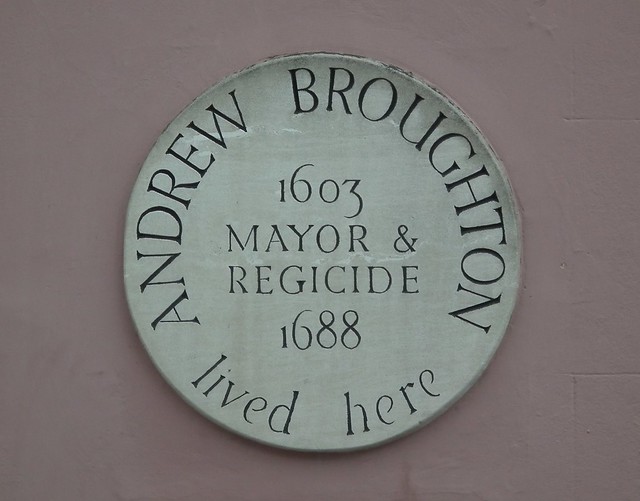
Andrew Broughton is an interesting figure in English history. Broughton was the Mayor of Maidstone, England. He also was the Clerk of the Court at the High Court of Justice of the trial King Charles I of England. As Clerk of the Court, he read out the charge against the king and required him to plead. At the end of the trial, he declared the court’s sentence of death. (3)
At the restoration of the English Monarchy, Andrew Broughton fled England and escaped to Switzerland in 1663. He died there in 1687.
A monument in St. Martin’s Church, Vevey, Switzerland reads as follows:
In Mermoriam Of Him who being with Andrew Broughton joint clerk of the Court which tried and condemned Charles the First of England, had such zeal to accept the full responsibility of his act, that he signed each record with his full name John Phelps. He came to Vevey, and died like the associates whose memorials are about us, an exile in the cause of human freedom. This slab is placed at the request of William Walter Phelps of New Jersey, and Charles A. Phelps of Massachusetts, descendants from across the seas.

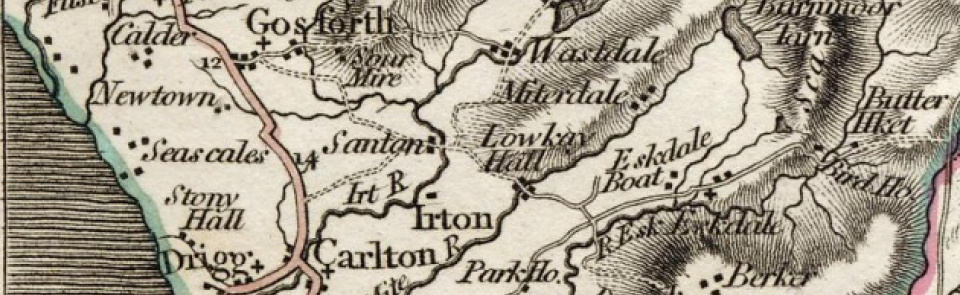
Our Borodell family roots actually take us to English farm country and the village of Santon, which at the time was part of Cumberland County. Cumberland is a historic county in northern England; it became part of Cumbria in 1974. It is an area of England that is predominantly rural and is known for its farming.
Historically, the people of Cumberland County, England, had a significant Scottish heritage due to the area’s long-disputed border with Scotland, meaning the region frequently changed hands between the two kingdoms, leaving a strong imprint of Scottish culture on the local population; the name “Cumberland” itself is derived from the Celtic inhabitants of the region, known as the Cumbri.
What is known is that John Borodell was born in England about 1600 and died there before 1640, when his brother-in-law Robert Patrickson took guardianship of his minor children. We know he was the son of Robert Borodell. He most likely was born in Cumberland County, now part of Cumbria. The family connections to this area are strong ones. His father lived in Gosforth, and his grandfather owned land and lived in Cragg House in Santon. His sister Alice married a man that lived in Egremont, Cumberland. Egremont is near Gosforth and Santon.
His father Robert Borodell was born about 1556 in Cumberland (now Cumbria) County, England; he died before 6 November 1634 (the date of the inventory of estate), leaving an estate of roughly L202, including L139 owed to him. In or around 1576 he was surely the yeoman “Robert Boadell” of Gosforth who putatively owned money to the estate of Lancelot Fletch of Cockermouth. In 1608 Robert sued his landlords in chancery concerning a messuage [a dwelling house with outbuildings and land assigned to its use] called Tottlerigg which Robert held by the custom of tenant right. Nothing is known about his wife or wives. (1)
The Gosforth mentioned above is a village near Santon.
Robert Borodell was the third born son of Nicolas Borodell.
Nicolas Borodell was born about 1530 and died 18 October 1597. He lived in Cragg House in Santon, Cumberland (now Cumbria) County, England. It is believed he may have acquired Cragg House on 6 October 1561, when he bought property from John Irton, a gentleman, and Anne, his wife. (1)
On the same day he made his will, Nicholas sold his property “Cragg House” in trust to Walter More of St. Bees, Nicholas Copeland, rector of Gosforth, and John Cote of Woodend (likely the testator’s son-in-law), to be held in trust for his widow during her lifetime, and finally to pass to his son John for his lifetime, then finally to pass to the longest liver of the remaining three sons (and his heirs males). He was married to Ellice ___, who survived him. (1)
His will was dated 10 Oct 1597, and it was proved 18 Oct 1597.
A bit about Cumberland County, now in Cumbria, and Santon:
The most north-western county in England is Cumbria, which is known to many as The Lake District. In centuries past there was no such county, and the area now known as Cumbria consisted of the two counties of Cumberland and Westmorland the latter of which included northern parts of both the West Riding of Yorkshire and Lancashire. Today it remains a largely rural county whose economy now is based on sheep farming on the rough uplands, with crops being grown in the fertile lowlands, and of course tourism. (5)
In the English county of Cumbria sits the small village of Santon. It is located near the Scottish border in the county’s northern region. The village is surrounded by beautiful countryside, with rolling hills and lush green fields. Travelers flock there frequently to take in the breathtaking beauty and serene ambiance. (7)
The village’s history is extensive and dates back to the Roman era. Numerous Roman ruins can be seen nearby, such as a bathhouse and fort. The village also played an important role in the medieval period, with a castle and a church dating back to the 12th century. Visitors can now explore these historic locations and discover more about the intriguing history of the village. (7)
Santon Bridge is a small village in Cumbria, England, located at a bridge over the River Irt.
Santon refers to the broader area encompassing the village of Santon Bridge, within the civil parish of “Irton with Santon”.

The meaning of the surname Borodell:
Borodell would appear to be a corruption or alternate spelling of Borrowdale, a small area in the English county of Cumberland (now Cumbria), which happens to be near the origins of my ancestor John Borodell. Gosforth and Santon are both in Cumberland County (now Cumbria), the family also had dealings with those from Cockermouth, which is near Grange in Borrowdale.
The surname Borrowdale is from Cumberland [now Cumbria] where they derived their name from the village of Borrowdale, in the parish of Crosthwaite, often called Grange in Borrowdale. The village dates back to at least c. 1170 when it was listed as Borgordale and meant “valley of the fort river” derived from the Old Scandinavian word “berg” + “by. (8)

I would be remiss if I did not discuss my direct ancestor Margaret Borodell, sister of Ann. Margaret was the second born daughter of John Borodell. She was born about 1625 in England.
She married, first, on 8 September 1647 at Cambridge, Massachusetts to Rev. Thomas Shepard, as his third wife. They had one child: Rev. Jeremiah Shepard, who is my direct ancestor. There is much written about Rev. Thomas Shepard, I have written about him in my blog twice. He was an American Puritan minister and a significant figure in early colonial New England.
After his death, she married second to Rev. Jonathan Mitchell on 19 November 1650 at Cambridge, Massachusetts. The Hartford church had asked Jonathan Mitchell to become their pastor, but he declined wanting to return to Cambridge where Rev. Shephard was the pastor. After his death, it was unanimously voted that Jonathan Mitchell should be their pastor which he accepted. He was ordained 21 August 1650. At about the same time, his fiancé, Sarah Cotton, the daughter of Rev. John Cotton, minister of Boston, unexpectedly died. So, he married Margaret Shephard, widow of his predecessor at Cambridge church, Rev. Shephard.
She and Rev. Jonthan Mitchell had numerous children. Her second husband died 9 Jul 1668 at Cambridge.
Margaret was evidently living amidst great tribulation in December 1678, when Reverend Daniel Russell of Charleston left six pounds to ‘the Relict of the Reverend Mr. Jonathan Mitchel of Cambridge, and Simpathezing with her many straits‘. (1)
Margaret likely died at Cambridge in early 1691. Her inventory was taken 4 Apr 1691, her son Jonathan Mitchell administering the estate. Although I am sure her family buried her in Cambridge, her exact place of burial is unknown. Unlike her sister, she does not have a fancy headstone. Her first husband Rev. Thomas Shepard is buried in the Cambridge Cemetery in Cambridge, her second husband Rev. Jonathan Mitchell is buried in the Old Burying Ground in Cambridge. She most likely was buried near one of her husbands.

References:
- Miscia, Travis Dodge, The Cumbrian Origins and Puritan Connections of Ann (Borodell) Denison and Margaret (Borodell) (Shepard) Mitchell, NEHGS (New England Historic Genealogical Society) Vol. 178 No. 3, Page 256 & Page 252.
- Ann “Lady Ann” Denison formerly Borodell. Wikitree.
- Benton, Charles Edward, Ezra Reed and Esther Edgerton: Their Life and Ancestry, A.V. Haight Company, 1912, https://archive.org/stream/ezrareedandesth00bentgoog#page/n58/mode/2up/
- Andrew Broughton (1603-1688). OpenPlaques.org
- Scot, Mary. What Happened to Cumberland County (England)? Why is it not considered its own county anymore? quora.com
- Mark Walters. The Wildflower Notebook A diary of visits to wildflower locations in the UK. River Irt – Crag House to Santon Bridge, Cumbria – 14th June 2015. A WordPress Blog.
- Welcome to Santon. Town and Village Guide.com.
- Borrowdale Name Meaning, Family History, Family Crest & Coats of Arms (houseofnames.com)
To learn more about the trial of Charles I and the regicides including Andrew Broughton:
- Reluctant regicides? The trial of Charles I revisited. Friday 30 May 2014 | Andrew Hopper. media.nationalarchives.gov.uk
- Regicides of King Charles I. wikitree.com
- Murder in Lausanne: The Death of an English Regicide in Exile. The History Woman’s Blog. A WordPress Blog.
If you’d like to learn more about the 52 Ancestors in 52 Weeks project, please visit here:
Or join the Facebook group Generations Cafe.
If you use any information from my blog posts as a reference or source, please give credit. Give a link back to my work that you are referencing. Unless otherwise noted, my work is © Anna A. Kasper 2011-2026. All rights reserved. Thank you.


 Anna's Musings & Writings
Pingback: My Ancestor Rev. Thomas Shepard, an English and American Puritan Minister and Significant Figure in Early Colonial New England. | Anna's Musings & Writings