
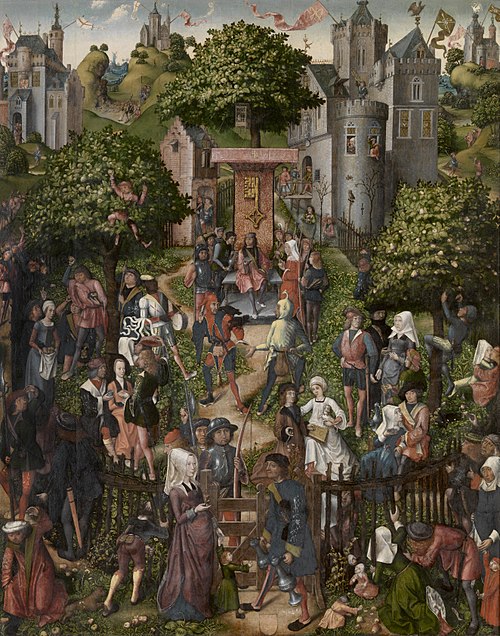
I have many interesting ancestors in this same family line, so much is known of them. I have chosen to write about my paternal 19th great-grandfather, Wicker von Ovenbach zur Ecke of Frankfurt am Main. He was a Patriciate of Frankfurt.
The Patriciate of Frankfurt am Main consisted of a closed caste of merchant and noble families who monopolized the city’s council governance as hereditary Schöffen (lay judges and aldermen) during its status as a free imperial city from the late Middle Ages until the end of the Holy Roman Empire in 1806. (1)
The prefix “Von” signifies his association with the landed gentry or aristocracy. In records from the 13th and 14th centuries, variations of the surname frequently switch between von Ovenbach, von Offenbach, and at times von Ofenbach. The family’s name is derived from Offenbach am Main, located close to Frankfurt in the state of Hesse.
The designation “zur Ecke” typically referred to a notable residence in Frankfurt, which was commonly used by the elite to differentiate various branches of a family. Though their origins trace back to Offenbach am Main, by the 14th century, the family had firmly established itself as influential figures in Frankfurt.
He was the son of Herman von Ovenbach (also referred to as Knoblauch) and Guda von Burgel. He wed Else von Holzhausen, who belonged to the prominent Holzhausen family of Frankfurt. He was a significant figure within Frankfurt’s Patriciate, the city’s highest social echelon. During the 1300s, his titles and positions would have positioned him as part of the “urban nobility” within the Free Imperial City of Frankfurt. The “von Ovenbach” (or “von Offenbach”) family belonged to a select circle that held sway over the Patriciate of Frankfurt am Main. In 1311, he was granted the Münzenberg fiefdom in Oberrad, and in 1333 he also secured the imperial pledge for this village.
In the medieval social structure, Wicker would have lived, dressed, and fought as a knight, despite his influence being anchored in the city rather than in a rural estate. He was a member of the “first bench” of the council, the most influential political faction in one of the empire’s key cities.
He would have probably belonged to one of the two main noble societies in Frankfurt as a member of the Patriciate: Zum Frauenstein, which was a little more welcoming to the affluent newcomers, or Alten Limpurg, which was the old, established aristocracy.
He most likely serviced on the City Council (Rat), which was a body that oversaw city governance. His class controlled the judiciary and political authority, guaranteeing that the city’s laws safeguarded his financial interests.
He was “immediately subordinate” solely to the Emperor, not a local Duke or Count, because Frankfurt was an Imperial Free City. His family gained great prominence and a direct line to the center of the Holy Roman Empire as a result.
He would have received his income from city taxes, hereditary holdings outside the city, and—unusually for Frankfurt’s nobility—investments in banking and foreign trade.
Rather than residing in a secluded castle, he would have lived in an urban manor. This would have been a stone home inside the city walls that was defended. These “court-houses” frequently had private chapels and towers to indicate your rank to the lower merchant class.
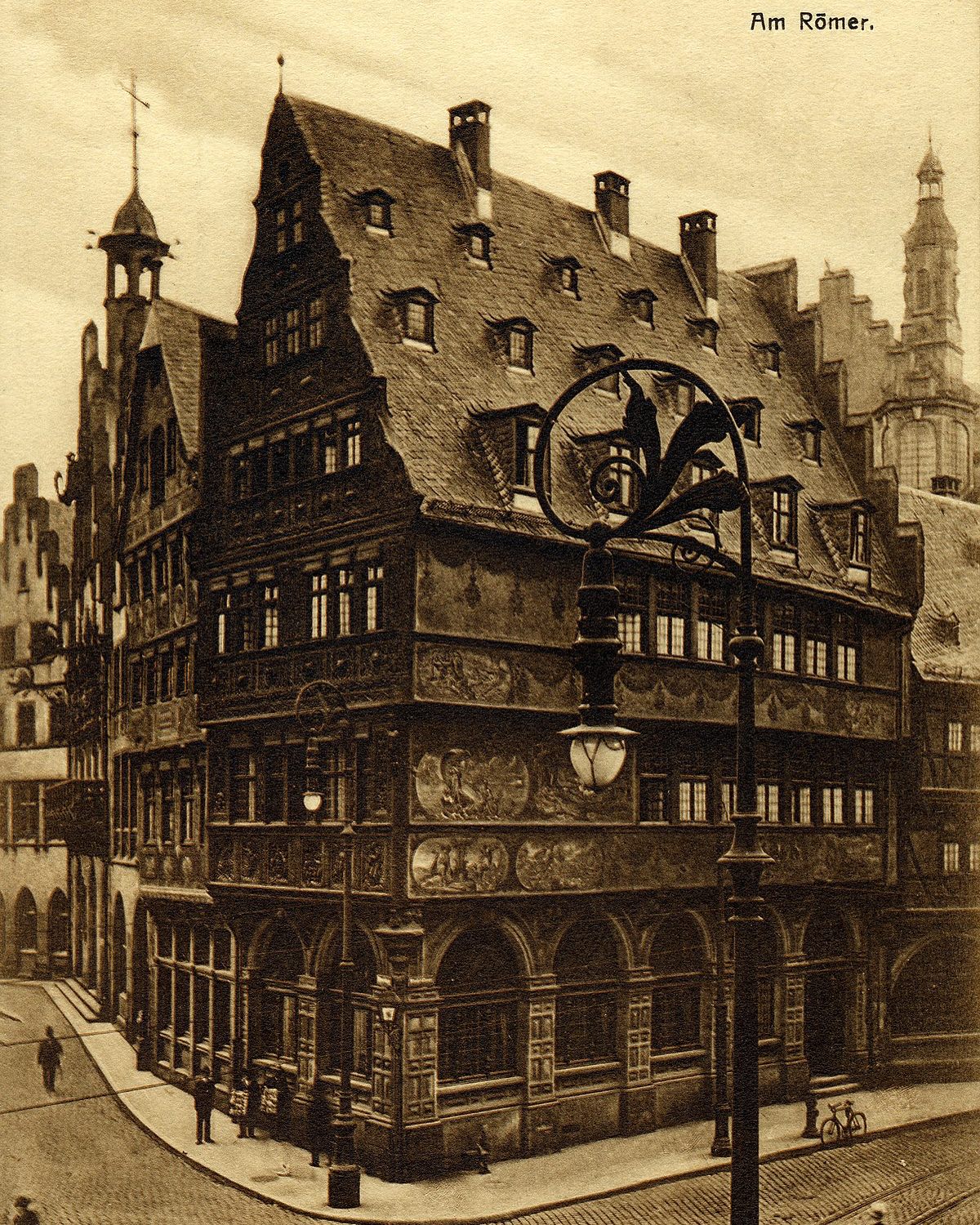
The photo above was taken in the year 1900 and is of The Salzhaus (Salt House) in Frankfurt Am Main, Germany. Many of the building’s ornate wooden carvings were moved to a safe location to protect them from the bombings of WWII. In 1944, the original court-house was destroyed, but historical photographs capture its famous relief-carved facade, which stood 22 meters tall and featured intricate wooden panels depicting vines, figures, and scrollwork.
When looking at the photo of Salzhaus, you are viewing the “Gold Standard” of what my ancestors regarded as a decent home. Their particular home would have had the same imposing height, red sandstone base, and steep-pitched roof, even though it might not have been as “busy” with carvings.
As a high-ranking patrician in 14th-century Frankfurt, Wicker von Ovenbach zur Ecke led a life defined by political duty, high-stakes legal judgment, and significant social privilege. His day would be a blend of intense civic administration and the refined lifestyle of the urban elite.
A day in the life of my ancestor Wicker von Ovenbach zur Ecke:
Like most medieval citizens, his day began at sunrise. His morning would have started with Catholic Mass. As a member of the elite, he likely attended a private mass or went to the Imperial Cathedral of Saint Bartholomew. Followed by administrative tasks—overseeing city markets, managing family investments, or sitting in judgment at the local court.
Leisure time, in the afternoons, he would have engaged in “noble” pursuits like hunting in the city-owned forests or horsemanship practice. He would have returned to his prestigious family residence, likely a large half-timbered stone house that stood as a symbol of his family’s power. Unlike the commoners, he would have had servants to handle daily chores and a kitchen equipped with relatively modern luxuries for the time.
Evenings were for drinking societies and banquets where alliances were forged over wine and music. Wicker would have hosted or attended lavish dinner parties with other patrician families like the Holzhausen or Cronberg. These were not just social events but key networking opportunities to cement marriage alliances and business deals.
He would have participated in jousts to maintain combat skills and social prestige, often coinciding with the massive Frankfurt Fairs, which drew people from across Europe.
Life was not always peaceful. Until the late 15th century, the private feud (Fehde) was a legal tool to settle disputes. He might have found himself leading a small band of men to raid a rival’s estate or defend Frankfurt’s trade routes from “robber knights”. When the Emperor called, he would have provided high-quality cavalry, equipped with the latest plate armor and lances.
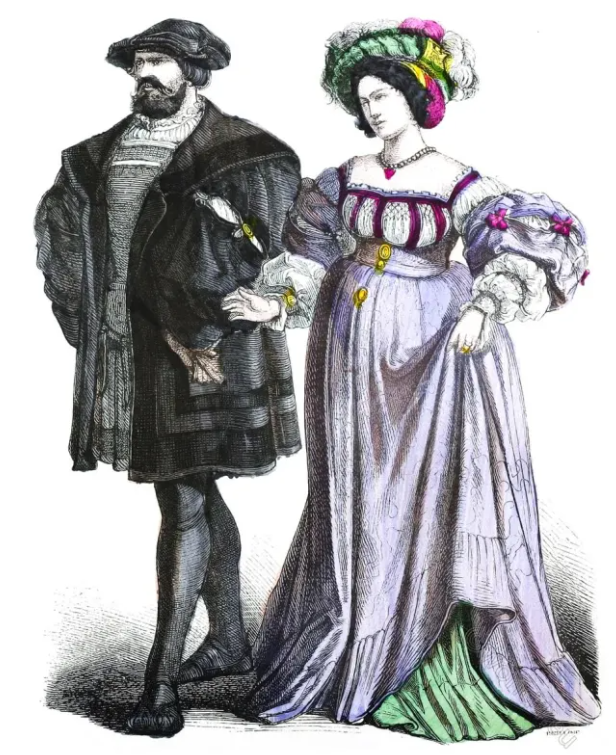
My line continues with Gypel von Ovenbach I and Jutta von Knoblauch and his son, Gypel von Ovenbach II with his wife Greda von Doring. Gypel von Ovenbach, and his son of the same name were part of the Patriciate in Frankfurt.
My next ancestor is Gypel von Ovenbach III. He married Anna Ecke. This couple had one child, a daughter, Anna. She was considered ultimo gentis (the last legitimate child of his race/line). The daughter, Anna, inherited his fiefs and passed them to her husband, Henne Kule.
I am not descended from Anna. Gypel von Ovenbach III had a mistress, whose name has been lost to time. I descend from Johannes Overbach, a son born of this affair. Records list Johannes as the father of Conrad Offenbach and the illegitimate son of Gypel von Ovenbach. Due to his illegitimate status, his half-sister, Anna, was the heiress of his father’s land and wealth.
Johannes Offenbach is thought to have married a woman with the first name Elsa ____. As an illegitimate son within a noble family, his social status would have been transitional; likely he moved into roles in administration or law. The maiden name of his wife, Elsa, is unknown. Given Johannes’s position as the illegitimate son of a rural knight, he would not have been a candidate for the highest “Uradel” (ancient noble) marriages. Instead, Elsa likely came from one of the following family backgrounds: Established Artisan or Merchant Elite, Administrative/Civil Service Family, or of the Ehrbarkeit (Honorable Class).
The social impact of marrying Elsa was that Johannes secured a stable, legitimate household in Frankfurt. This move was a strategic pivot of his status.
His son, Johann Conrad Offenbach, is my next ancestor. Conrad was a Kastenschreiber, who was not a physical “box maker” in the sense of a carpenter, but rather a specialized clerk or registrar (from the German Kasten, meaning chest/coffer, and Schreiber, meaning scribe/clerk). This shows my direct family line still had some means to educate their children.
Johann Conrad married first to Catharina Schmidt, the daughter of Peter Schmidt, and second to Margaretha Schott. The parentage of his second wife is unknown for now. But we know that the Schott family was part of the elite patriciate in both Frankfurt and Strasbourg. In Strasbourg, the Schotts were prominent as printers, humanists, and city officials.
His first marriage to Catharina Schmidt was an essential “foundational” step in Johann Conrad’s social ascent. While the Schott marriage later connected him to the pan-European intellectual elite, the Schmidt marriage anchored him firmly into the powerful Frankfurt administrative and legal class.
I am currently working on other blog posts where I am writing about what Johannes’ life would have been like growing up; Elsa’s family; their son Conrad Offenbach and his two marriages and how they changed the status of the family; and how the later convergence of two lines, Offenbach and Pastoir, acted as a full “reset button” for our family’s social status.

My direct line:
- Wicker von Ovenbach zur Ecke and Else von Holzhausen.
- Gypel von Ovenbach I and Jutta von Knoblauch.
- Gypel von Ovenbach II and Greda von Doring.
- Gypel von Ovenbach III and his mistress.
- Johannes Offenbach and Elsa ____.
- Johann Conrad Offenbach and Margaretha Schott.
- Catharina Offenbach and Peter Semmler.
- Margaretha Semmler and Johan Heinrich Schwebel.
- Johann Heinrich Schwebel and Anna Margaretha Pastoir.
- Anna Barbara Schwebel and Philipp Grosshans.
- Johann Friedrich Grosshans and Anna Margaretha Bertsch.
- Emanuel Grosshans and Anna Catherina Werner.
- Johann Jacob Grosshans and Anna Felicitas Sammer/Sommer.
- Anna Felicitas (Felizitas) Grosshans and Michael Weinmann.
- Anna Margaretha Weinmann and Johann Jacob Propheter.
- Margaretha Propheter and Johann Georg Fried.
- Margaretha Fried and Heinrich Weiss.
- Margaret (Margarethe) Weiss and Elias W. “Eli” Wegt Nutick Udig Utick. (My great-great-grandparents).
Reference:
- Das Franfurter Patriziat – frankfurter-patriziat.de
Further reading about Frankfurt am Main and the Patriciate of Frankfurt:
- Patriciate of Frankfurt am Main – wikipedia.org
- Patriciate of Frankfurt am Main – grokipedia.com
- About Frankfurt – History – frankfurt.de
- History of Frankfurt am Main – kupi.com
If you use any information from my blog posts as a reference or source, please give credit and provide a link back to my work that you are referencing. Unless otherwise noted, my work is © Anna A. Kasper 2011-2026. All rights reserved. Thank you.


 Anna's Musings & Writings
Pingback: Felicitas Grosshans Weinmann, 52 Ancestors, Week 11, Lucky. | Anna's Musings & Writings