
In the past, I have written about my maternal ancestors Daniel Streing/Strang, Sr., and Charlotte Marie Lemaistre. I discussed their lives in France, England, and New York. In my writings about them, I did not take their lines further back than their parents and siblings.
At the time I originally wrote about them in 2021, they were my first confirmed French ancestors. I now know that I have some additional French Huguenot ancestors on my paternal Verdon lines that migrated to Colonial America. French Protestants also migrated to Berlin and Brandenberg and the Rhineland of Germany in the late 1600s to escape intense religious persecution after the Revocation of the Edict of Nantes in 1685, which stripped them of their religious freedoms. On my more recent paternal German lines, I have discovered I have French Huguenot LeBeau/de la Barre, Vacher/Vasher, Coeu, Charles, and Dupree ancestors that came to live in Ludwigshafen am Rhein and Frankenthal, in the Rhineland-Palatinate region of Germany, but they had all migrated from Uzès, Gard, France. I also have maternal French Huguenot Bonnet, Lebrond (Lebron), Rolande, and Rogon ancestors that lived in Alpes-de-Haute-Provence, France and fled to Berlin, Germany.
French Huguenots were French Protestants, primarily Calvinists, but the group also included Lutherans, who faced intense religious persecution in the 16th and 17th centuries.
My Beauharnais ancestors are on my maternal side. They are the ancestors of Charlotte Marie Lemaistre. She was the daughter of Jean Lemaistre and Charlotte Mariette. The Beauharnais ancestors are on her father’s lines.

The surname Beauharnais is derived from the French word beau, meaning beautiful, and harnois, which today has the meaning of harness. The second part of the surname is based on the Old French harneis meaning armor, military equipment, and accoutrements for a soldier or horse. Thus, there is an occupational link to the craft of making “beautiful” armor or soldier’s gear.
Originating in Brittany, the Beauharnais (also spelled Beauharnois) family became established in the 14th century in Orléans. They were initially merchants before expanding their influence and landed property. Members of the Beauharnais family occupied honorable positions in Orléans for centuries, and expanded their landholdings to include various lordships, including Miramion and La Chaussée. By the end of the 16th century, they had become part of the noblesse de robe (judiciary nobility).
The Beauharnais family was a well-known French noble family that gave rise to important people throughout the French Revolution and the Napoleonic era, such as Alexandre de Beauharnais and his son Eugène de Beauharnais.
We have to go back an additional four generations to get to our Beauharnais ancestors.
Jean Lemaistre married Charlotte Mariette. He was baptized on 7 March 1621 in Giens, Loire Valley, Orléans, France, as the son of son of Samuel Lemaistre and Jacqueline Souchay. He died in May 1680 in Orléans, Loiret, Centre, France.
Samuel Lemaistre was baptized on 1 December 1582 in Orléans, Loiret, Centre, France, as the son of Denis Le Maistre and Marie Le Noir. He died on 20 January 1643 in Orléans, Loiret, Centre, France.
Marie Le Noir was born in Orléans, Loiret, France, as the daughter of Pierre Lenoir and Jeanne Buatier. She died on 31 March 1631 in Orléans, Loiret, France. Her mother, Jeanne Buatier, is listed as the wife of Pierre Le Noir and the mother of Marie Le Noir in several sources. (1, 2, & 3)
Jeanne Buatier was born in Orléans, Loiret, France, as the daughter of Nicolas Buatier and Marie Beauharnais. She died on 24 August 1594 in Orléans, Loiret, France. It is at this point we encounter the Beauharnais family.

Marie Beauharnais married Nicolas Buatier on 19 July 1521. She was the daughter of Guillaume Beauharnois and Marie Le Vassor. You will see Marie listed in the above record as their fifth child.
Her father, Guillaume Beauharnois, was the Lord of Miramion, La Chaussee, La Grilliere, and Villechauve. He was the son of Jean Beauharnais and Jeanne Boilleve.
In 1505, he is listed as the Treasurer of Finances and Steward of the House of Jean d’Orléans (Le trésorier des finances et intendant de la Maison de Jean d’Orléans). This title would have referred to an official that managed the wealth and household of a prominent nobleman. In the 1500s, it would have meant he held an administrative position for a royal house. The term “Jean d’Orléans” likely refers to a member of the powerful French House of Orléans. It was not a distinct royal house but a cadet branch of the ruling House of Valois, representing a significant line of princes and dukes with royal lineage but not in the direct line to the French throne.
In 1517, he is listed as the Alderman of Orléans. In 16th-century France, the job of alderman (échevin) was to serve as a municipal administrator and magistrate within a town’s governing body. The specific duties generally revolved around overseeing local affairs, administering justice, and managing public finances. He died 30 October 1545 in Orléans, Loiret, France.

Jean Beauharnais was the Lord of Miramion and of La Chaussee. He was the son of Guillaume Beauharnais II and Jaquette Le Marie.
Jean Beauharnais was the Provost of the Marshals and a lawyer in Orléans. In 16th-century France, a Provost of the Marshals (prévôt des maréchaux) was a judicial official who maintained order within army camps, administering justice for soldiers and ensuring adherence to military law through a system known as the maréchaussée. These officials headed small contingents of sergeants, known as “archers,” and their courts were itinerant, following the army to adjudicate on issues like desertion, treason, and disputes between soldiers and the civilian population.
In 1482, Jean was accused of embezzlement. I was unable to discover any additional information regarding this charge.
His father, Guillaume Beauharnais II, was the Lord of Miramion and La Chaussee. He married on 15 November 1425 to Jaquette Le Marie. He was the son of Guillaume Beauharnais I and Marguerite De Bourges.
Guillaume Beauharnais I was the Lord of Miramion and of La Chaussee. His occupation is listed as a Merchant of Orleans (Marchand d’Orléans). He married on 20 Jan 1390 to Marguerite De Bourges.
Children of Guillaume Beauharnais I and Marguerite De Bourges:
- Jean Beauharnais. He married Ann de Loynes.
- Jeanne Beauharnais. She married Jean Hillaire.
- Guillaume Beauharnais. He married Jacquette Le Marie. (My direct ancestors).
- Peronnelle Beauharnais.
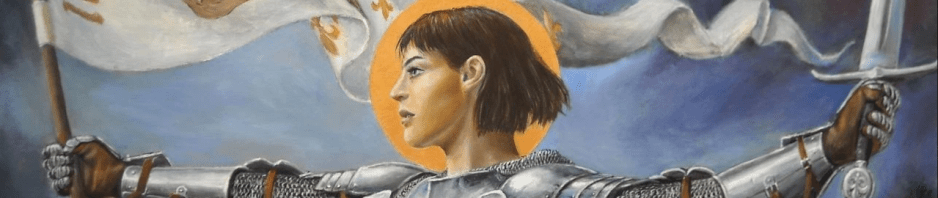
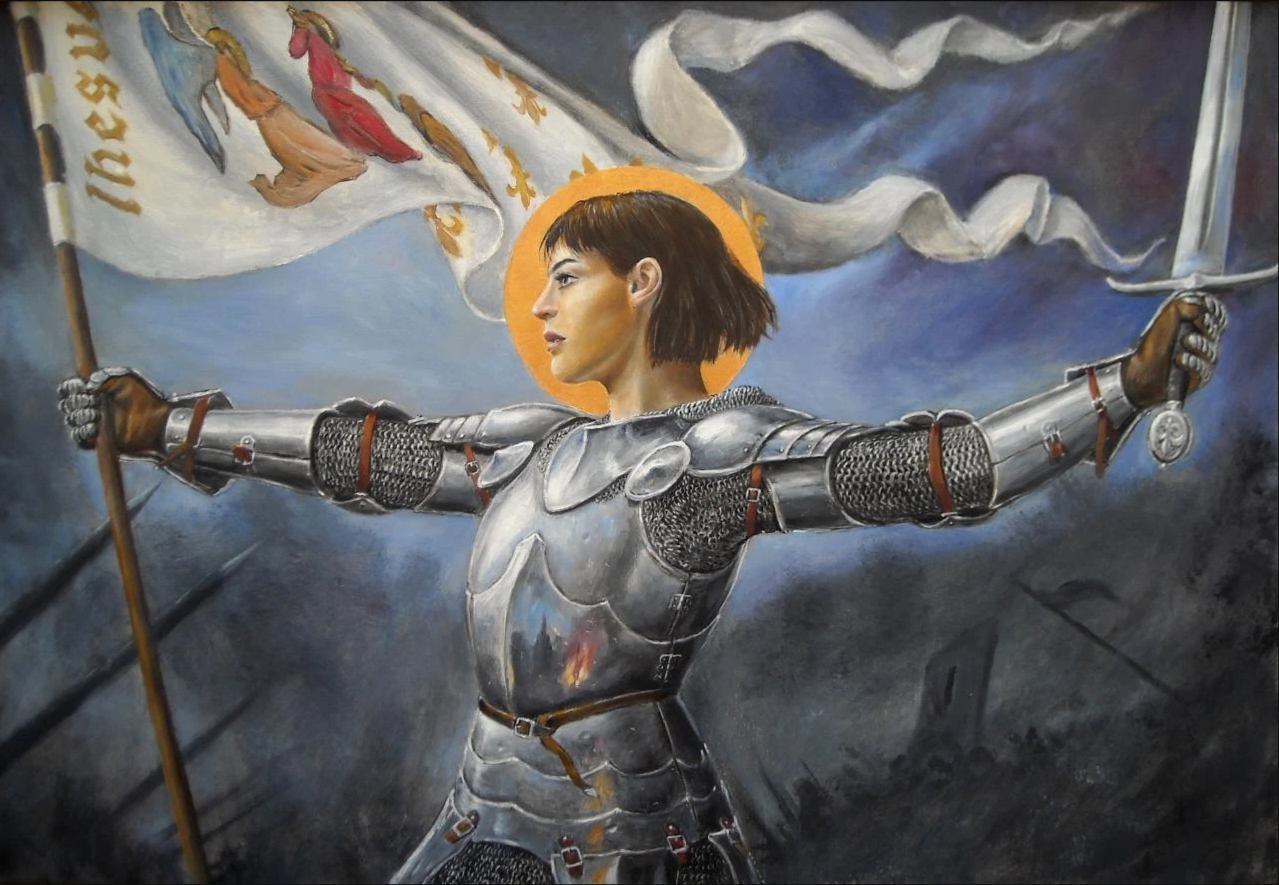
The Beauharnais family members were involved in the defense of Orléans in 1429 and were present during Joan of Arc’s famous lifting of the siege. Beauharnais family members served as soldiers and magistrates, and they fought alongside her.
Jean Beauharnais, sibling of my ancestor, gave his observations of Joan of Arc at the nullification trial that posthumously exonerated her:
“I often saw Jeanne while in Orleans; there was nothing in her which could merit reproof; she was humble, simple, chaste, and devoted to God and the Church. I was always much comforted in talking with her.” – Jean Beauharnais

As a Catholic, I have a special place in my heart for St. Joan of Arc. Also, my son was born on her birthday.
Joan of Arc (Jeanne d’Arc) was born in Domrémy, France, on 6 January 1412, to Jacques and Isabelle d’Arc. She was raised with a strong religious faith and learned domestic skills from her mother. She was known throughout the region for her kindness toward others. During her childhood, France was embroiled in the Hundred Years’ War, battling both the English and a French faction from Burgundy. (4)
At age 13, Joan began experiencing divine visions and hearing voices from Saint Michael, Saint Catherine, and Saint Margaret. Over the next five years, these voices guided her to lead the French forces that successfully lifted the English siege of Orléans, escort Charles to Reims for his coronation, and expel the invading English forces.
On February 14, 1429, she traveled to Chinon, meeting with the Dauphin Charles on March 9th. He approved her mission to recapture Orléans, which she and her forces accomplished in a week. On July 17, 1429, Charles was crowned King of France in Reims Cathedral.
After the coronation, the king became less receptive to Joan’s counsel. She continued fighting until she was captured by the Burgundians. They, in turn, handed her over to the English after a year. The English condemned Joan as a witch and heretic, and she was burned at the stake in Rouen’s marketplace on May 30, 1431. (4) Her ashes were cast into the River Seine from the top of the Old Mathilde bridge.
In 1455, a formal appeal known as the “Trial of Nullification” or “Rehabilitation Trial” was launched to clear Joan of Arc’s name, 24 years after her 1431 execution. During this proceeding, friends, family, and former associates provided depositions that offered crucial testimony about her character, piety, and divine mission.
Her trial was nullified in 1456, and almost 500 years later, in 1920, Pope Benedict XV canonized her as a saint.

Originally, I had intended to also write about some of our other well-known cousins. I decided there was more than enough to write about just with my direct ancestors and Joan of Arc. At a future date, I will write about our Beauharnais 2nd cousin Madeleine Fabry, who was the wife of Pierre Séguier, Chancellor of France, and Alexandre de Beauharnais, and his wife, Joséphine. She was born Marie Josèphe Rose Tascher de La Pagerie. After the death of her husband, Alexandre, she married Napoleon Bonaparte. Later, their marriage was annulled because she did not produce an heir for Napoleon. She went by the first name Rose until she met Napoleon; he preferred Joséphine.
Alexandre de Beauharnais and Joséphine are related to many current European royal houses through their children. This link is primarily via their daughter Hortense de Beauharnais, who married Napoleon’s brother Louis Bonaparte. Their son, Eugène de Beauharnais, was the father of Joséphine of Leuchtenberg. Through these descendants, they are the direct ancestors to the ruling families of Sweden, Norway, Denmark, Belgium, and Luxembourg.
My direct line:
- Guillaume Beauharnais and Marguerite De Bourges.
- Guillaume Beauharnais and Jaquette Le Marie.
- Jean Beauharnais and Jeanne Boilleve.
- Guillaume Beauharnais and Marie Le Vassor.
- Marie Beauharnais and Nicolas Buatier.
- Jeanne Buatier and Pierre Lenoir.
- Marie Le Noir and Denis Lemaistre.
- Samuel Lemaistre and Jacqueline Souchay.
- Jean Lemaistre and Charlotte Mariette.
- Charlotte Marie Lemaistre and Daniel Strang.
- Mary Prudence Strang and Maj. John P. Budd.
- Elijah Budd and Hannah Ursula “Ursy” Sine.
- Mary Budd and Solomon Palmer.
- Floyd Palmer and Barbara Wolf.
- John Palmer and Mary Ann Spotts (Spatz).
- Susan Palmer and Capt. John Davis Kennedy. (My great-great-grandparents)
References:
- Goujet, Claude-Pierre. Nouveau supplément au Grand dictionnaire historique. Pg. 739
- Haag, Emile. La France protestante. Pg. 535.
- Montjouvent, Philippe. Les Beauharnais: Les grands ancêtres, 1390-1846. 2005. Pg. 26
- Jeanne d’Arc by Søren Bie
To learn more about Joan of Arc (Jeanne d’Arc):
- Joan of Arc. French Women & Feminists in History: A Resource Guide. Library of Congress.
- St. Joan of Arc. French heroine. Encyclopædia Britannica.
- Who was St. Joan of Arc? St. Joan of Arc Catholic High School.
- Joan of Arc. HISTORY.com Editors.
- Joan of Arc. Potter’s Wax Museum.
- Joan of Arc. Wikipedia.
- Where to go in France to know St. Joan of Arc by Alice Alech – published on 02/11/25. Aleteia — Catholic Spirituality, Lifestyle, World News, and Culture.
- History Of Joan Of Arc – Who Was Jeanne D’Arc? by Joshua J. Mark – published on 28 March 2019. World History Encyclopedia.
Further reading:
- The grand old history of Orléans. Explore 2,000 years of Orléans history, a tale of prosperous periods and turbulent times… Destination Orléans Val De Loire.
- La Chaussée – French Birthplace of Acadia – 52 Ancestors #427 by Roberta Estes – posted on July 16, 2024. WordPress.
- A walk through 18th century Orléans. Notes from Camelid Country. A travel blog from Bolivia to Belgium via Berlin. WordPress.
- Saint Joan of Arc. Saint of the Day. Daily Journey with the Saints. Dynamic Catholic.
- The de Beauharnais Dukes of Leuchtenberg and Princes Romanovsky: French? German? Russian? by Jonathan Spangler – posted December 2, 2023.
- St. Joan of Arc. Novenas and Prayers. Feast: May 30. Servants of the Pierced Hearts of Jesus and Mary.
If you use any information from my blog posts as a reference or source, please give credit and provide a link back to my work that you are referencing. Unless otherwise noted, my work is © Anna A. Kasper 2011-2026. All rights reserved. Thank you.


 Anna's Musings & Writings
Pingback: Daniel Streing / Strang, Sr. and Charlotte Marie Lemaistre – My first confirmed French Ancestors. | Anna's Musings & Writings
Pingback: My Immigrant Ancestor Daniel Strang, Sr. – A Frenchman Who Could NOT Make a Tasty Fricassee! | Anna's Musings & Writings