

I spent my pre-teen and teenage years in Spring Valley, California. This area is a suburb located to the east of San Diego. Notably, there are peacocks that roam freely, finding their place among the homes and streets in the hills above Casa de Oro. I have a fondness for the peacocks! Whenever I return home for a visit, I always make an effort to spot them. The calls of the peacocks are like music to my ears.
Peacocks are technically known as peafowls. The males are called peacocks, while the females are known as peahens, although both genders are commonly called “peacocks” in casual conversation. (1)
Numerous early Christian artworks, including paintings and mosaics, depict the peacock. The peacock continues to be a symbol during the Easter and Christmas seasons, particularly in Eastern traditions. (2) The ‘eyes’ found in the peacock’s tail feathers represent the omniscient nature of God in Christianity and, in some views, symbolize the [Holy Mother] Church. A depiction of a peacock drinking from a vessel is interpreted as a Christian faithful partaking in the waters of eternal life. Additionally, if one perceives its feathered tail with numerous ‘eyes’ as the celestial dome adorned with the sun, moon, and stars, the peacock may also represent the cosmos. The peacock is linked to Paradise and the Tree of Life, as well as to the concept of immortality. In Christian imagery, the peacock is frequently portrayed in proximity to the Tree of Life. (9)
The peacock can be seen in numerous mosaics and images found in the baptisteries of both Eastern and Western ancient Catholic Churches.
The peacock has historically represented nobility. Monarchs frequently included peacocks in their gardens. Peacocks can be found adorning the interiors of royal palaces and featured in the designs of royal garments. Additionally, the peacock serves as a symbol for the Vatican. There are also mentions of peacocks acting as protectors at the Gates of Paradise.

The bronze statues of a pinecone and a peacock in a courtyard at the Vatican Museum are situated in an area known as the Belvedere Courtyard. This space was designed by Donato Bramante starting in 1506 for Pope Julius II in order to link the Vatican Palace with the Sistine Chapel. The original design of the courtyard featured three tiers connected by staircases and bordered by galleries that were slightly angled towards the Sistine Chapel.
The Cortille della Pigna, also known as the Court of the Pinecone, features the well-known bronze pinecone statue that stands 13 feet tall and was originally part of a fountain from Roman times near the Pantheon. This statue was relocated to the courtyard of the former St. Peter’s Basilica during the Middle Ages and was moved once more in 1608 to its current location. (6)
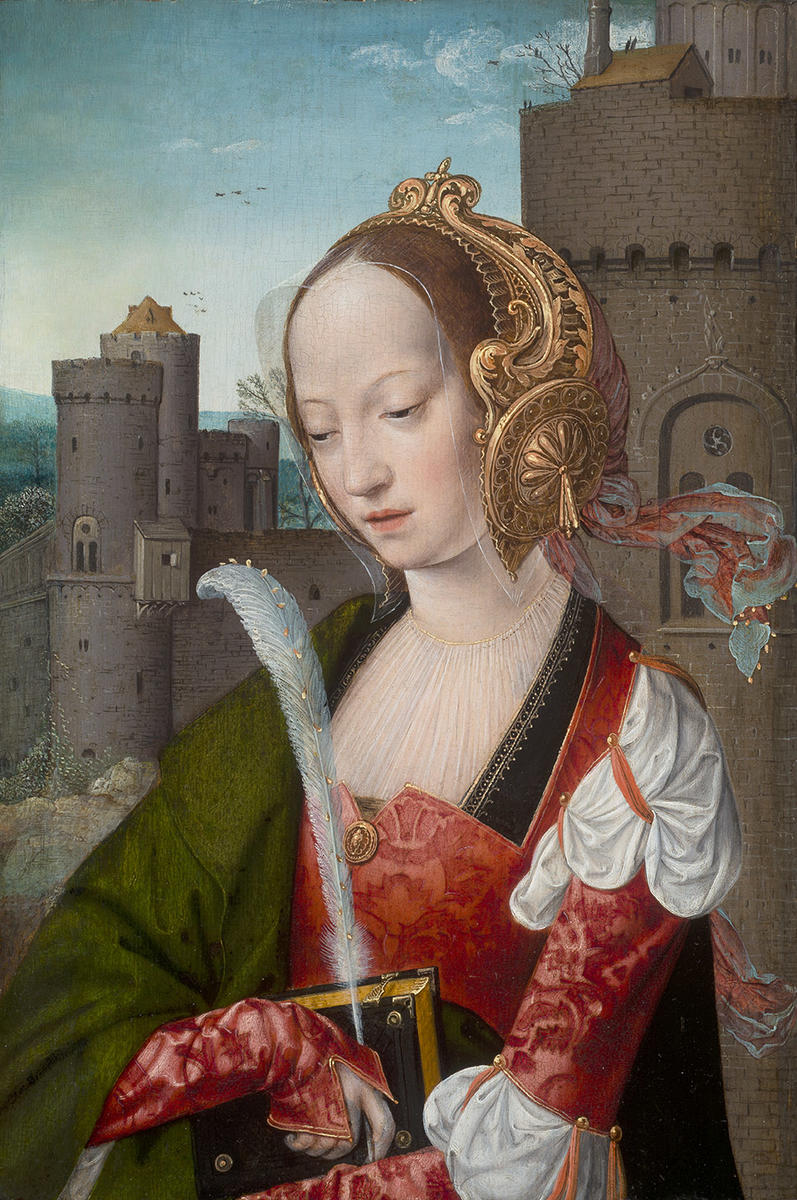
For Ashkenazi Jews, the golden peacock represents happiness and artistic expression, with the bird’s feather quills serving as a metaphor for a writer’s muse. (3)
Peacocks have fascinated people for millennia. Even King Solomon was recognized for having peacocks, which represented his immense riches.
During the reign of King Solomon, his fleet of Tarsis vessels brought back cargoes that included “gold and silver, ivory, as well as monkeys and peacocks” over voyages that lasted three years. (1 Kings 10:22) While some of Solomon’s ships made journeys to Ofir (likely located in the Red Sea region; 1 Kings 9:26-28), 2 Chronicles 9:21 associates the transportation of these cargoes—peacocks included—with the ships that “went to Tarsis” (which is thought to be in Spain). (8)
In ancient times, it was thought that the skin of a peacock was impervious to decay and would remain intact even after its death. Saint Augustine examined this idea and was astonished at how long the skin actually persisted, noting in City of God, “a year later, it was still unchanged, though somewhat more shriveled and drier.”
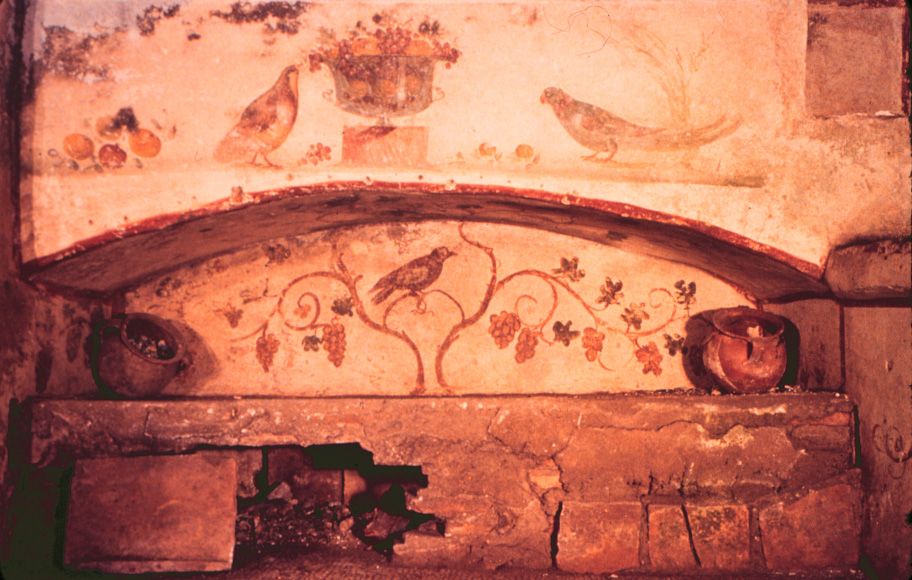
Photo originally found at divdl.library.yale.edu
This unusual occurrence prompted various ancient cultures to regard the peacock as a symbol of immortality, while Christians viewed it as a reminder of the heavenly realm. The peacock’s feathers, which shed once a year, reinforced this association and introduced the spiritual representation of resurrection, as the peacock would grow new feathers.
Furthermore, the eye-shape pattern on the peacock’s plumage reminded Christians of the omnipresent eye of God. The peacock is an ancient symbol of eternal life. The peacock’s tail, adorned with its ‘thousand eyes’ symbolizes omnipotence and is frequently attributed to the Archangel Michael. The peacock’s feather is sometimes associated with St. Barbara. (4, 5, & 12)
For these reasons, peacocks were often discovered in Christian catacombs and churches, appearing prominently on tombs as a perfect representation of eternal life and the soul’s immortality.

This stone marble panel [above] likely originated from a European church, monastery, or convent dating to the 6th or 7th century. Other similar carvings from the same era demonstrate that these symbols served as funerary images on sarcophagi, the joined peacocks and cross providing a reminder of the eternal afterlife. The vines and leaves encircle the cross and peacocks. Another interpretation is that the two collectively represent the sacred body and blood of Christ. The museum offers a text suggesting the possibility that the vines, the source of wine, and the peacock, the incorruptible flesh, would together be a symbol for Christ. (7)
Other connections to the peacock within Christianity: The relationship between the old law and the new law typology is closely related to the symbolism of the peacock. Observing the bird’s molting feathers and subsequent re-growth, Christians drew an immediate parallel to Christ’s fulfillment of the old law—all things old pass away only to be reborn into a greater glory. Just like peacock discards its old feathers, the Law of Moses is set aside. Moreover, just as the peacock grows more beautiful feathers, so emerges the Law of Christ. (10)
The awe-inspiring stained-glass window by Guido Nincheri shown below is located in Quebec, Canada in The Church of Saint-Léon-de-Westmount. In this full image of the window, you can see God and His angels above Adam and Eve alongside the animals in the Garden of Eden. This stained-glass window is absolutely stunning! And I ADORE that it has animals found in Paradise including the  peacock (guardians of the Gates of Paradise).
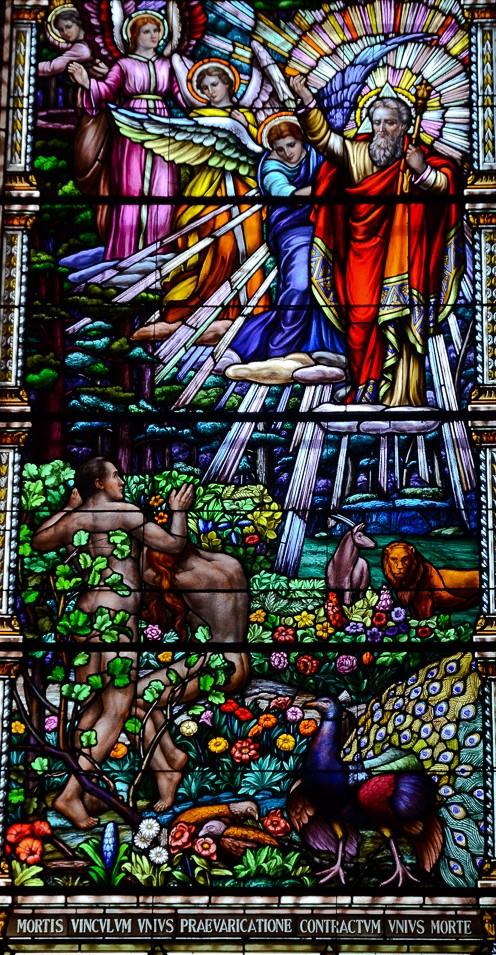
God’s Gift: Eve and Adam in a Floral Paradise – Institute for Stained Glass in Canada.
If you’d like to learn about other symbols in Christian art and their meanings, please see my blog post Symbols in Christian Religious Art.
References:
- Britannica Online Encyclopedia and Wikipedia, peacock | Facts & Habitat | Britannica & Peafowl – Wikipedia
- “Birds, symbolic”. Peter and Linda Murray, Oxford Dictionary of Christian Art (2004).
- “The Golden Peacock”. Jewish Folk Songs.
- What does the peacock symbolize in Christian art? (aleteia.org)
- Peacock as an Ancient Christian Symbol of Eternal Life — Early Christian Symbols of the Ancient Church (jesuswalk.com)
- The Vatican: the Pope, Peacocks and a Pinecone – Boarding Pass (boardingpasstraveler.com)
- Peacocks, Vines and a Cross – Ancient and New Symbols for the Early Church (heimsath.com)
- 🥇 What Is The Meaning Of Peacock In Bible【 2021 】Symbolism (redargentina.com)
- Christian Symbolism (slife.org)
- Ernest Ingersoll, Birds in Legend, Fable, and Folklore (Toronto: Longmans, Green, and Co., 1923), pg. 145.
- Photo from Gelato Quest: Photos and ramblings from Italy, unless I get on the wrong train, in which case all bets are off. Gelato Quest: “The Devil Is A Zombie!” Says Vatican
- Symbols in Christian Art (symboldictionary.net) via the Internet Archive – Wayback Machine.
If you use any information from my blog posts as a reference or source, please give credit and provide a link back to my work that you are referencing. Unless otherwise noted, my work is © Anna A. Kasper 2011-2026. All rights reserved. Thank you.


 Anna's Musings & Writings
Pingback: Symbols in Christian Religious Art | Musings of Lady Anna Kasper
Pingback: The feather - WE Magazine