
I have a TON of paternal German ancestors from in and around Klingenmünster, Germany. There was lots of intermarriage among the same families, and thus I descend twice from several of the same couples. Many of the surnames are more common ones such as Weiss, Wendel, Fried, Hacker/Hecker, Bohrer, Willem, etc. But there are some surnames that are less common such as Propheter, Weinmann, Sartor, Sambach, LeBeau, etc. Then there are the ones that are actually much rarer, such as Fünfstück.
How we get back to my Fünfstück ancestry is via my paternal fifth great-grandmother Maria Katharina Sambach.
Maria Katharina Sambach was born on 1 June 1765 and died 29 January 1832 in Gleiszellen. She was baptized in Klingenmünster. Gleiszellen is 1.1 miles from Klingenmünster. She married on 11 Oct 1785 in Klingenmünster to Peter Wendel, who was the son of Johannes Wendel and Anna Maria _____.
Maria Katharina Sambach was the daughter of Johannes Sambach and Maria Magdalena Fünfstück.
Her mother, Maria Magdalena Fünfstuck, was baptized on 12 April 1736 in Gleiszellen-Gleishorbach, Südliche Weinstraße, Rhineland-Palatinate, Germany. She was the daughter of Johann Georg Fünfstuck and Elsabeth Florentina (Anna Florentina) Holdberg. The family migrated to Copenhagen, Denmark within months of her birth, and it is in Copenhagen that her two siblings, Christian and Anna Florentina Fünfstuck, were born. It appears her parents and two proven siblings remained in Copenhagen, Denmark. Her father is listed as deceased and a former citizen, in her marriage records, so he had died prior to her returning to the Klingenmuenster area to reclaim her father’s holdings there.
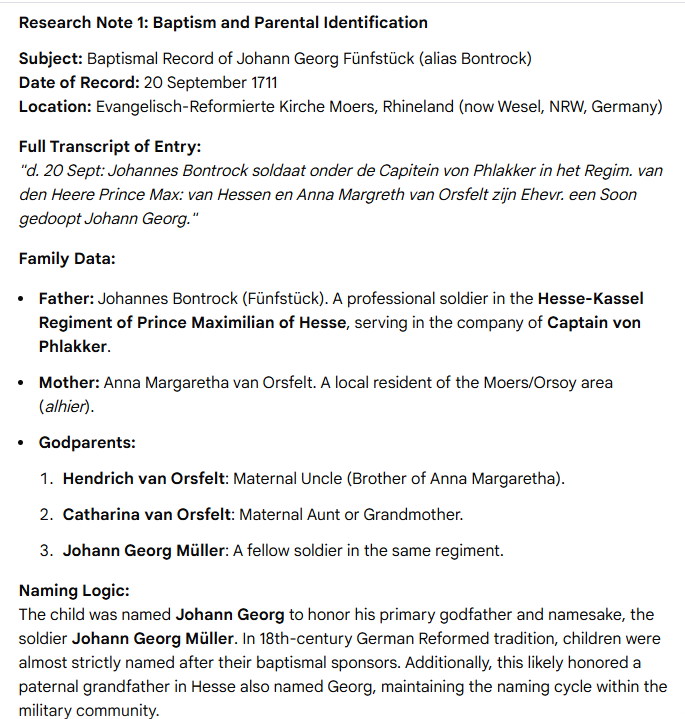
Her father, Johann Georg Fünfstück, was baptized on 20 September 1711 in Moers, Wesel, North Rhine-Westphalia, Germany, and died in Copenhagen, Denmark. Below is an image of my research note regarding baptism and parental identification of Johann Georg Fünfstück (alias Bontrock). As shown, George was the son of Johannes Bontrock (Fünfstück), a professional soldier in the Hesse-Kassel Regiment of Prince Maximilian of Hesse, serving in the company of Captain von Phlakker, and Anna Margaretha van Orsfelt.
Her mother, Elsabeth Florentina Holdberg, was baptized 21 September 1712 in Moers, Wesel, North Rhine-Westphalia, Germany and died in Copenhagen, Denmark. She was baptized as Elsabetha Florentina, and is listed by that name, as well as Anna Florentina, in Moers records. She is listed as Anna Florentina or just Florentina in later Palatine and Copenhagen, Denmark church records. She was the daughter of Arnold Holdberg and Sibilla Davids.
Within months of the birth of Maria Magdalena Fünfstück, the family migrated to Denmark. The baptism records for her two siblings, Christian and Anna Florentina Fünfstück are found in the Sankt Petri Kirke (St. Peter’s Church) in Copenhagen, Denmark. This church served the German-speaking congregation in Copenhagen.
Germans migrated to Denmark during this time for economic opportunities, to escape from German instability, and sometimes for religious freedom. Some reasons they returned to Germany: they found that Denmark also had economic hardships, conscription and increased control by Danish rulers, failed expectations, new opportunities back home – a new ruler in a German state might have offered incentives to return home, chain migration – if family members had already settled back in Germany, it provided support for them if they returned. There was constant warfare in the 18th century, as well as German fragmentation – it was not a single country, it had several small states, each with different rulers.
They disappear from church records in Copenhagen and, at least the one daughter, returned to Germany sometime prior to 1761. Maria Magdalena Fünfstück married on 11 October 1761 in Klingenmuenster, Südliche Weinstraße, Rhineland-Palatinate, Germany, to Johannes Sambach, the son of Stephan Sambach.
Why did George migrate to the Palatine? While his father, the Hessian soldier Johannes Bontrock, and his brother, Johannes, remained firmly rooted in the Moers area, Johann Georg Fünfstück chose a different path. He traveled 250 miles south to the Palatinate, a region still scarred by the very wars his father had fought in. There, he established ‘holdings’ in the Klingenmünster area—perhaps an attempt to build a legacy independent of the family he left behind.
Yet, this new life was brief. Just months after his daughter Maria Magdalena was baptized in 1736, he uprooted the family again for the 500-mile journey to Copenhagen. It wasn’t until decades later, after Johann Georg had died in Denmark, that Maria Magdalena would return to the Palatinate to reclaim the specific ground her father called his own.
The fact that Maria Magdalena had to return to reclaim the holdings implies that when the family left for Denmark, the land wasn’t sold, but likely “held” in a legal limbo or managed by a local steward. Her return as an adult was a high-stakes legal mission to prove she was the rightful heir to a father who had been absent from the area for many years.
In the early 18th century, Moers was a small, fortified residence town (Orange-Nassau) with a population often under 1,000 within its immediate walls, though surrounding rural areas increased this number slightly. The town was significantly smaller and served mainly as a strategic military outpost rather than an industrial or commercial hub.
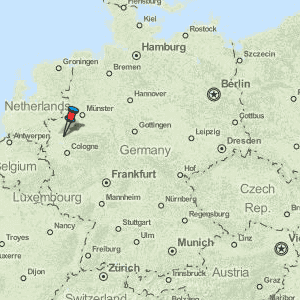
In the above image, you can see where Moers is located with Germany. At the time that my ancestors lived in Moers, it was a garrison town in transition for my ancestor Johannes Bontrock (Fünfstück). Life in Moers was defined by its status as a heavily fortified stronghold. Until 1702, Moers was the personal property of the Princes of Orange. Even after it passed to Prussia in 1712, the town retained a distinct Dutch character in its architecture and religious practices. The town was ringed by a massive, two-mile-long fortification wall featuring a moat and a star-shaped dam. As a soldier, Johannes would have lived and worked within these formidable defenses, which were designed to protect the strategic flax market and the castle of the Counts of Moers. When Prussia took over in 1712, all Dutch troops were expelled. This coincided with the birth Elsabeth Florentina Holdberg, who grew up during the early years of “enlightened absolutism” under the Prussian crown.
Moers was a center for Reformed (Calvinist) education and faith, home to the Gymnasium Adolfinum, a Protestant college founded in 1582. This religious identity was central to the community, influencing everything from baptismal naming traditions to social standing. Being the son of a Hesse-Kassel soldier meant growing up in an environment of extreme discipline. The Hessian army was famous for its “iron discipline” and constant drilling, but it also offered economic perks, such as tax exemptions for soldiers’ families.
Today, Moers has a population of over 100k residents. The city is often called Gateway to the Lower Rhine, it combines a historical old town with modern infrastructure and proximity to major hubs like Duisburg. Despite its population size, it is sometimes considered a medium-sized, cozy city rather than a major metropolis compared to neighboring cities like Düsseldorf.

The Fünfstück surname was misread and mistranslated by many researchers attempting to read German church records (the church records often being quite difficult to read!) as Funstrocks/Funstercke. It was a cousin in Germany that correctly read and listed her maiden name in his tree as Fünfstuck.
The surname Fünfstück is a rare surname, in German the word means five pieces or five parts. Fünf is the word for the number five in the German language. The word stück has multiple meanings, including piece, item, and part. It comes from the Middle High German word stücke and the Old High German word stucchi. It is related to the word stock and likely means “that which is cut off or hewn to pieces“.
The exact meaning of the surname Fünfstück has been lost to time, but it thought to be a nickname related to something involving the number five.
Spelled with umlauts as Fünfstück, it is found mainly in Germany where there are 422 people with the surname, six in Austria, and one in Switzerland. Without the umlaut, spelled as Funfstuck, it is found only in the United States, where twenty-seven people carry the surname.
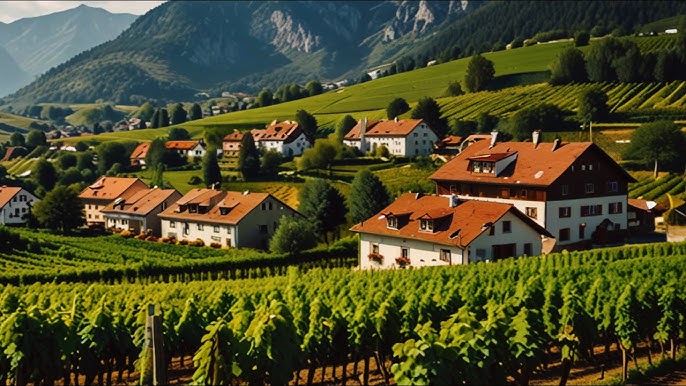
Currently, Klingenmünster has 2,400 inhabitants and is part of the municipality of Bad Bergzabern in the Südliche Weinstraße (Southern Wine Route) district in the southern part of Rhineland-Palatinate, Germany. It’s located along the German Wine Route and is known for its vineyards, rolling hills, and picturesque villages. The region is also a popular destination for hiking. The village of Klingenmünster is located directly at the transition of the Palatinate Forest to the Rhineland plain and is surrounded by vineyards. The center of the village was once the important Benedictine abbey “Clinga Monasterium”, which is one of the oldest abbeys in Germany. High above Klingenmünster towers majestically the Landeck Castle, a ruined hill castle, accessible via hiking trails, the castle ruins of Heidenschuh and Schlössel can also be explored.

My direct line:
- Johannes Bontrock (Fünfstück) and Anna Margaretha van Orsfelt
- Johann George Fünfstück and Elsabeth Florentina [Anna Florentina] Holdberg
- Maria Magdalena Fünfstück and Johannes Sambach
- Maria Katharina Sambach and Peter Wendel
- Kathrina Wendel and Johann Jakob Weiß
- Heinrich Weiß and Margaretha Fried
- Margaret (Margarethe) Weiss and Elias “Eli” (Wegt) Nutick (my 2nd great-grandparents)
This blog post was updated with new information on 27 March 2026.

If you use any information from my blog posts as a reference or source, please give credit and provide a link back to my work that you are referencing. Unless otherwise noted, my work is © Anna A. Kasper 2011-2026. All rights reserved. Thank you.


 Anna's Musings & Writings
Pingback: My Weiss, Fried, Propheter, and Related Ancestors from Klingenmünster, Germany | Anna's Musings & Writings