
My sixth great-grandmother is Rebecca Hicks. She married John Armstrong, Jr. on 26 August 1714 at St Johns Parish, Joppa, Maryland. Joppa is a former colonial town in Maryland. He was the son of John Armstrong and Jane Boone.
She was born at about 1698, making her 16 years old when she married. She was the daughter of William Hicks and Jane ____. I have not seen any documentation showing the maiden name of Jane, wife of William Hicks.
She has sometimes been listed in many trees as being the daughter of William Hicks and Jane Ellery, both born in Devon, England. Her father was William Hicks, but he was not born in Devon, England. He was born in Colonial New York, and his wife’s name was Jane, but not Jane Ellery. Jane Ellery, who married William Hicks in Devon, England, remained in England, where both she and her husband died. This couple never came to Colonial Maryland.

Many researchers mention in their notes that Rebecca Hicks’ parentage is in question. The will of William Hicks names sons William, James, Nehemiah and Henry. William’s will was dated 11 November 1710 and proved 30 December 1710. His wife Jane administered the estate.
After his death, his widow Jane married second to Thomas Cutchin on 28 October 1713 in Joppa, Maryland.
Rebecca Hicks is listed at the bottom of the Hicks family history, Baltimore County Maryland Families, but only with the information that she married John Armstrong

Although there are no daughters mentioned in the will of William Hicks, in the record shown above and cited below, it proves he had at least 2 daughters, Elizabeth and Rebecca. We know that William Hicks died in 1710, and his widow Jane married Thomas Cutchin.
In a document dated 30 January 1723 and found in Baltimore County records, Elizabeth Hicks gave to her mother, Jane Cutchin, the following, saying in this writ of obligation, “one Bright Bay mare with a starr in her forehead and the first colt that this said mare brings is to be given unto William Armstrong son to John Armstrong which said mare shall belong to the said Jane Guggin [Cutchin] during her life and after her death to fall unto Elizabeth Hicks with all her offspring except for said mentioned colt. but in case the said Elizabeth Hicks go to Virginia after her marriage and return unto this county again, then the foresaid mare shall be delivered unto the said Elizabeth Hicks and her husband.“
It does not mention her sister by name, my ancestor, Rebecca Hicks Armstrong, but it does mention Rebecca’s husband, John Armstrong, and her son, William Armstrong (who is also my direct ancestor). Rebecca named her son William after her father and also named a son Nehemiah after her brother, who is mentioned in their father’s will. I also have a DNA connection to the descendants of Nehemiah Hicks.
Rebecca’s father, William Hicks, was born about 1677 in New York. He married Jane ___ about 1694 in Maryland. He died 11 November 1710 in Baltimore, Maryland.

William Hicks was the son of Thomas Hicks and Mary Doughty. Upon seeing her maiden name was Doughty, I thought she could possibly be a descendant of my Mayflower Pilgrim ancestor, Edward Doty. But that is not the case. She was born in Flushing, New York, which is now a part of Queens. She was the daughter of Elias Doughty and Sarah ____. Elias Doughty was born in Oldbury, Gloucestershire, England, and was the son of Puritan minister Rev. Francis Doughty and Bridget ____. The Doughty lines can be taken back several more generations and I will write about these Doughty ancestors in the future.
Thomas Hicks was born about 1640 in either Weymouth, Massachusetts, or Newport, Rhode Island. His parents lived two years in Weymouth before migrating to Newport.
He was the first judge of Queens County New York and filled that office for many years. In 1666 he obtained from Governor Nicolls a patent for four thousand acres of land including Great Neck Long Island and lands adjacent and lived there in English manorial style. He was married twice, both wives were named Mary. His first wife being Mary Butler (widow of John Washburn), by whom he had two sons, Thomas and Jacob.
The famous Quaker preacher Elias Hicks, the founder of that branch of the Society of Friends known to this day as Hicksites, was the son of John Hicks and Mary Smith. He was the grandson of Jacob Hicks and Hanah Carpenter, and the great-grandson of Thomas Hicks and his first wife Mary Bulter.
Elias Hicks is my 2nd cousin, 7x removed, meaning he and my 5th great-grandfather, William Armstrong, were direct 2nd cousins.
Thomas Hicks married secondly to Mary Doughty, with whom he had ten children; six sons: Isaac, William, Stephen, John, Charles, Benjamin and four daughters: Phebe, Charity, Mary and Elizabeth. A paragraph in the New York Post Boy of 24 January 1749 referring to the death of Judge Hicks says he left behind him his own offspring above three hundred children, grandchildren, great-grandchildren, and great-great-grandchildren, dying well into his 90’s.
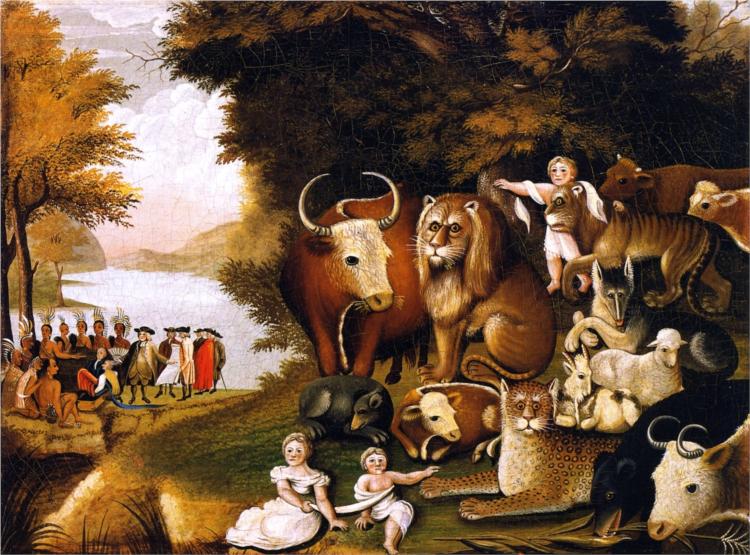
American folk painter and distinguished Christian Quaker minister Edward Hicks was the son of Isaac Hicks and Catherine ____. He was the grandson of Gilbert Hicks and Mary Rodman, great-grandson of Issac Hicks and Elizabeth Moore, and the great-great-grandson of Thomas Hicks and second wife Mary Doughty. He became a notable Quaker because of his paintings.
He painted variations on the Quaker theme of peace and brotherly love throughout his life, as exemplified by his more than sixty versions of the Peaceable Kingdom, he also apparently offered artistic instruction. Hicks reportedly taught his younger cousin Thomas Hicks, and the Bucks County Intelligencer in 1864 reported that, as a youth, the academic painter Martin Johnson Heade was “placed under the instruction of Edward Hicks…to be taught the art of painting.” (5)
Edward Hicks is my 3rd cousin, 6x removed, meaning he and my 4th great-grandfather Nathaniel Shepherd Armstrong were direct 3rd cousins.
Thomas Hicks was the son of John Hicks and Herodias Long. John Hicks was born in Southwark St Olave, which is now part of the modern London Borough of Southwark.
Southwark St Olave was an ancient civil and ecclesiastical parish on the south bank of the River Thames, covering the area around where Shard London Bridge now stands in the modern London Borough of Southwark, ultimately named after St. King Olaf II of Norway. The boundaries varied over time, but in general the parish stretched east from London Bridge past Tower Bridge to St Saviour’s Dock. Southwark St Olave and St Thomas replaced the civil parish in 1896. It was abolished in 1904 and absorbed by Bermondsey parish. (1)
The parentage of John Hicks is unproven. We are able to glean some information about him from his marriage record in England.
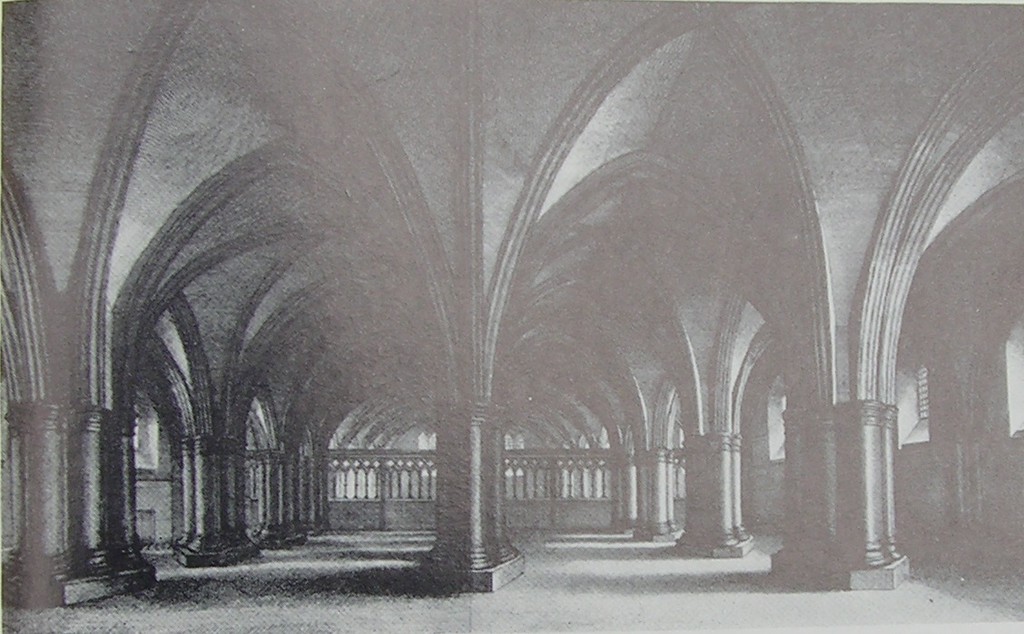
He married on 14 March 1637 at St Faiths Church, London, England to Harwood (Herodias) Long, the daughter of William Long:
March 14, 1636/37: Wch date, appeared p[er]sonally John Hicke of ye parish of St. Olaves in Southwark Salter and a batchelour aged about 23 yeares and alledged that he intendeth to marrie with Harwood Long spinster aged about 21 yeares ye daughter of William Long Husbandman who giveth his Consent to this intended marriage And of ye truth of the pr[e]mises as also that he knows of no Lawfull let or impediment by reason of anie pr[ior] contract Consanguinity affinitie or otherwise to hinder this intended marriage he made faith and desires license to be married in ye parish Church of St ffaith London [signed] John Hicke. (3)
Based on his marriage record, he was about 23 years old, which makes his year of birth about 1614, and we know he was from the parish of St. Olaves in Southward Salter. St Olave’s Church, Southwark was a church in Southwark, England which is believed to be mentioned in the Domesday Book of 1086. It was located on Tooley Street. It was demolished in 1926 and is now the location of St Olaf House, which houses part of the London Bridge Hospital. (2)
They were married in the under church of Old St. Paul’s Cathedral, called St. Faith’s church. There is a Chapel of St. Faith located today in the cathedral’s crypt. Old St Paul’s was destroyed in the Great Fire of 1666. The dedication is to St. Faith, the virgin martyr of Aquitaine, who suffered martyrdom in the time of Diocletian.
The origin of the surname Hicks derives from the given name Hicke and means son of Hick. This name is of English origin and widespread throughout England. The name Hicke is a variant of Richard. Ric means power and hard, meaning strong. It is of Norman origin from the Middle English personal name Hikke, a rhyming pet form of Ricard, a Norman-Picard form of Richard. (4)

There are at least seven people listed as famous descendants of Herodias Long and her partner, George Gardiner. I only found a few famous people descended from Herodias Long and first husband, John Hicks. The first being Willis Carrier, descended from Hannah Hicks Haviland. The others, Elias Hicks, and Edward Hicks, that I discussed earlier, are descendants of Thomas Hicks.
Willis Carrier was an American engineer who is best known for inventing modern air conditioning. He invented the first electrical air conditioning unit in 1902. It was designed to provide a convenient indoor atmosphere in his publishing house to prevent papers from expanding and contracting. In 1915, he founded Carrier Corporation, a company specializing in the manufacture and distribution of heating, ventilation, and air conditioning (HVAC) systems.
The direct ancestors of Willis Carrier are Hannah Hicks and William Haviland. Hannah Hicks Haviland was a sibling of my ancestor Thomas Hicks, both being children of John Hicks and Herodias Long.
I live in the high desert of NW Arizona. This summer I will be quietly thanking my Hicks cousin as my HVAC unit keeps me and my kitty Snickers cool!
There is far too much I could write about the lives of Herodias Long and John Hicks; therefore, I decided to write about them in another entry just about them.
My direct line from John Hicks and Herodias Long:
- John Hicks and Herodias Long.
- Thomas Hicks and Mary Doughty.
- William Hicks and Jane ____.
- Rebecca Hicks and John Armstrong.
- William Armstrong and Elizabeth Shepherd.
- Nathaniel Shepherd Armstrong I and Hannah Norris.
- John A. Armstrong and Sarah “Sally” Norris.
- Bradford Carroll Armstrong and Martha A. Knight Lyons.
- George Pendleton Armstrong and Alice Elizabeth Nutick (my great-grandparents).

References:
- Southwark St Olave. Wikipedia.org
- St Olave’s Church, Southwark. Wikipedia.org
- Ancestry.com. London and Surrey, England, Marriage Bonds and Allegations 1597-1921, Vol. 19: pg. 92, indexed under John Hicke. Ancestry Sharing Link.
- Hicks Name Origin, Meaning and Family History. your-family-history.com
- Edward Hicks. National Gallery of Art.
To learn more about Willis Carrier:
- Willis Carrier, Innovator. Who Made America? pbs.org
- Meet the Inventor of Modern Air Conditioning. The Story of a Company | The Standard of an Industry. williscarrier.com
- The Long, Hot Road To Modern Air Conditioning. By Sam Sanders. npr.org
- The Unexpected History of the Air Conditioner. The invention was once received with chilly skepticism but has become a fixture of American life. By Haleema Shah. smithsonianmag.com
To learn more about the Chapel of St. Faith:
- St Faith under St Paul’s. Lost London Churches Project.
- St Faith under St Paul’s. The Worshipful Company of Church Clerks.
To learn more about St. Faith:
- Saint Faith. All Saints and Martyrs. saintscatholic.blogspot.com
- Saint of the Day: St. Faith. aleteia.org
If you use any information from my blog posts as a reference or source, please give credit and provide a link back to my work that you are referencing. Unless otherwise noted, my work is © Anna A. Kasper 2011-2026. All rights reserved. Thank you.


 Anna's Musings & Writings