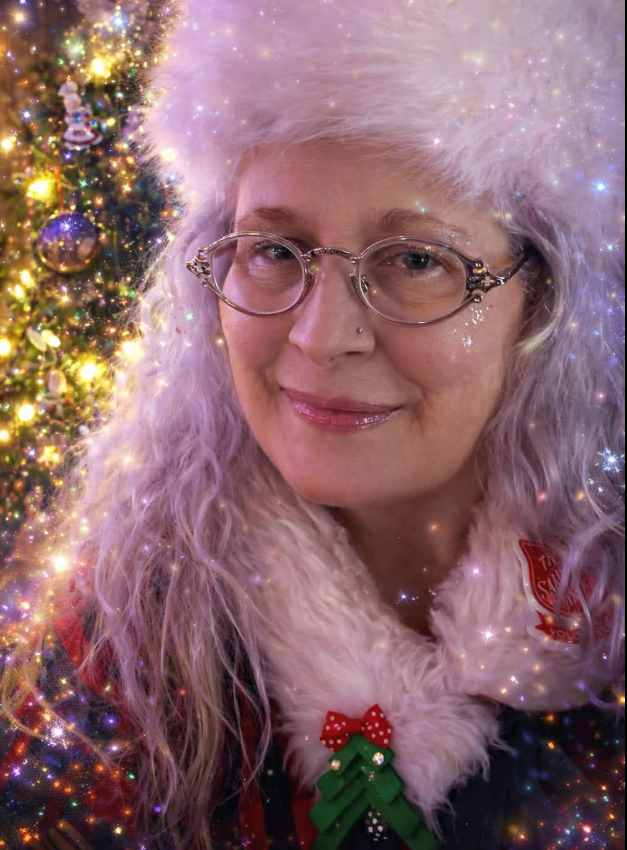
The holiday season has arrived early this year. Early November, and I have already pulled my red velvet Mrs. Claus outfit out of the closet, adjusted my festive accessories, and begun ringing the bell at Hobby Lobby. Walmart is next on my schedule. For the past several years, my red kettle shifts didn’t start until the day after Thanksgiving. But this year, the bells started ringing weeks early, and I am more than thrilled to get out there and start spreading the early holiday cheer.
Last month, as I was organizing my schedule and getting my Mrs. Claus outfit ready, I found myself thinking about a rather extraordinary discovery I’d made while researching my family history.
My name is Anna. Every winter, I volunteer to dress up as Mrs. Claus to ring the bell for the Salvation Army. And through years of deep-dive genealogical research into the old records of southwest Germany, I have proven that my direct 13th-great-grandmother was a woman named Anna Claus.
To understand how a modern-day Anna ended up ringing a bell in the shoes of Mrs. Claus, we have to travel back to the late 13th century in the bustling, self-governing Free Imperial City of Esslingen am Neckar. Nestled deeply within the historic region of Swabia, Esslingen was a proudly Swabian town where daily life was conducted in the distinct Swabian German dialect.
By the late 13th century, hereditary surnames were becoming established in German towns, although naming practices varied. Many surnames developed from a person’s occupation, place of origin, family relationships, or given name.
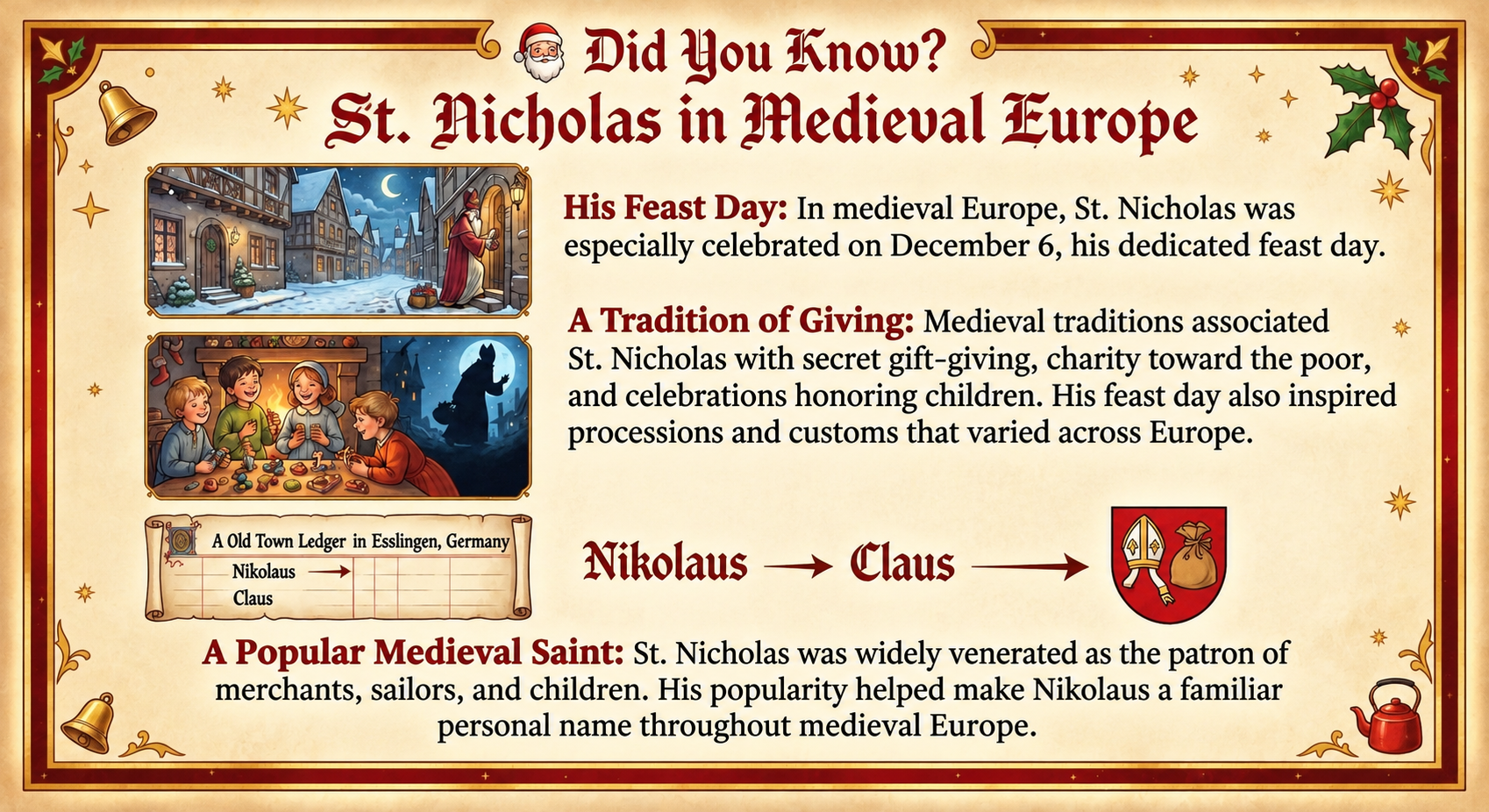
In the Middle Ages, St. Nicholas was celebrated on his feast day, December 6, rather than being associated primarily with Christmas Day as he is today. Long before the modern Santa Claus existed, medieval Europeans honored St. Nicholas through traditions of gift-giving, processions, and charitable acts for children and the poor. As the patron saint of merchants, sailors, and children, he was widely venerated throughout Europe.
And here’s an interesting historical connection: Esslingen had its very own chapel dedicated to St. Nicholas! Located on the Inner Bridge, the Nikolauskapelle was first mentioned in written records in 1350. Dedicated to the patron saint of boatmen and river rafters, the little chapel was already standing when my Claus ancestors lived in the area. Remarkably, it still stands today.
The surname Claus developed from the personal name Nikolaus, which was commonly shortened in German-speaking regions. In 1294, a man named Uzo Claus appeared in Esslingen’s legal records. By 1323, another man named Henricus Claus appeared in regional records. Whether these men were my direct ancestors is unknown, but their presence shows that the Claus surname was already established in the region. They may have been related to my family, although that connection has not been documented.
Fast forward two centuries to around the year 1500, up on the steep, sun-drenched vineyard hills of Hegensberg overlooking Esslingen. Here we find my 14th-great-grandfather, Damian Claus Sr.
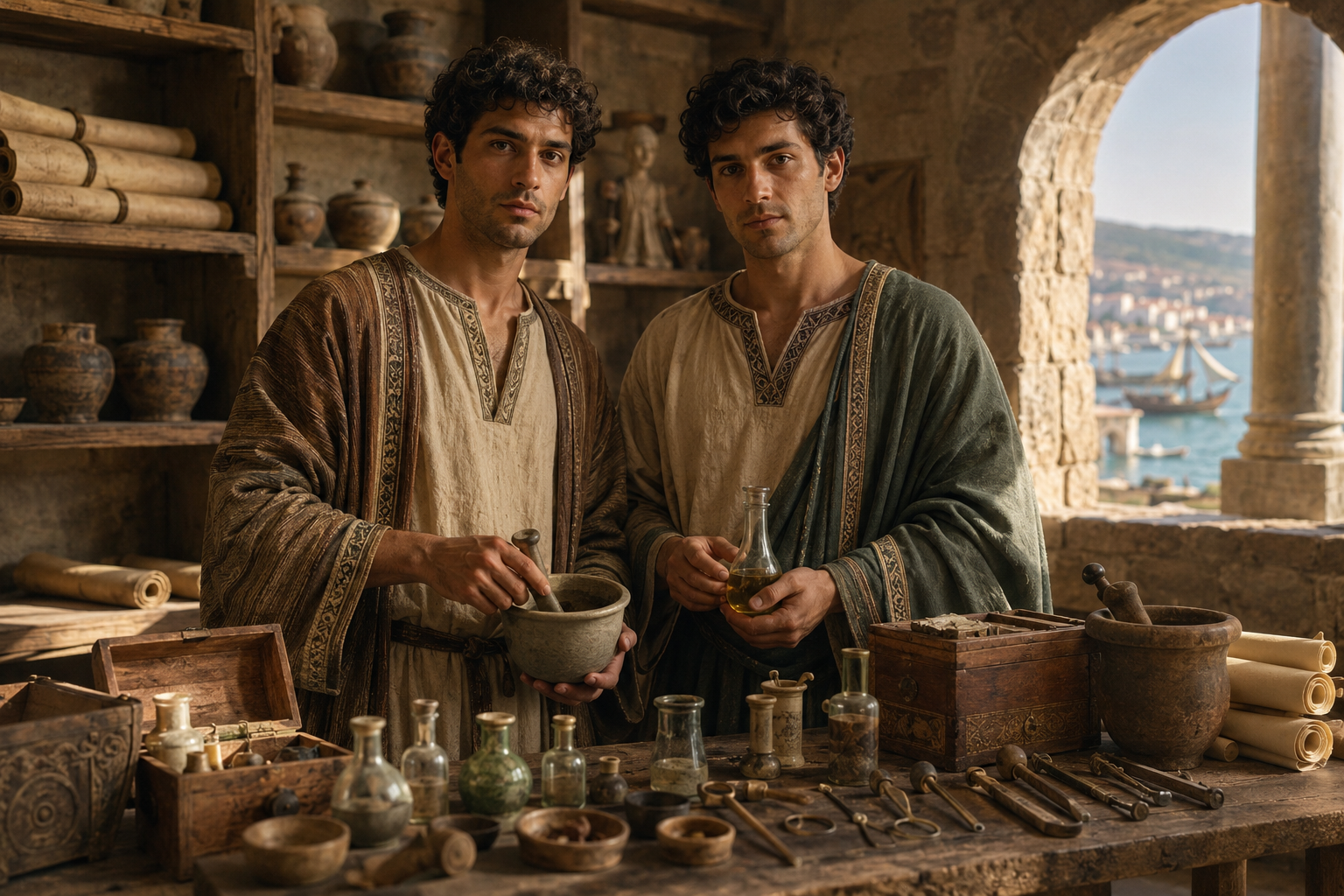
⚕️ Meet Saints Cosmas and Damian: The Moneyless Twin Physicians
They might look like movie stars in the historical visualization above, but these third-century twin brothers were physicians who, according to Christian tradition, refused payment for treating the sick. Known as the “Silverless Healers,” they cared for rich and poor alike. They became patron saints of physicians and medicine, and their names remained familiar throughout medieval Europe.
My 14th-great-grandfather, Damian Claus, who lived in the vineyard hills of Swabia around 1500, shared his name with one of these saints. Whether he was named specifically in honor of St. Damian is unknown, but it’s an intriguing possibility.
If you are a genealogist, you know that names like Hans, Martin, and Georg are a dime a dozen in old German records. But Damian? Damian stands out like a beacon. Interestingly, research into personal names recorded in Kaufbeuren, a Swabian town, between 1461 and 1550 found no occurrences of Damian, despite the local veneration of Saints Cosmas and Damian. The saints had been honored in southern Germany for centuries.
Interestingly, Saints Cosmas and Damian were venerated in the region where my ancestor lived. The historic parish church in nearby Bad Cannstatt was dedicated to them, as was a church in Jesingen near Kirchheim unter Teck. Both existed during Damian Claus’s lifetime around 1500.
Damian and his wife, Apollonia, raised a family that became deeply intertwined with another prominent local Swabian clan: the Xanter family.
The surname Xander has its origins in the ancient Greek name Alexander, meaning “defender of men.” German surname research identifies Xander, Sander, and Zander as shortened forms of Alexander. In my family’s early church records, the surname appears as Xander, while later generations are recorded as Xanter. It’s fascinating to see this spelling change documented across generations of the same family.
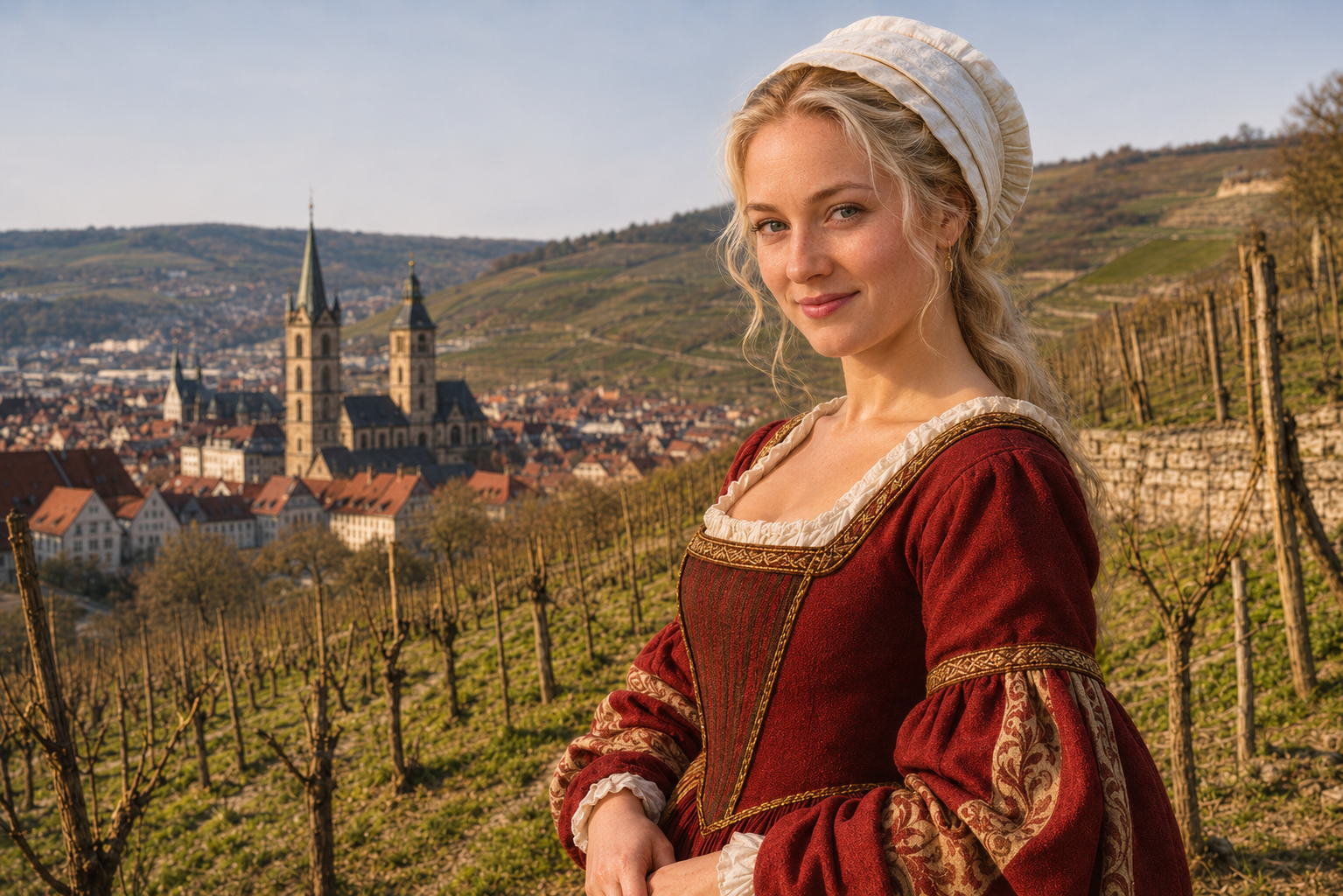
🍷 Meet My 13th-Great-Grandmother, Anna Claus (b. 1528)
Above is a historical visualization that imagines my direct ancestor, Anna Claus, in the mid-1500s. The daughter of Damian Claus and wife of Michael Xanter, she stands on the vineyard hills of Hegensberg, overlooking Esslingen, Germany. I’ve given her a hint of a family resemblance, along with a rich red gown and traditional linen head covering.
Little did she know that nearly 500 years later, her direct descendant—also named Anna—would be putting on her own red velvet outfit to ring a bell for charity!
One of the more unusual discoveries in my research was how closely the Claus and Xanter families became connected through marriage. Three Claus siblings married three Xanter siblings! Among these couples were my direct ancestors, Anna Claus and Michael Xanter.
These marriages brought the two families together across several households in the vineyard-growing community around Esslingen. Whether property, family connections, or simply the circumstances of living in the same community influenced these marriages, I cannot say. But finding three sibling marriages between the same two families was certainly an interesting genealogical discovery!
The family remained in Germany for generations, living through the Protestant Reformation and centuries of European conflicts. My own branch did not emigrate to America until 1865. From Anna Claus and Michael Xanter in 16th-century Swabia, the family line continued through the generations to my own.
So, this November, when I put on my costume, pick up my brass bell, and stand beside the Salvation Army red kettle at Hobby Lobby and Walmart, I will be thinking about the incredible thread that connects my present to our past.
There is something rather amusing about discovering an ancestor named Anna Claus when I spend every Christmas season dressed as Mrs. Claus. Additionally, there is a historical link to St. Nicholas, whose name inspired the surname Claus and whose generosity became a part of the customs associated with Christmas.
I cannot know what my ancestors thought about St. Nicholas or how they celebrated his feast day. But I like the coincidence that, centuries later, another Anna is standing outside collecting donations for people who need help.
I won’t just be volunteering. I’ll be carrying the name of my 13th-great-grandmother Anna, celebrating the charitable spirit of St. Nicholas, and enjoying a remarkable connection between my family’s centuries-old history and my own Christmas tradition with every ring of the bell.
Do you have any holiday traditions that accidentally mirror your family history? Drop a comment below and let’s talk roots!
My direct line:
- Damian Claus and Apollonia ______
- Anna Claus and Michael Xanter
- Anna Xanter and Hanß Gnapper
- Michael Gnapper and Margaretha Breuning
- Hanß Gnapper and Anna Fritz
- Margaretha Gnapper and Michael Weinmann
- Johann “Hanß” Georg Weinmann and Susanna Guth
- Georg Ruprecht Weinmann and Elisabetha Rapp
- Michael Weinmann and Anna Felicias Großhans
- Anna Margaretha Weinmann and Johann Jacob Propheter
- Margaretha Propheter and Johann Georg Fried
- Margaretha Fried and Heinrich Weiss
- Margaret (Margarethe) Weiss and Elias Wilhelm “Eli” Utech (Nutick) – my great-great grandparents.

Most of what is written above is based on my own family tree research and examining of German church and other records. The few sources used sparingly are listed below.
References:
- Aus Sorge um die Gesundheit: Geschichte der Medizin in der Region, edited by Peer Frieß and Dietmar Schiersner, 2021, p. 50
- Dräger, Kathrin. Familiennamen aus dem Rufnamen Nikolaus in Deutschland. Regensburger Studien zur Namenforschung, vol. 7. Regensburg: Edition Vulpes, 2013. A scholarly study of German surnames derived from the personal name Nikolaus, including Claus and related forms.
- University of Freiburg. “Ein Nikolaussack voller Namen.” 2018. A summary of Dr. Kathrin Dräger’s research on German surnames derived from Nikolaus.
- Hanks, Patrick, ed. Dictionary of American Family Names. Oxford University Press, 2003. Entry for “Xander,” reproduced by FamilySearch.
- Stadt Esslingen am Neckar. Schein und Fassade. Historical material concerning Esslingen’s Nikolauskapelle, constructed around 1300 and first documented in 1350.
- University of Hamburg, RomanIslam Center. “Nicholas of Myra.” Historical background on St. Nicholas and German customs surrounding his feast day.
- Lendering, Jona. “Nicholas of Myra: Early Evidence.” St. Nicholas Center. An examination of early historical accounts and legends associated with St. Nicholas.
Image Credits: The “Did You Know?” St. Nicholas graphic and the historical visualizations of Saints Cosmas and Damian and my direct ancestor Anna Claus were created using ChatGPT (OpenAI) for illustrative purposes. The historical visualizations are artistic interpretations, not authentic portraits. The photograph of me dressed as Mrs. Claus is my own.
Unless otherwise noted, all original research, transcriptions, and written content are © Anna A. Kasper 2011–2026. All rights reserved. Please do not re-post full text or screenshots without permission and proper attribution. Thank you for respecting independent genealogical research! 🔎 🐺 🔔 🎄


