Decoding the Mysteries of Our Dutch and Norwegian Origins:
This week’s writing prompt for 52 Ancestors, Week 35: A Spot on the Map.
As we dig deep into the mud of 17th-century New Amsterdam, we don’t only uncover names of individuals on tax rolls. We uncover ancient cultural identities, which are directly embedded in the origins of those surnames. With a major family discovery emerging from my research, let’s take a look at the intriguing origins of two of my key maternal lines: Fulkerson and Van Leeuwe.
1. Fulkerson:
The Ship’s Carpenter from Bergen. Though we tend to link the Fulkerson name strongly to the close-knit communities of Dutch Reformed churches in New York and New Jersey, the origin of this name is not Dutch at all – it’s Scandinavian!
The Original Patriarch:
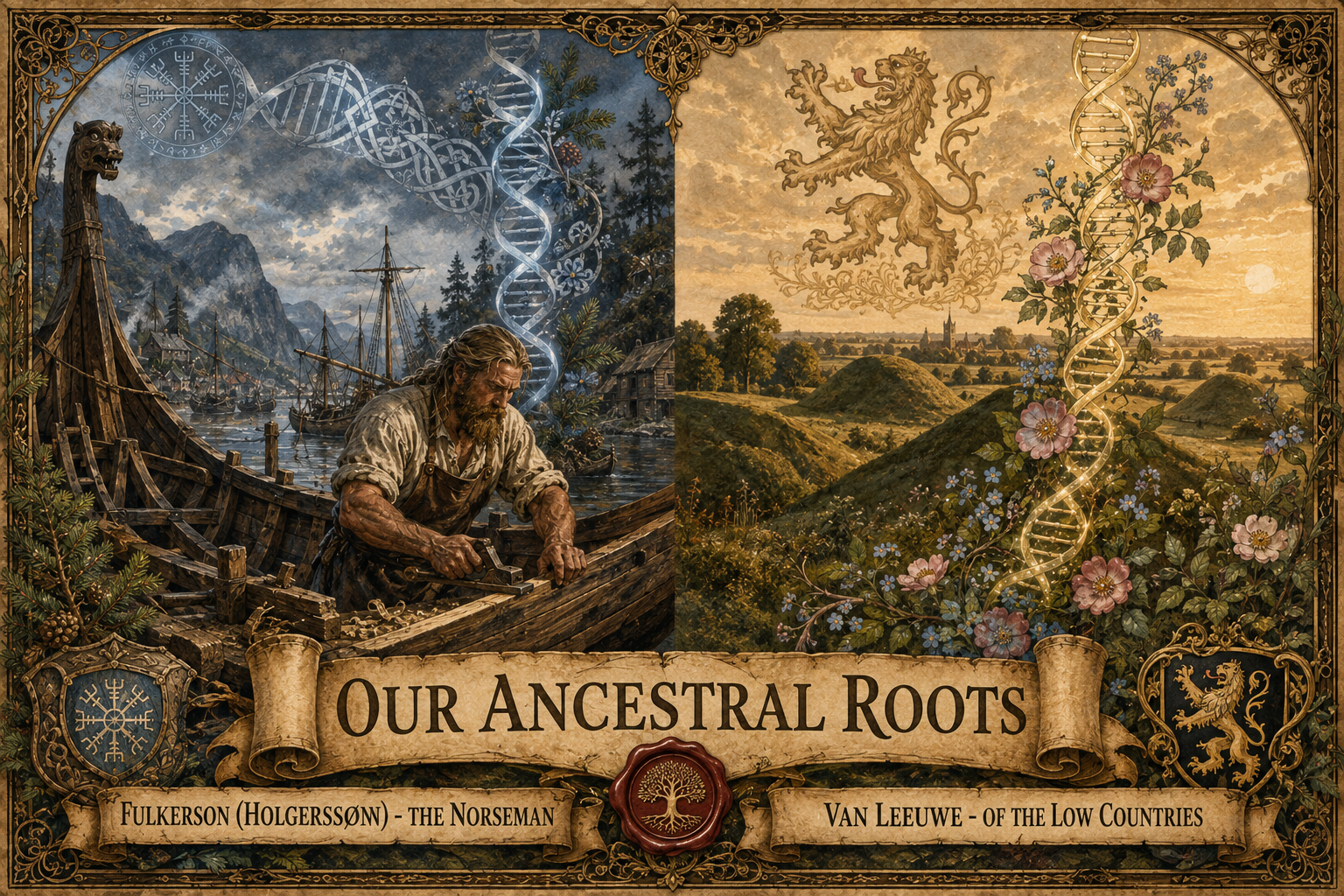
Our immigrant founder was Dirck Volckertszen, nicknamed Dirck De Noorman (“Dirck the Norseman”) by the clerks of early New Amsterdam.
The Norwegian Origin:
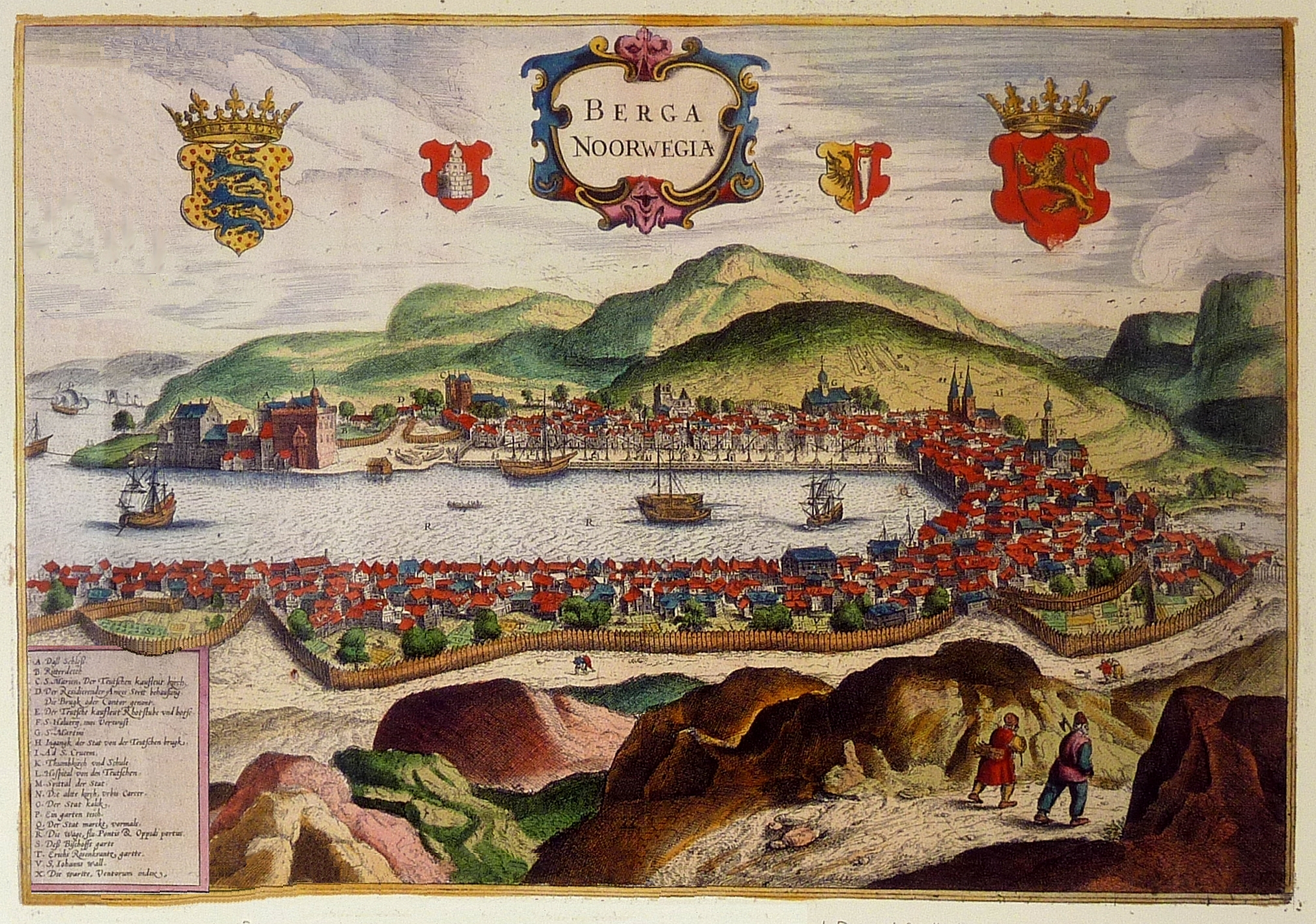
Dirck was born around 1595 in Norway and is traditionally associated with Bergen, one of Norway’s great maritime and trading centers. A skilled carpenter, commonly described as a ship’s carpenter or shipwright, he eventually made his way into the Dutch colony of New Netherland, where he became one of its early settlers. His exact route to New Netherland and the circumstances of his immigration remain uncertain.
The Historical Clue (Holgerssøn):
In contemporary records, Dirck appears under more than one name form. Dutch records identify him as Dirck Volckertszen, while court records also record him as Dirck Holgerson/Holgersen. The latter is unmistakably Scandinavian in form and strongly reflects his Norwegian background.
Holgersen/Holgerssøn means “son of Holger,” using the Scandinavian patronymic system. Volckertszen, by contrast, is a Dutch patronymic form. Rather than representing two unrelated identities, the different names reflect the multilingual world of New Netherland, where a Norwegian immigrant’s name could be rendered differently depending on the language and conventions of the clerk making the record.
Over time, the Dutch colonial form Volckertszen and its variants developed into the hereditary American surname Fulkerson.
The Academic Reference:
Want to read the raw 1600s court minutes and land patents for Dirck’s massive lands in Bushwick, Brooklyn? Read John O. Evjen’s 1916 academic masterpiece Scandinavian Immigrants in New York, 1630-1674 (pages 69-78) where he is showcased as a main character alongside the legendary Norwegian pioneers such as Albert Andriessen Bradt and Hans Hansen Bergen.
The American Version:
Over the course of generations, as his son Volkert Dircksen and further descendants migrated to English systems of New Jersey, the phonetic spelling was changed from Volckertszen to Folkertson, and later evolved into the Fulkerson we know today.
2. Van Leeuwe: The Burial Mounds of the Low Countries
Our matriarch Dinah Van Leeuwe (b. 1694) possesses a wonderful toponymic (locational) surname, which reveals exactly the location of her family on the European map before crossing the ocean.
The Literal Translation:
In modern Dutch, Van Leeuwen translates literally as “from the lions”. It’s a beautifully fierce heraldic symbol often associated with early Dutch coats of arms.
The Deep Medieval Origin:
However, etymologists trace the name back even earlier than this animal symbol. Geographical place-name Leeuwen (used in regions such as Gelderland and Limburg) originates from the ancient Germanic word hlaiw, meaning burial mound or tumulus.
The Meaning:
The Van Leeuwe name may have roots considerably older than the modern Dutch word leeuw, meaning “lion.” Some Dutch place-names containing Leeuwen have been connected with an older Germanic word associated with a burial mound or grave. If our Van Leeuwe surname originated from such a place-name, its linguistic roots may ultimately reach back to this ancient landscape vocabulary. However, the surname alone cannot tell us that our particular ancestors lived beside prehistoric burial mounds; their specific geographic origin must be established independently through historical records.
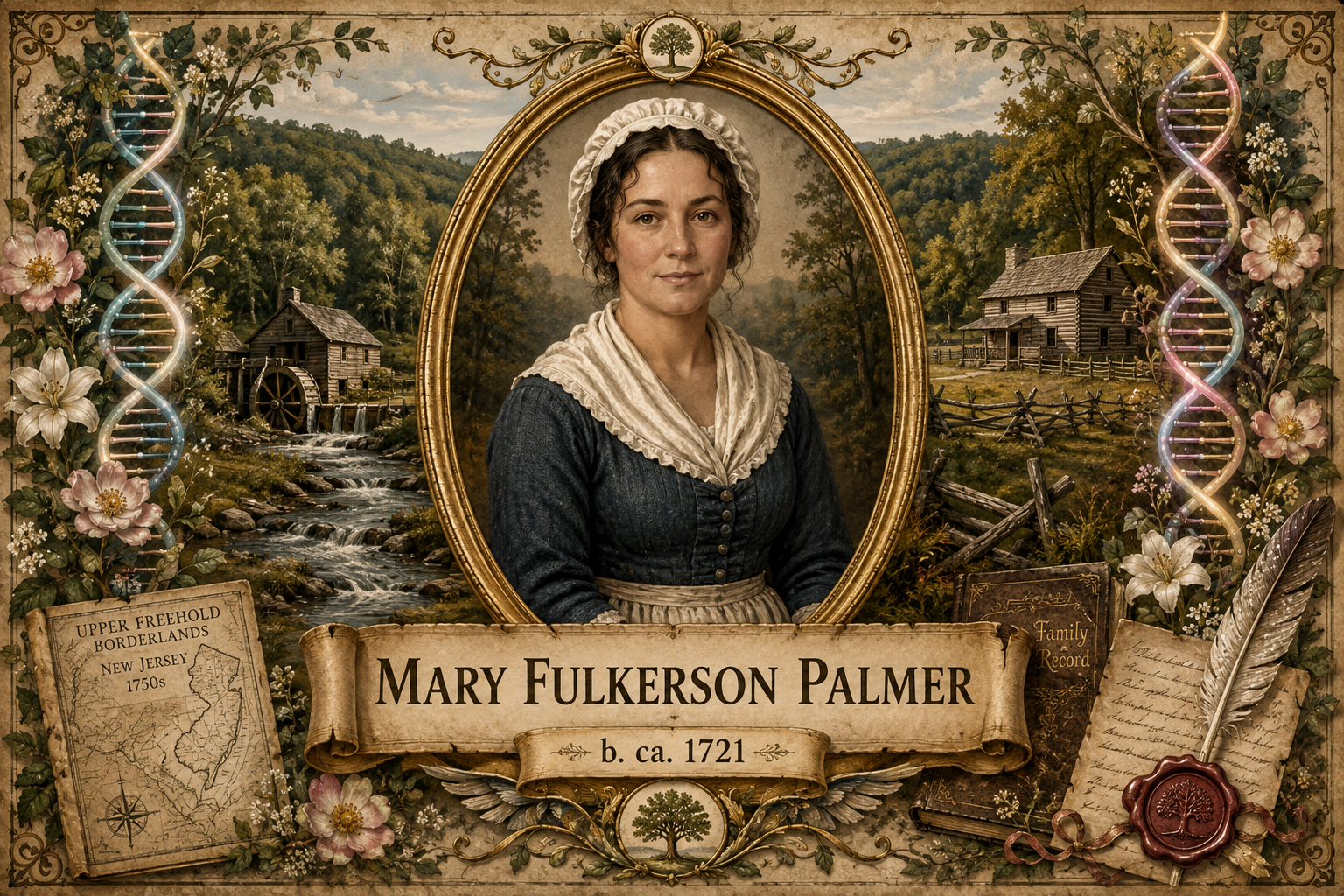
Now that we know exactly who our Fulkersons and Van Leeuwes were, let’s discuss the woman who carried their blood into our lineage: Mary/Maritje Fulkerson (b. ca. 1721).
Years of mainstream online family trees failed to reveal her later life. Some attempt to call her “died young” without any proof whatsoever. Others even attempt to assign an August 1724 baptism record, which actually belongs to her uncle Dirck and aunt Grietje’s child, missing our real Mary, born circa 1721, called Maritje in her family and leaving her real footprint in the borderlands of New Jersey.
On paper, the origins Antje Palmer, daughter of Mary/Maritje Fulkerson, remained lost to time, leaving her with no documented parentage. DNA, however, has opened a remarkable new path into that brick wall. 🧬
In the future, I will post what may be the most significant achievement of my research into our Greatsinger-related female Palmer/Fulkerson branch. By comparing the DNA results of four family members, I have been able to build an extensive network of multi-branch DNA matches. One of those testers is particularly valuable as a genetic control, helping to eliminate matches attributable to other known maternal lines and narrow the cluster associated with this colonial Dutch family.
Together, our results include close to 50 DNA matches tracing through descendants of six Fulkerson brothers whose families spread across the United States. When this genetic evidence is combined with the documentary, geographic, chronological, and family evidence, it forms a compelling case that our ancestor Antje Palmer Greatsinger was the daughter of the elusive English farmer John Palmer and Mary/Maritje Fulkerson of New Jersey. Although DNA evidence of this age cannot by itself establish their parentage with absolute certainty, the convergence of multiple independent lines of evidence makes this a highly probable reconstruction.
I will present the full evidence, examine the “same-name” errors that have spread through Ancestry family trees, and explain why I believe the frequently repeated identification of Antje’s father as Emanuel Pamer/Palmer of Lancaster County, Pennsylvania, is incorrect. I will also reconstruct the remarkable story of the couple I believe the evidence identifies as her parents.

Research Notes:
Extracted from John O. Evjen’s “Scandinavian Immigrants in New York, 1630-1674” (Minneapolis, 1916) and contemporary New Amsterdam legal registries.
- The Bushwick Baseline (1661): On March 14, 1661, Dirck Volckertszen stood alongside 22 fellow frontier settlers to sign the formal petition to Director Peter Stuyvesant. This historic document officially requested common pasture lands for cattle, the clearing of four public roads to nearby creeks (“kills”), and a strict mandate forcing all regional leaseholders to build within the fortified town limits of Boswyck (Bushwick) to defend against attacks.
- The Greenpoint Patent (1645): Long before anchoring the town of Bushwick, Dirck was awarded an expansive ground brief (land patent) on April 3, 1645, covering a massive hook of land at Greenpoint, Brooklyn. Facing south along Noorman’s Kill (Norman Creek), he raised a heavily built log-and-timber cabin to shelter his boatwright equipment. This home was so durable it remained continuously occupied for 200 years.
- The Frontier Defense Strategy: Because Greenpoint was heavily isolated from New Amsterdam, Dirck actively tried to recruit rugged neighbors to help guard the water basin against localized Native American uprisings. In 1649, he leased a substantial parcel of his acreage to fellow Norwegian pioneer Jochem Calder, followed by several outright land sales to close allies throughout the early 1650s.
- The Tragic Indian Wars (1643–1655): Evjen chronicles the steep cost Dirck paid for maintaining his frontier outpost. During the violent Native American retaliations of 1643 and 1655, his fields were salted, and his standing barns were burned to the ground. The conflict struck his immediate family circle directly:
- 1652: His son-in-law Jan Hermensen Schutt (husband of daughter Grietje) was killed.
- 1655: A second son-in-law, Cornelis Hendricksen Van Dort (first husband of Magdalena “The Flying Angel” Dircks), was killed during the Peach Tree War.
- 1659: A third son-in-law, Herman Hendricksen Rosenkrans (Magdalena’s second husband), was captured and tortured for eight days before escaping.
1. FULKERSON / HOLGERSSØN
- The Linguistic Root: The name is an American phonetic adaptation of the Dutch patronymic Volckertszen (son of Volckert). Volckert stems from the ancient Germanic name Volkhard or Folkhard, a compound of polk/volk (meaning “the common people” or “army”) and hard/hart (meaning “brave,” “fierce,” or “strong”).
- The Norwegian Origin: In secular New Amsterdam court proceedings, the phonetic spelling traces directly to his native Scandinavian patronymic: Holgerssøn (son of Holger). Holger derives from the Old Norse name Hólmgeirr, a compound of hólmr (meaning “island” or “isolated land”) and geirr (meaning “spear”).
- Evjen, John O. Scandinavian Immigrants in New York, 1630-1674. Minneapolis: K.C. Holter Publishing Company, 1916. See also the Fredrikstad Lagtingsprotokoll (1607–1615), Riksarkivet, which highlights the coastal trade phonetics of the Holgersen/Helgesen variations in early maritime registries.
2. VAN LEEUWE / VAN LEEUWEN
- The Literal Shorthand: In modern Dutch, the surname translates literally to “from the lions” (leeuw = lion), which evolved as a popular medieval heraldic household moniker or innkeeper sign.
- The Deep Topographic Meaning: Etymologists track the regional placename Leeuwen (found in Gelderland and Limburg) far past the animal symbol. It derives directly from the ancient dative plural form of the Old Dutch word lēo, which stems from the Proto-Germanic root hlaiw—meaning “burial mound,” “tumulus,” or “sacred tomb”. A person tagged as Van Leeuwen in the 13th century belonged to a family whose farm directly bordered ancient, visible prehistoric burial earthworks.
- Leendert Brouwer, Nederlandse Familienamenbank (Dutch Surname Database), Meertens Instituut, Amsterdam. See also: Van Leeuwen (surname), historical compilation of toponymic distributions in Gelderland and Limburg; and the Germanic etymological tracking of hlaiw (grave/tomb) in the Gothic and Old Saxon linguistic corpuses.
Further Reading:
- Dirck Volckertszen de Noorman. Fulkerson Family Tree. Our Family History.
- Nynorsk – Grind – Norwegian for «Gate» A gate to the landscape. Bergen – The Urban Community.
- REHOOK WAR STORIES – Full Article: Norwegians
- Norwegian Americans – Wikipedia
Image Citations:
Mary Fulkerson Palmer Portrait. Portrait of a 1750s colonial American woman of Dutch descent in Upper Freehold, New Jersey, framed by vertical DNA helixes and wild roses” prompt. ChatGPT, DALL-E 3 model, OpenAI, August 26, 2026. Private digital collection of the author.
Our Ancestral Roots Graphic. A professional heritage graphic split in half showing a 17th-century Norwegian shipwright in Bergen harbor on the left, and early medieval Dutch burial mounds under a heraldic lion on the right, framed by vertical DNA helixes” prompt. ChatGPT, DALL-E 3 model, OpenAI, August 26, 2026. Private digital collection of the author.
Map of Bergen, Norway. Braun, Georg (1541–1622) and Franz Hogenberg (1535–1590). “Berga, Norvegiae celebre emporium” [Map of Bergen]. From Civitates Orbis Terrarum, Volume IV, Cologne, c. 1571–1600. Copperplate engraving. Public domain.

If you’d like to learn more about the 52 Ancestors in 52 Weeks project, please visit here:
Or join the Facebook group Generations Cafe.
Unless otherwise noted, all original research, transcriptions, and written content are © Anna A. Kasper 2011–2026. All rights reserved. Please do not re-post full text or screenshots without permission and proper attribution. Thank you for respecting independent genealogical research!


Fantastic! and I appreciate all the sourcing and links. Please share more of your book discoveries from Archive.org. I look forward to the DNA article. Thank you for sharing!
LikeLiked by 1 person