Surname Saturday: My Wentworth Ancestors of Colonial Virginia, Maryland & Yorkshire, England. Our Kin Barbara Wentworth & Robert Holgate, Archbishop of York.

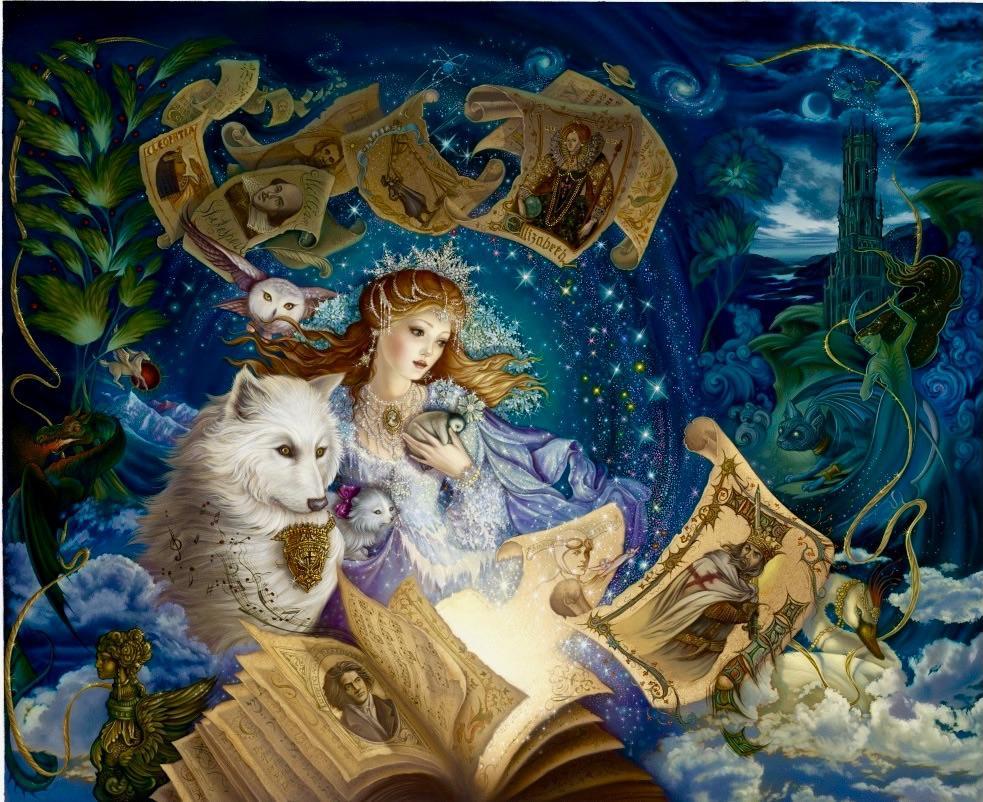
Graphic above is Gateway Ancestors. Artwork from bookThe Legend of Holly Claus by Brittney Ryan with illustrations by Laurel Long.

Many describe our Wentworth ancestors as Gateway Ancestors, meaning a direct link to being descended from royalty. This is partly true, via a female line some generations back lead to being descended from King John I of England. I would consider our direct Wentworth ancestors to be more royalty adjacent.

The members of the Wentworth family of both the U.S. and Australia are descended from Thomas Wentworth, who died in 1522 in Yorkshire, England, and Jane, the daughter of Sir Oliver Mirfield.

The American Wentworth branch of New Hampshire is descended from Thomas’ son Oliver. The Wentworth branch of Virginia and Maryland, and the Australian Wentworths, are descended from another son, Roger. My line is via the son Roger Wentworth and his wife Elizabeth Wentworth, who were kin.

Roger Wentworth’s wife Elizabeth was the daughter of John Wentworth, Gentleman of Pontefract (Pomfret), who had 40 acres in Ferrybridge, West Yorkshire. Her father died when she was 13 years old. It is a 2.5-mile distance between Pontefract and Ferrybridge. Thomas Wentworth, of North Elmsall, West Yorkshire, Esquire, became her guardian and married her to his second son, Roger.

The land in Ferbrigg (Ferrybridge), consisting of forty acres, was held by John Wentworth under a system of knight-service, meaning he owed military service to the king in exchange for the land.

When John Wentworth died, the land reverted to the crown, as it was held by knight-service. King Henry VII, instead of simply taking the land, seized it in fee, meaning he took ownership of the land and its associated rights. Elizabeth, John Wentworth’s daughter and heir, was thirteen years old at the time. Henry VII also took Elizabeth into his fee, meaning he took control of her and her inheritance, including the land.

The Wentworth family was a prominent American political family, mostly based in the British colonies and later the U.S. states of New Hampshire, Maryland, and the Commonwealth of Virginia.

Sarah Wentworth is my paternal 9th great-grandmother. Many list her as born in Virginia, but she was born in Yorkshire, England, prior to the family coming to Colonial America. She was born about 1645, and died about 1700 in Stafford County, Virginia. She married in Charles County, Maryland to Daniel Mathena (Matheny), who was born at Bossenden Farm near Canterbury in County Kent, England. He died at his Hope Plantation in Stafford County, Virginia.

There is much written about my Mathena (Matheny) ancestors in Colonial America, England, and France. He was the son of William Matheny, the great-grandson of a Huguenot refugee from Flanders. I intend to fully write about him and his ancestry in the future.

Daniel Mathena went to Charles County, Maryland, where he acquired Portowne, Wentworth-Woodhouse, Fernes, Mathena’a Folly, and Cowland plantations in Charles County. He acquired Wentworth-Woodhouse from his father-in-law, Thomas Wentworth. In 1681, Daniel Mathena became embroiled in an early Protestant uprising against Lord Baltimore’s dominated Catholic government in Colonial Maryland. He was given a choice to leave Maryland or stand trial. He left to avoid prosecution for his part in the rebellion. He, with Sarah and the rest of the family, moved to present-day Stafford County, Virginia and to Hope Plantation on Aquia Creek, where he farmed tobacco.

Daniel Mathena and Sarah Wentworth had the following children:

  1. Mary Matheny was born in 1663 at Mathenia’s Folly in Charles County, Maryland, and died in 1679 at Mathenia’s Folly in Charles County, Maryland.
  2. Susannah Matheny was born 11 January 1664 at Mathenia’s Folly in Charles County, Maryland, and died 8 June 1708 in Stafford County, Virginia. She married first to Solomon Day, and second to John Davis. (She and husband John Davis are my direct ancestors).
  3. Sarah Matheny was born in 1668 in Charles County, Maryland, and died in 1679 in Charles County, Maryland.
  4. Elizabeth Matheny was born 1671 in Charles County, Maryland, and died 1674.
  5. William Wentworth Matheny was born about 1665 in Charles County, Maryland, and died 12 December 1705 at Hope Plantation, Stafford County, Virginia. He married Frances, widow of Richard Mason.
  6. Daniel Mathena, Jr., was born in 1674 in Charles County, Maryland, and died about 1750 in Maryland or Virginia.
Pictured above is the tombstone for Daniel Mathena (Matheny)

Daniel and Sarah are both buried in the Aquia Episcopal Church Cemetery in Aquia, Stafford County, Virginia.

Sarah Wentworth was the daughter of Thomas Wentworth, a descendent of the Wentworth-Woodhouse (Wodehouse) families of England, and Isabell Joynson. Her father, a Gentleman, was of Wentworth’s Rest and Wentworth-Woodhouse Plantations in Charles County, Maryland. Daniel Mathena and Thomas Wentworth were neighbors.

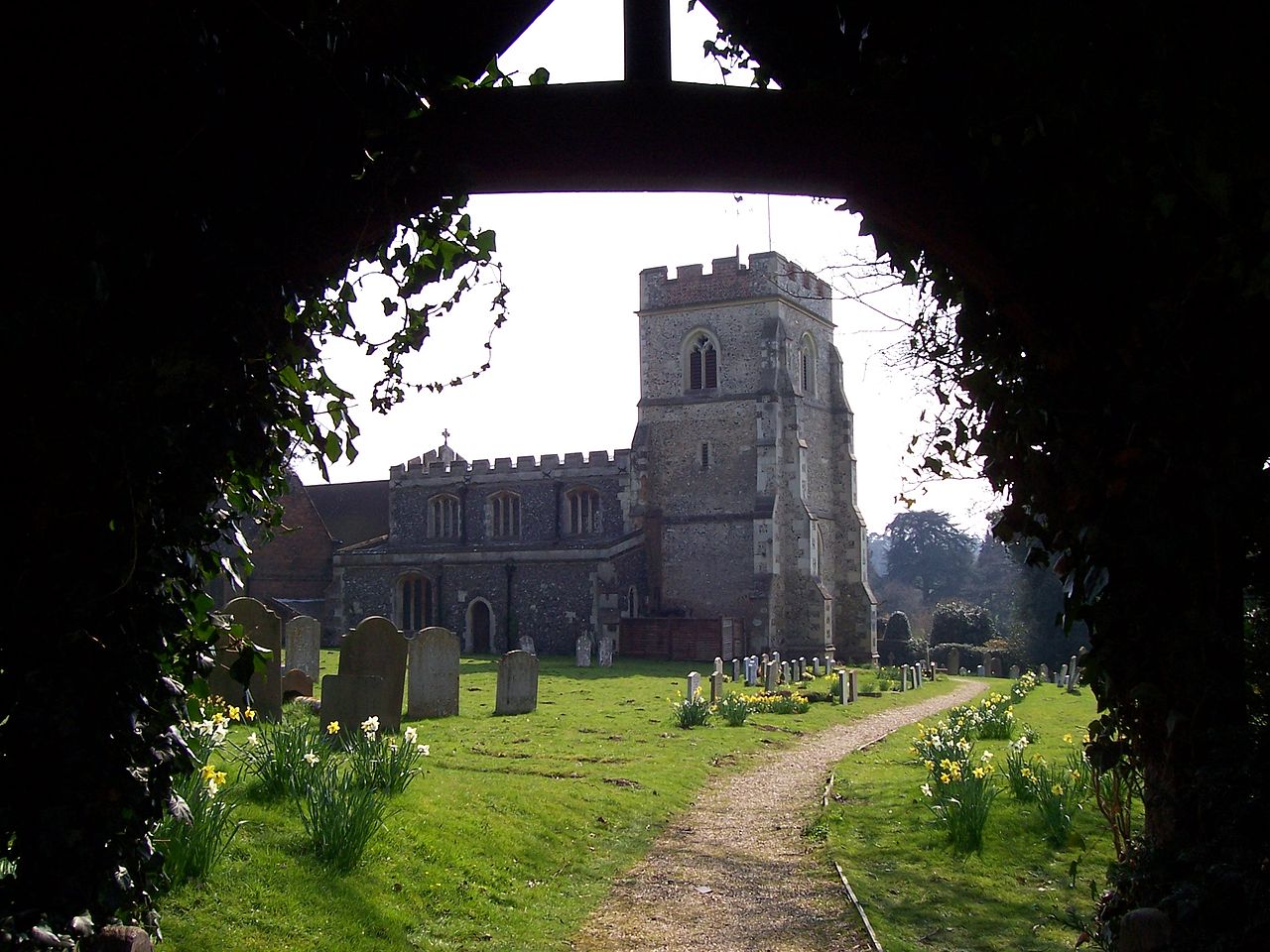
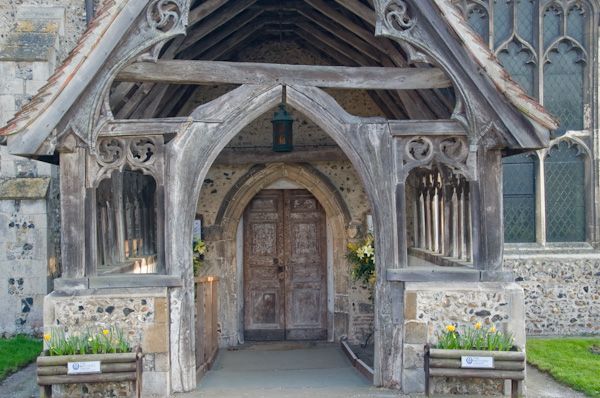
Photo above is of the Church of St. Martin in Womersley.

There are two marriage records found for Thomas Wentworth. He marries Isabell (incorrectly transcribed as Scott) Joynson on 7 November 1643 at the Church of St. Martin in Womersley. Womersley is about 5 miles from South Kirkby, where he was born, and he would have been 18 years old.

The parentage of Isabell Joynson is taken from the burial record of her brother named Henry Joynson, the baptism record of her brother Henry Johnson, and the baptism record of her sister Judith Johnson. All the records list them as the children of William Joynson of Smeaton (Kirk Smeaton). Kirk Smeaton is about 3 miles from Womersley.

It’s far from easy to read the handwriting in these Womersley church records from the Tudor era. Those attempting to transcribe the records read Isabell as Scott, but when I viewed the church record and researched handwriting styles of this period, her name is clearly listed as Isabell Joynson.

They listed Henry Joynson as Judaby! Once again, when I viewed the church record, it took me a while to realize that it said Henry. I knew Judaby was incorrect.

Also, in the Judith Johnson baptism record they list her as Indith. I was able to see pretty quickly that it was Judith.

William Joynson had at least five children:

  1. Isabell Joynson was born about 1627 in Kirk Smeaton, Yorkshire, and died before January 1658 at Womersley, Yorkshire. She married Thomas Wentworth on 7 November 1643 at the Church of St. Martin in Womersley, Yorkshire.
  2. Henry Joynson was born about 1630 in Kirk Smeaton, Yorkshire, and buried 7 June 1641 in the churchyard of St. Martin in Womersley, Yorkshire.
  3. Judith Johnson was baptized 20 September 1635 at the Church of St. Martin in Womersley, Yorkshire.
  4. Henry Johnson was baptized 21 July 1641 at the Church of St. Martin in Womersley, Yorkshire.
  5. Elizabeth Joynson, spinster, was buried 11 January 1668 in the churchyard of St. Martin in Womersley, Yorkshire.

Willliam Joynson may have been related to:

  1. James Johnson, who married Ann Kirby on 27 September 1661 at the Church of St. Martin in Womersley, Yorkshire.
  2. Thomas Johnson, who married Anne Sate on 14 November 1661 at the Church of St. Martin in Womersley, Yorkshire. This Thomas Johnson may have been the Thomas who was the schoolmaster at Kildwick, Yorkshire.

Isabell Joynson, wife of Thomas Wentworth, would have been the mother of our ancestor Sarah Wentworth Mathena. Isabell dies before January 1658 when Thomas Wentworth marries second to Elizabeth Hodgson at the Church of St. Martin in Womersley. This second wife would have been the one to come to Colonial Virginia with him.

Thomas Wentworth was christened on 13 September 1625 at All Saints in South Kirkby, Yorkshire, England. He was the son of Richard Wentworth and Anne Holgate. He was born into a cadet branch of the ancient Wentworth family. Anne Holgate was baptized on 27 January 1603 at Royston, Yorkshire, England, as the daughter of Henry Hoalgate (Holgate). Based on her baptism record it shows that Henry Holgate lived in Grimethorpe. The name of the wife of Henry Holgate is unknown, some link him as being married to a woman named Mary Walker, but I have not seen any church records or other documentation to link her conclusively as being married to Henry Holgate of Grimethorpe, Yorkshire, England. Although, it is a possibility. She may be the Mary Walker baptized on 6 February 1585 in Kildwick, Yorkshire, England, as the daughter of George Walker and Jeneta ____.

Henry Holgate was baptized 17 November 1582 in Halifax, Yorkshire, England, and died 18 March 1657 in Grimethorpe, Yorkshire, England. He was the son of John Holgate.

Some list Henry Holgate as the son of John Holgate and Ellena Specke. This is not possible for John was only twelve years old when the marriage of this couple took place. Johannes (John) Holgat married Ellena Specke on 18 May 1561 in Halifax, Yorkshire, England. He was most-likely kin.

Our John Holgate married Grace Normanton on 6 November 1570 in Halifax, Yorkshire, England.

They had at least one child, a daughter, named Mary Holgate. She was baptized 1 February 1573 at Halifax, Yorkshire, England, and buried 15 November 1595 at St. John the Baptist churchyard in Halifax, Yorkshire, England.

Grace Normanton Holgate would have died prior to him marrying again in 1576.

Johne Holgate married Margaret Vicars on 1 July 1576 at St John the Baptist, Halifax, Yorkshire, England.

We know that Margaret Vicars was the daughter of Edmund Vicars of Birstall, Yorkshire, England. Margaret was baptized 1 December 1540 in Halifax, Yorkshire, England. This makes Margaret aged thirty-five when she married.

Only the name of the father is listed in the baptism records, so I am assuming his wife Margaret Vicars was the mother of all these children. John Holgate had the following children:

  1. Michaell Holgate baptized August 1577 at St. John the Baptist Church Halifax, Yorkshire, England. He married Sara Cheetam on 13 April 1607 at St. John the Baptist Church Halifax, Yorkshire, England.
  2. Prudence Holgate baptized 11 August 1577 in Halifax, Yorkshire, England. She died 11 November 1632 in Halifax, Yorkshire, England.
  3. John Holgate baptized 14 September 1579 in Halifax, Yorkshire, England, and was buried 10 January 1619/1620 at St Peter’s, Birstall, Yorkshire, England. He married Elizabeth Roods on 4 July 1604 at St Peter’s Church, Birstall Yorkshire, England.
  4. Susan Holgate who married Isaac Wilson on 15 May 1611 at St. John the Baptist Church, Halifax, Yorkshire, England. She died 11 November 1632 in Overton, Yorkshire, England. As adults, most of her children migrated to Colonial Massachusetts.
  5. Henry Holgate baptized on 17 November 1582 at St. John the Baptist Church Halifax, Yorkshire, England. He died 18 March 1657 at Grimethorpe, Yorkshire, England. His wife’s name may have been Mary Walker.
  6. Grace Holgate baptized 27 February 1585 at St. John the Baptist Church Halifax, Yorkshire, England.
  7. Sara Holgate baptized 27 February 1586 at St. John the Baptist Church, Halifax, Yorkshire, England. She married James Wilkinson on 13 Oct 1618 at St. John the Baptist Church, Halifax, Yorkshire, England.
  8. Ester Holgate baptized 3 November 1588 at St. John the Baptist Church, Halifax, Yorkshire, England.

Back to our Wentworth ancestors. Thomas Wentworth was christened on 13 September 1625 at All Saints in South Kirkby, Yorkshire, England. He was the son of Richard Wentworth and Anne Holgate.

Richard Wentworth was the son of Sir William Wentworth, Sr. and Margaret Hales.

Sir William Wentworth of South Kirkby Son & Heir of Sir Thomas Wentworth Marryed Margaret Daughter of Sir Alex’r Hales and had issue Sir Thomas, Richard, Michael, Hugh, Ann Marryed to John Rayes Esqe and Eliz marryed to Thomas Horncastle Esqe“. (1)

Sir William Wentworth was the son of Sir Thomas Wentworth (II) and his wife Ursula Swinnowe. Ursula Swinnowe was the daughter of John Swinhow.

Sir Thomas Wentworth of South Kirkby Marryed Ursula Daughter of John Swinowe Esqe and had issue, Sir William & John, Thomas, & Dorothy Marryed to Mr Bolton, Frances to Mr. Hewett“. (1)

Sir Thomas Wentworth (II) was the son of Sir Thomas Wentworth (I) and Elizabeth Flinthill, the daughter of Edward Flinthill.

Sir Thomas Wentworth of South Kirkby Son, Heir of Roger Wentworth Marryed Eliz Daughter & Heir of Sir William Flinthill and had issue Sir Thomas, Roger, Christopher, Hugh and Alice Marryed to John Barker Esqe, Isabel Marryed to Thomas Fliteholle Esqe“. (1)

Sir Thomas Wentworth (I) was the son of Roger Wentworth and his wife, Elizabeth Wentworth. At the beginning of this post, I discussed the relationship between Roger Wentworth and his wife Elizabeth Wenworth, who were kin to each other.

Roger Wentworth of South Kirkby, Esqe, Second Son of Sir Thomas Wentworth of North Elmshall Marryed Eliz Daughter and sole heir of Mr John Wentworth of Poulepott and had issue Thomas, William, John, Henry & Isabel, Marryed to Lione Portington of Barnybydunn Esqe, Eliz Marryed to Sir Nicholas Fitzwilliams of Bently near Doncaster“. (2)

Roger Wentworth, Esq. was the second son of Sir Thomas Wentworth of North Elmsall, England, and Jane Mirfield (daughter and eventual posthumous co-heiress of Oliver Mirfield of Howley by his wife Isabel Savile).

Sir Thomas Wentworth was the son of John Wentworth, Esq. of North Elmsall, England and Joan Calverley.

It is at this point, with our ancestor Joan Calverley, that our line becomes directly descended from English Royalty.

She was the daughter of Walter Calverley and Elizabeth Markenfield (the daughter of Sir Thomas Markenfield and Beatrice Sotehill).

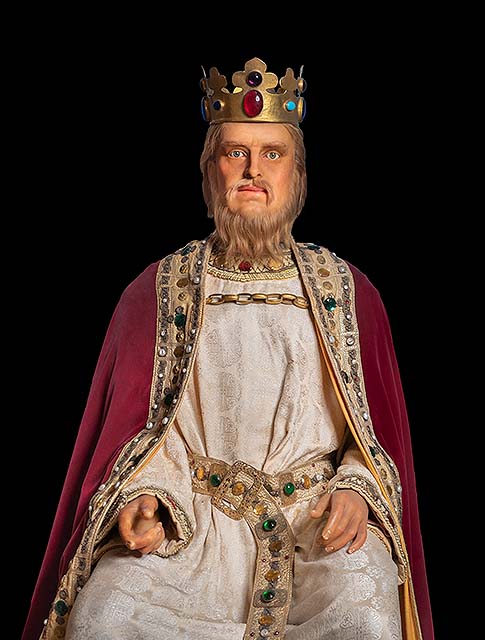
Above is the wax figure of John I, King of England found at Potter’s Wax Museum in St. Augustine, Florida.

My family line going back to King John I of England, is as follows:

  1. Beatrice Sotehill and Sir Thomas Markenfield.
  2. Henry Sotehill and Eleanor Moseley.
  3. Sir Henry Sotehill and Joan FitzWilliam.
  4. Sir William FitzWilliam and Maude de Cromwell.
  5. Sir Ralph Cromwell and Maud de Bernacke.
  6. Sir John Bernacke and Joan Marmion.
  7. Sir John Marmion and Maud de Furnival.
  8. Sir John Marmion and Isabel _____.
  9. Sir William Marmion and Lora de Dover.
  10. Rose (Rohese) de Dover and Sir Richard FitzRoy.
  11. King John I of England and his mistress Adela De Warenne.

King John I and his mistress Adela De Warenne were related. She was his half-first cousin. Being descended from this couple does make us related to many, many people, including royalty, historical figures, politicians, etc.

The above photo is Tudor Woman With A Candle by Lee Avison

The scandalous Barbara Wentworth. She was a sister to our ancestor, Thomas Wentworth. Both were the children of Roger Wentworth and Elizabeth Wentworth. I discussed Roger and Elizabeth earlier. Roger’s father, Thomas Wentworth, became the guardian of Elizabeth at age 13 after her father, John Wentworth, died, and he married her to his second son, Roger Wentworth.

Being from a cadet branch of the Wentworth family, Barbara’s family were considered of the minor nobility during the Tudor era.

When she was five years old, her parents arranged for her to be married to Anthony Norman, who was seven years old. Thereafter, the couple lived with Barbara’s parents.

Once Barbara reached the age of twelve, it was considered to be the age of consent for marriage to a Tudor woman. At the time, she stated that she would never accept Anthony as her husband. According to witnesses, her relations tried to persuade her to accept Anthony as her husband. She was not convinced despite the pleas from her family and expressed she could not “fynde it in hir harte to love hym.” It was said that some saw Anthony try to kiss her occasionally after returning from travels, but she always rejected his attempts.

When Barbara was about twenty-three years old, in 1549, she tried to have the marriage annulled. We can reasonably conclude that her reasons were because she wanted to marry someone else.

Documents regarding this case are available to read at York, including witness statements. Her husband, Anthony, fought against having the marriage annulled. His own witnesses aim to prove that the “lowe pepill” of the area considered them to be man and wife, and that they had lived together under the same roof up until five years prior.

The actual judgement documents are not available and have been lost to time, but the laws at the time were generally accepted to mean that marriages conducted between children were not valid unless both parties consented upon reaching the age majority and the union must have been consummated. The documents show that once Barbara was old enough, she did not consent to the marriage, and that it was not consummated.

A few months later, in January 1550, Barbara remarried, so we can conclude that her marriage to Anthony was deemed invalid. It appears that her new groom would have been able to know of the verdict and would not have taken her to be his wife, if he believed she was still legally married to Anthony. After all, the banns were called, and the marriage was performed in public.

The marriage banns were read at Adwick-le-Street in Christmas week 1549 for Barbara’s marriage to Robert Holgate, Archbishop of York, and evidently no objections were made. The wedding was at Bishopthorpe (where the Archbishops of York officially resided) on 15th January 1550.

The Church of England under the reign of Edward VI had no requirement for celibacy. He was aged sixty-eight when the marriage took place. He was old enough to be her grandfather!

We also have a connection to the Holgate family of Archbishop Robert Holgate. Our ancestor Thomas Wentworth, brother of Barbara Wentworth, had a great-grandson, Richard Wentworth, who married Anne Holgate.

We know that our ancestor Anne Holgate was baptized on 27 January 1603 at Royston, Yorkshire, England, as the daughter of Henry Hoalgate (Holgate). In Dugdale’s Visitation of Yorkshire, it shows that her father, Henry Holgate, was of Grimethorpe, Yorkshire. The distance between where Henry lived in Grimethorpe and where his daughter was baptized at Royston is 4.9 miles.

Archbishop Robert Holgate was born about 1482 in Hemsworth, Yorkshire. He was the son of Thomas Holgate and Elizabeth Champernon.

Hemsworth is 4.8 miles from Grimethorpe. There was a distant kinship between Archbishop Robert Holgate, and our ancestor, Anne Holgate Wentworth. She was born one-hundred and twenty-one years after the birth of the Archbishop.

Pictured above is Archbishop Robert Holgate.

It’s difficult to gauge Barbara’s feelings about marrying someone old enough to be her grandfather. During the entire resulting scandal, only the perspectives of the men are expressed. We can only make assumptions about Barbara’s thoughts. We might conclude that the marriage was likely her decision, since she initiated the annulment of her marriage to Anthony Norman in order to marry Archbishop Holgate.

The reasons why Archbishop Holgate wanted to marry are known. He married in order to prove his Protestantism to the skeptical Duke of Northumberland.

Her family appears to have been quite upset regarding the situation. It is impossible to determine if their anger stemmed from her annulment with Anthony or her union with the Archbishop. This period in England was one of significant upheaval, and not everyone supported the notion that clergy could abandon their vow of celibacy.

Barbara’s father’s will, created in 1551 just after her marriage to the Archbishop, does not mention her at all, as he bequeaths all his assets to his other three children. Nevertheless, her brother seems to have maintained a connection with her, as his own will names her as an executor.

It is rumored that Barbara had two children with the Archbishop, but there is no evidence to support this claim. This is not uncommon, as births were seldom recorded unless the child belonged to the highest ranks of the nobility. In 1558, a Robert Holgate from Yorkshire entered Christ’s College, Cambridge. He may have been a son of Robert Holgate and Barbara Wentworth.

Their lifestyle appears to have been quite comfortable. The archbishop was influential and affluent, suggesting that Barbara enjoyed the privileges of a noblewoman, including luxurious clothing, exquisite cuisine, and numerous servants at her service. The inventories of the Archbishop revealed lavish items such as Turkish carpets, beds filled with down feathers, and gold dishes among their luxuries.

Two years following the marriage between Barbara and the Archbishop, Anthony went to the king’s council seeking to reclaim Barbara. Anthony was in significant debt. Did Anthony want her back because he truly loved her? Or did he believe he might receive financial restitution for the “losses” he had endured?

His lawsuit must have been rejected, as the Council called for an investigation, and nothing further was heard about it. Later, the council awarded funds to the Archbishop and his wife together, indicating that their union likely received their formal endorsement.

Following the death of the Protestant King Edward in 1553, there was a last-ditch effort by the Duke of Northumberland to install his daughter-in-law Jane Grey as queen, but ultimately, the Catholic Queen Mary ascended to the throne.

When Queen Mary ascended to the throne in 1553 and reinstated Catholicism in England, Holgate was imprisoned in the Tower and subsequently lost his position for violating his vow of celibacy. In March 1554, all his assets, including jewelry and silverware, were confiscated. In addition to his opulent decorations, the Archbishop possessed a significant number of livestock, including 2,500 sheep and “four or five score” horses. Everything was sold prior to any official accusations being made against him, about which he later expressed great dissatisfaction.

In the latter months of 1554, Archbishop Holgate composed a letter of “apology” to the Queen, admitting to his transgressions and renouncing them. He stated that he had made an unwise marriage, setting a poor example, but claimed he wedded Barbara only to avoid being labeled a papist by the Duke of Northumberland. He sincerely expressed remorse for this and implored the queen for her pardon. The Queen forgave him. After paying the crown £1,000 for his offenses, and a bond of 20,000 marks required by the Queen to assure his “good behavior.” Holgate was released from the Tower in January 1555 but was never allowed to resume his priestly office. But he did regain many of his estates – at Yeddingham, Huggate, Hemsworth, Malton and York, promising to use his assets for charitable purposes. He passed away in London that November, leaving a will proved 5th December 1556.  

During his life, he established three grammar schools in Hemsworth, where he was born. Later, in the late nineteenth century, the school moved to Barnsley; ironically, its old Hemsworth buildings are now the Catholic Church of the Sacred Heart. He also established schools in Malton, where he had served as Prior of the Gilbertines, and York.

In his will of 1555, he provided that almshouses should be built to provide for persons aged 60 years or over from the ancient parishes of Hemsworth, Felkirk, South Kirkby, and Wragby. Originally located near the Hemsworth church, they were relocated to a new location on the outskirts of Hemsworth in 1860. Today, Archbishop Holgate’s Hospital provides 24 self-contained homes for its almspeople. Barbara Wentworth Holgate is not mentioned in the will of her husband.

So, what became of Barbara? The documentation regarding her concludes with the Archbishop’s decision to renounce their marriage. A 19th-century author suggested that she went back to Anthony and was reunited with him as his wife, but there is no proof to back up that claim.

It is likely she never married again. Individuals opposed to married clergy might have viewed her as lacking in morals. Additionally, there were likely some who believed she was rightly considered Anthony’s spouse.

Photo above is of The Manor House, at Scrooby in the 1920s.

It is believed that she owned Scrooby in 1558, due to the grant that provided her joint ownership with the Archbishop. She probably kept the estate for the remainder of her life and relied on its income for support.

We do not know the date of Barbara’s death or where she is buried. I like to think of Barbara as being a strong woman of her time. As we are currently celebrating Women’s History Month in the month of March, I felt it was a perfect time to write about her. She endured years of pressure from her family to accept the marriage to Anthony Norman, a man they had selected for her, but she refused to give in. She then filed a lawsuit for an annulment of her marriage in the church courts. By marrying the Archbishop, she disobeyed her family and the local religious conservatives and would have faced a great deal of social rejection, and possibly downright animosity. Her husband, Archbishop Holgate, for whom she had made so many sacrifices, subsequently rejected her, claiming that he had only married her to keep from being perceived as a Catholic.

Wenworth and Holgate Surname Meanings:

Wentworth. An English surname, a habitational name from Wentworth in Yorkshire. The placename probably derives from the Old English personal name Wintra + Old English worth ‘enclosure’. (3)

Holgate. An English surname from Middle English hol(e) ‘hollow’ + gat(e)gate ‘path, road’. The name may be topographic, for someone who lived by a ‘hollow road’, or habitational from any of several places so named, such as three places called Holgate in Yorkshire. (4)

My direct line, beginning with the ancestors I share with Barbara Wentworth Holgate:

  1. Roger Wentworth and Elizabeth Wentworth.
  2. Sir Thomas Wentworth and Elizabeth Flinthill.
  3. Sir Thomas Wentworth and Ursula Swinnowe.
  4. Sir William Wentworth and Margaret Hales.
  5. Richard Wentworth and Anne Holgate.
  6. Thomas Wentworth and Isabell Joynson.
  7. Sarah Wentworth and Daniel Mathena (Matheny).
  8. Susanna Matheney and John Davis.
  9. Susannah Davis and Charles Thomas.
  10. Mary Thomas and Jeremiah York.
  11. Lydia York and James Watts.
  12. Lydia Watts and Lewis Gooden.
  13. Mary Ann Gooden and McGuire Doughty.
  14. John Louis Doughty and Cynthia Ann Barrett.
  15. Mary Adalaide “Mame” Doughty and James Francis Fay (my great-grandparents).
This image has an empty alt attribute; its file name is tudor-roses.jpg

References:

  1. Wentworth Family – Tudorplace.come.ar
  2. (WMB). English Origins of New England Families; Second in Three Volumes; Vol III; Genealogical Publishing Co., Inc.; 1985; pg 665.
  3. Wentworth Surname Meaning. ancestry.com
  4. Holgate Name Meaning. familysearch.org

Additional sources:

  1. The Scandalous Barbara Wentworth. The History Geeks. facebook.com

To learn more about our Wentworth family in general and our kin that went to New Hampshire:

  1. Wentworth Family. en.wikipedia.org
  2. The Wentworth Takeover: How One Family Dominated Portsmouth and New Hampshire 1715-1775. portsmouthathenaeum.org
  3. The rise and fall of NH’s first family at Portsmouth Athenaeum by Sherry Wood. seacoastonline.com

To learn more about King John I of England:

  1. John Lackland (r. 1199-1216). royal.uk
  2. John (c.1167 – 1216). bbc.co.uk
  3. John of England. simple.wikipedia.org

To learn more about Archbishop Robert Holgate:

  1. Robert Holgate, Archbishop. historyofyork.org.uk
  2. Tudor Minute November 15, 1555: Robert Holgate Died by Heather Teyskor. englandcast.com
  3. The Last Will of Robert Holgate alias Halgate, Doctor of Divinity and late Archbishop of York. archbishopholgatehospital.org
  4. Archbishop Robert Holgate and his Hospital. onceiwasacleverboy.blogspot.com
  5. Robert Holgate. en.wikipedia.org

If you use any information from my blog posts as a reference or source, please give credit and provide a link back to my work that you are referencing. Unless otherwise noted, my work is © Anna A. Kasper 2011-2025. All rights reserved. Thank you.
Posted in Famous Kin, Genealogy, Religious | Tagged , , , , , , , , , , , , , , , , , , , , , , , , , , , , , , , , , , , , , , , , , , , , , , , , , , , , , , , , , , , , , , , , , , , , , , , , , , , , , , , , , , | 3 Comments

Surname Saturday: My Cock Ancestors of Southwold, Suffolk, England

My maternal 12th great-grandmother is Christian Cock. She was born about 1560 in Southwold, Suffolk, England, and died before 3 November 1612 in Somerleyton, Suffolk, England. She married about 1580 in Southwold, Suffolk, England, to Thomas Gentleman. After her husband’s death, she married secondly on 3 June 1600 in Somerleyton, Suffolk, England, to Thomas Harrison. She married twice and had six known children by her first husband and two more by her second husband.

Christian Cock and Thomas Gentleman are my direct ancestors. Thomas Gentleman was the son of William Gentleman and Margaret Balden. There is much more known about my Gentleman ancestors of Dunwich and Southwold, and we can take those lines back much further. I will write about my Gentleman ancestors in the future.

Christian Cock was the daughter of John Cock, who was born about 1540 in Suffolk, England, and died after 27 December 1598 in Southwold, Suffolk, England. Not much is known about her father, John Cock, but he was named in the will of her first husband, Thomas Gentleman, who left him a gold ring. So, we know that he had a cordial relationship with his son-in-law.

There was a will of John Cock of Southwold made on 22 May 1614, and it names all the children of Thomas Gentleman and Christian Cock. However, the wording of the will makes it more likely that this was the will of Christian Cock’s brother or another close relative, rather than that of her father. As well as the fact that her father had died some years before, this will was written, making it highly likely it was the will of her brother or other close kin.

In the 1600s, Southwold, England, was a fishing port town with Puritan emigrants and a history of radicalism. Many Puritans emigrated from Southwold to the Massachusetts Bay Colony in the 1630s. In 1643/44, Puritanical vandals destroyed 130 pictures and four crosses in the church vestry. My ancestors in Southwold were not Puritans; they were members of the Church of England. Southwold’s economy was based on fishing in the 17th and 18th centuries. The town exported fish to London, Iceland, and the continent. In 1659, a fire destroyed almost the entire town in four hours. When the town was rebuilt, it included large green spaces to prevent future fires. 

Southwold was called Sudwolda in 1086 and Sudwald in 1227. From the Old English language, the name means the south woodland or forest.

Although there are no variations of the Cock surname in the few records available for my ancestors, the name can have variants of Cox, Cocke, and sometimes even Cook and Cooke. The origins of the surnames Cox and Cocke are the same as Cock. Whereas Cook(e) has a different meaning, deriving from a person with the occupation of cook, so it is not related to the surname Cock.

I do have Cox ancestors in my tree that were from England and settled in Colonial Maryland, and I will write about them at some time in the future.

The name has a few origins. First, it may have derived from a nickname given to someone proud or that strutted like a male chicken or an occupational name for someone who kept cocks. From the medieval nickname cok, meaning rooster, cock. The nickname was commonly added to given names to create diminutives such as Hancock or Alcock. It is also another term for a young lad. As cock became a common term for a boy, it may also have been used affectionately as a personal name. Another possibility is that it originated from the Anglo-Saxon word cocc, meaning haycock, heap, or hillock; dweller by the hill or hillock. It could also be from Middle English cok cok(k)e, meaning ship’s boat, and so perhaps used for a boatman. Lastly, in London, it could have been a name for someone who lived or worked at a house or inn known as The Cock from a sign depicting a haycock or mound, a boat, or a cock bird. (1, 2, 3, & 4)

I cannot be sure of the exact origins of the surname Cock in my family tree, but Southwold was a fishing village, and the Gentleman family were fishermen that owned fishing boats. It is possible that both the Cock and Gentleman families worked as fishermen, and that the Cock family’s name came from ship’s boat, and they were boatmen. But any of the above-mentioned origins of the surname could be possible.

My Cock and Gentleman ancestors are on my maternal side and are related to my Davidson and Gilman ancestors that I have written about prior.

My direct line:

  1. Christian Cock and Thomas Gentleman.
  2. Margaret Gentleman and Richard Ibrook, Jr. “Eyebrooke”
  3. Ellen “Helen” Ibrook Eyebrooke and Capt. Joshua Hobart.
  4. Deborah Hobart and Joshua Lincoln.
  5. Deborah Lincoln and John Lazell.
  6. John Lassell and Jael Cushing.
  7. Jael Lassell and Christopher Davison.
  8. Asa Davidson and Hopestill Hawley.
  9. Asa Davidson, Jr. and Catherine Cunningham.
  10. Mary Ann Davidson and Jacob (John Jacob) Doman.
  11. Sarah Jane “Jennie” Doman and Daniel Prindle.
  12. Anna Cora Prindle and Joseph Edward Cole (my maternal great-grandparents).

References:

  1. Cock last name popularity, history, and meaning. Name Census.
  2. Origin, popularity and meaning of the last name COCK. Geneanet.
  3. Last name: Cock. The Internet Surname Database.
  4. Cock Name Origin, Meaning and Family History. Your Family History: Surnames.

Further reading:

  1. Suffolk Village Signs: Southwold.
  2. Suffolk Heritage Explorer. Map of Southwold in the 16th century.
  3. Battle of Solebay. Wikipedia. An important battle fought in 1672 near Southwold.
  4. Doig, Sarah E., Battling the Elements: Southwold’s Changing Fortunes. A thousand years history.

If you use any information from my blog posts as a reference or source, please give credit and provide a link back to my work that you are referencing. Unless otherwise noted, my work is © Anna A. Kasper 2011-2025. All rights reserved. Thank you.


Posted in Genealogy, Religious | Tagged , , , , , , , , , , , , , , , , , , , , , , , , , , , , , , , , , , , | Leave a comment

Surname Saturday. My Hicks ancestors of Southwark St Olave, England & Colonial Rhode Island, New York & Maryland & Our Hicks Cousin Willis Carrier.

1954 Carrier Air Conditioner Ad "The New Silhouette" Description: 1954 CARRIER CORPORATION vintage print advertisement.
Above photo is 1958 Carrier Air Conditioner Vintage Ad. Willis Carrier is our Hicks cousin.

My sixth great-grandmother is Rebecca Hicks. She married John Armstrong, Jr. on 26 August 1714 at St Johns Parish, Joppa, Maryland. Joppa is a former colonial town in Maryland. He was the son of John Armstrong and Jane Boone.

She was born at about 1698, making her 16 years old when she married. She was the daughter of William Hicks and Jane ____. I have not seen any documentation showing the maiden name of Jane, wife of William Hicks.

She has sometimes been listed in many trees as being the daughter of William Hicks and Jane Ellery, both born in Devon, England. Her father was William Hicks, but he was not born in Devon, England. He was born in Colonial New York, and his wife’s name was Jane, but not Jane Ellery. Jane Ellery, who married William Hicks in Devon, England, remained in England, where both she and her husband died. This couple never came to Colonial Maryland. 

Many researchers mention in their notes that Rebecca Hicks’ parentage is in question. The will of William Hicks names sons William, James, Nehemiah and Henry. William’s will was dated 11 November 1710 and proved 30 December 1710. His wife Jane administered the estate.

After his death, his widow Jane married second to Thomas Cutchin on 28 October 1713 in Joppa, Maryland.  

Rebecca Hicks is listed at the bottom of the Hicks family history, Baltimore County Maryland Families, but only with the information that she married John Armstrong

The image above is of the writ of obligation between Elizabeth Hicks, her mother Jane Cutchin, brother-in-law John Armstrong and nephew William Armstrong.

Although there are no daughters mentioned in the will of William Hicks, in the record shown above and cited below, it proves he had at least 2 daughters, Elizabeth and Rebecca. We know that William Hicks died in 1710, and his widow Jane married Thomas Cutchin.

In a document dated 30 January 1723 and found in Baltimore County records, Elizabeth Hicks gave to her mother, Jane Cutchin, the following, saying in this writ of obligation, “one Bright Bay mare with a starr in her forehead and the first colt that this said mare brings is to be given unto William Armstrong son to John Armstrong which said mare shall belong to the said Jane Guggin [Cutchin] during her life and after her death to fall unto Elizabeth Hicks with all her offspring except for said mentioned colt. but in case the said Elizabeth Hicks go to Virginia after her marriage and return unto this county again, then the foresaid mare shall be delivered unto the said Elizabeth Hicks and her husband.

It does not mention her sister by name, my ancestor, Rebecca Hicks Armstrong, but it does mention Rebecca’s husband, John Armstrong, and her son, William Armstrong (who is also my direct ancestor). Rebecca named her son William after her father and also named a son Nehemiah after her brother, who is mentioned in their father’s will. I also have a DNA connection to the descendants of Nehemiah Hicks.

Rebecca’s father, William Hicks, was born about 1677 in New York. He married Jane ___ about 1694 in Maryland. He died 11 November 1710 in Baltimore, Maryland.

William Hicks was the son of Thomas Hicks and Mary Doughty. Upon seeing her maiden name was Doughty, I thought she could possibly be a descendant of my Mayflower Pilgrim ancestor, Edward Doty. But that is not the case. She was born in Flushing, New York, which is now a part of Queens. She was the daughter of Elias Doughty and Sarah ____. Elias Doughty was born in Oldbury, Gloucestershire, England, and was the son of Puritan minister Rev. Francis Doughty and Bridget ____. The Doughty lines can be taken back several more generations and I will write about these Doughty ancestors in the future.

Thomas Hicks was born about 1640 in either Weymouth, Massachusetts, or Newport, Rhode Island. His parents lived two years in Weymouth before migrating to Newport.

He was the first judge of Queens County New York and filled that office for many years. In 1666 he obtained from Governor Nicolls a patent for four thousand acres of land including Great Neck Long Island and lands adjacent and lived there in English manorial style. He was married twice, both wives were named Mary. His first wife being Mary Butler (widow of John Washburn), by whom he had two sons, Thomas and Jacob.

The famous Quaker preacher Elias Hicks, the founder of that branch of the Society of Friends known to this day as Hicksites, was the son of John Hicks and Mary Smith. He was the grandson of Jacob Hicks and Hanah Carpenter, and the great-grandson of Thomas Hicks and his first wife Mary Bulter.

Elias Hicks is my 2nd cousin, 7x removed, meaning he and my 5th great-grandfather, William Armstrong, were direct 2nd cousins.

Thomas Hicks married secondly to Mary Doughty, with whom he had ten children; six sons: Isaac, William, Stephen, John, Charles, Benjamin and four daughters: Phebe, Charity, Mary and Elizabeth. A paragraph in the New York Post Boy of 24 January 1749 referring to the death of Judge Hicks says he left behind him his own offspring above three hundred children, grandchildren, great-grandchildren, and great-great-grandchildren, dying well into his 90’s.

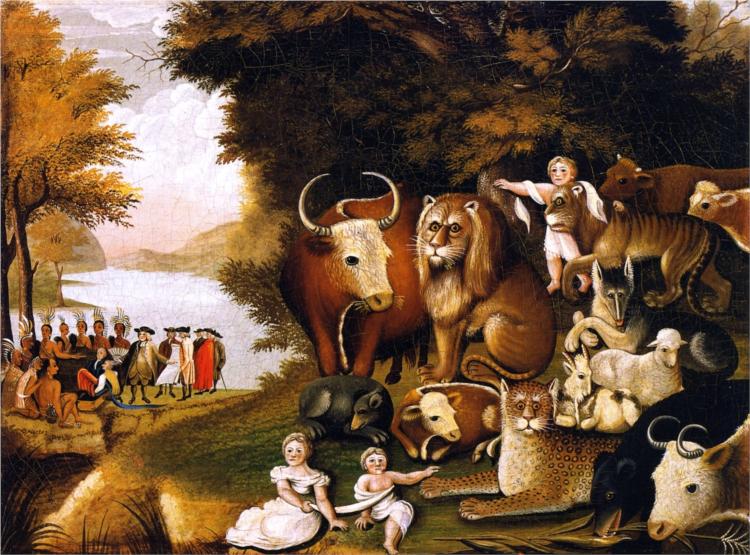
Artwork above is Peaceable Kingdom, by Edward Hicks, 1834,

American folk painter and distinguished Christian Quaker minister Edward Hicks was the son of Isaac Hicks and Catherine ____. He was the grandson of Gilbert Hicks and Mary Rodman, great-grandson of Issac Hicks and Elizabeth Moore, and the great-great-grandson of Thomas Hicks and second wife Mary Doughty. He became a notable Quaker because of his paintings.

He painted variations on the Quaker theme of peace and brotherly love throughout his life, as exemplified by his more than sixty versions of the Peaceable Kingdom, he also apparently offered artistic instruction. Hicks reportedly taught his younger cousin Thomas Hicks, and the Bucks County Intelligencer in 1864 reported that, as a youth, the academic painter Martin Johnson Heade was “placed under the instruction of Edward Hicks…to be taught the art of painting.” (5)

Edward Hicks is my 3rd cousin, 6x removed, meaning he and my 4th great-grandfather Nathaniel Shepherd Armstrong were direct 3rd cousins.

Thomas Hicks was the son of John Hicks and Herodias Long. John Hicks was born in Southwark St Olave, which is now part of the modern London Borough of Southwark.

Southwark St Olave was an ancient civil and ecclesiastical parish on the south bank of the River Thames, covering the area around where Shard London Bridge now stands in the modern London Borough of Southwark, ultimately named after St. King Olaf II of Norway. The boundaries varied over time, but in general the parish stretched east from London Bridge past Tower Bridge to St Saviour’s Dock. Southwark St Olave and St Thomas replaced the civil parish in 1896. It was abolished in 1904 and absorbed by Bermondsey parish. (1)

The parentage of John Hicks is unproven. We are able to glean some information about him from his marriage record in England.

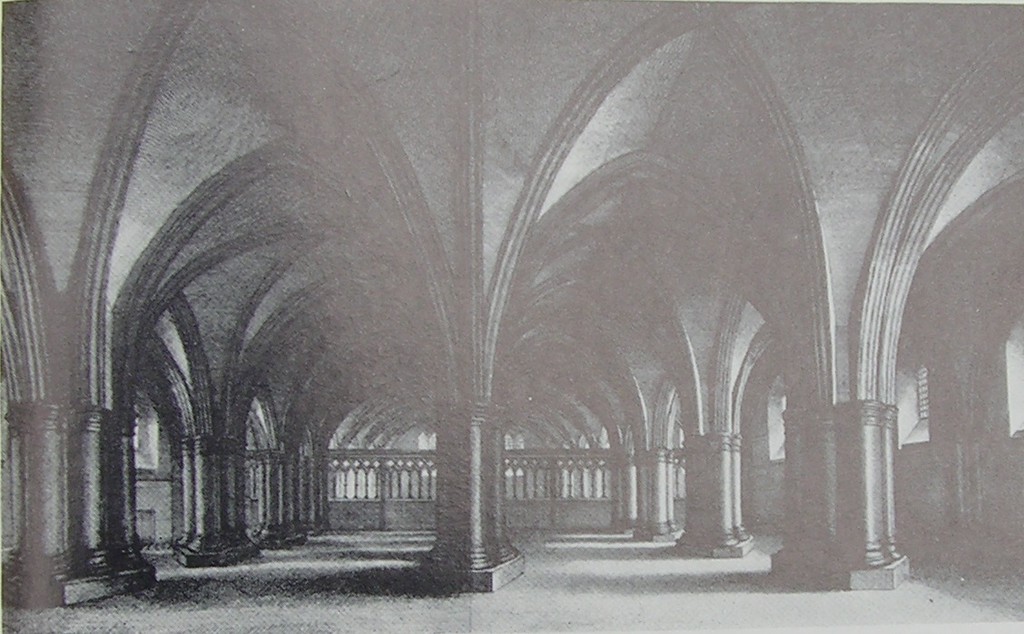
Image above is a print of The Church of St. Faith, The Crypt of Old St. Paul’s, From a View by Hollar.

He married on 14 March 1637 at St Faiths Church, London, England to Harwood (Herodias) Long, the daughter of William Long:

March 14, 1636/37: Wch date, appeared p[er]sonally John Hicke of ye parish of St. Olaves in Southwark Salter and a batchelour aged about 23 yeares and alledged that he intendeth to marrie with Harwood Long spinster aged about 21 yeares ye daughter of William Long Husbandman who giveth his Consent to this intended marriage And of ye truth of the pr[e]mises as also that he knows of no Lawfull let or impediment by reason of anie pr[ior] contract Consanguinity affinitie or otherwise to hinder this intended marriage he made faith and desires license to be married in ye parish Church of St ffaith London [signed] John Hicke. (3)

Based on his marriage record, he was about 23 years old, which makes his year of birth about 1614, and we know he was from the parish of St. Olaves in Southward Salter. St Olave’s Church, Southwark was a church in Southwark, England which is believed to be mentioned in the Domesday Book of 1086. It was located on Tooley Street. It was demolished in 1926 and is now the location of St Olaf House, which houses part of the London Bridge Hospital. (2)

They were married in the under church of Old St. Paul’s Cathedral, called St. Faith’s church. There is a Chapel of St. Faith located today in the cathedral’s crypt. Old St Paul’s was destroyed in the Great Fire of 1666. The dedication is to St. Faith, the virgin martyr of Aquitaine, who suffered martyrdom in the time of Diocletian.

The origin of the surname Hicks derives from the given name Hicke and means son of Hick. This name is of English origin and widespread throughout England. The name Hicke is a variant of Richard. Ric means power and hard, meaning strong. It is of Norman origin from the Middle English personal name Hikke, a rhyming pet form of Ricard, a Norman-Picard form of Richard. (4)

There are at least seven people listed as famous descendants of Herodias Long and her partner, George Gardiner. I only found a few famous people descended from Herodias Long and first husband, John Hicks. The first being Willis Carrier, descended from Hannah Hicks Haviland. The others, Elias Hicks, and Edward Hicks, that I discussed earlier, are descendants of Thomas Hicks.

Willis Carrier was an American engineer who is best known for inventing modern air conditioning. He invented the first electrical air conditioning unit in 1902. It was designed to provide a convenient indoor atmosphere in his publishing house to prevent papers from expanding and contracting. In 1915, he founded Carrier Corporation, a company specializing in the manufacture and distribution of heating, ventilation, and air conditioning (HVAC) systems.

The direct ancestors of Willis Carrier are Hannah Hicks and William Haviland. Hannah Hicks Haviland was a sibling of my ancestor Thomas Hicks, both being children of John Hicks and Herodias Long.

I live in the high desert of NW Arizona. This summer I will be quietly thanking my Hicks cousin as my HVAC unit keeps me and my kitty Snickers cool!

There is far too much I could write about the lives of Herodias Long and John Hicks; therefore, I decided to write about them in another entry just about them.

My direct line from John Hicks and Herodias Long:

  1. John Hicks and Herodias Long.
  2. Thomas Hicks and Mary Doughty.
  3. William Hicks and Jane ____.
  4. Rebecca Hicks and John Armstrong.
  5. William Armstrong and Elizabeth Shepherd.
  6. Nathaniel Shepherd Armstrong I and Hannah Norris.
  7. John A. Armstrong and Sarah “Sally” Norris.
  8. Bradford Carroll Armstrong and Martha A. Knight Lyons.
  9. George Pendleton Armstrong and Alice Elizabeth Nutick (my great-grandparents).

References:

  1. Southwark St Olave. Wikipedia.org
  2. St Olave’s Church, Southwark. Wikipedia.org
  3. Ancestry.com. London and Surrey, England, Marriage Bonds and Allegations 1597-1921, Vol. 19: pg. 92, indexed under John Hicke. Ancestry Sharing Link.
  4. Hicks Name Origin, Meaning and Family History. your-family-history.com
  5. Edward Hicks. National Gallery of Art.

To learn more about Willis Carrier:

  1. Willis Carrier, Innovator. Who Made America? pbs.org
  2. Meet the Inventor of Modern Air Conditioning. The Story of a Company | The Standard of an Industry. williscarrier.com
  3. The Long, Hot Road To Modern Air Conditioning. By Sam Sanders. npr.org
  4. The Unexpected History of the Air Conditioner. The invention was once received with chilly skepticism but has become a fixture of American life. By Haleema Shah. smithsonianmag.com

To learn more about the Chapel of St. Faith:

  1. St Faith under St Paul’s. Lost London Churches Project.
  2. St Faith under St Paul’s. The Worshipful Company of Church Clerks.

To learn more about St. Faith:

  1. Saint Faith. All Saints and Martyrs. saintscatholic.blogspot.com
  2. Saint of the Day: St. Faith. aleteia.org

If you use any information from my blog posts as a reference or source, please give credit and provide a link back to my work that you are referencing. Unless otherwise noted, my work is © Anna A. Kasper 2011-2025. All rights reserved. Thank you.

Posted in Famous Kin, Genealogy | Tagged , , , , , , , , , , , , , , , , , , , , , , , , , , , , , , , , , , , , , , , , , , , , , , , , , , , , , , , , | Leave a comment

My English Gilman Ancestors and My Famous Cousin U.S. President Abraham Lincoln.

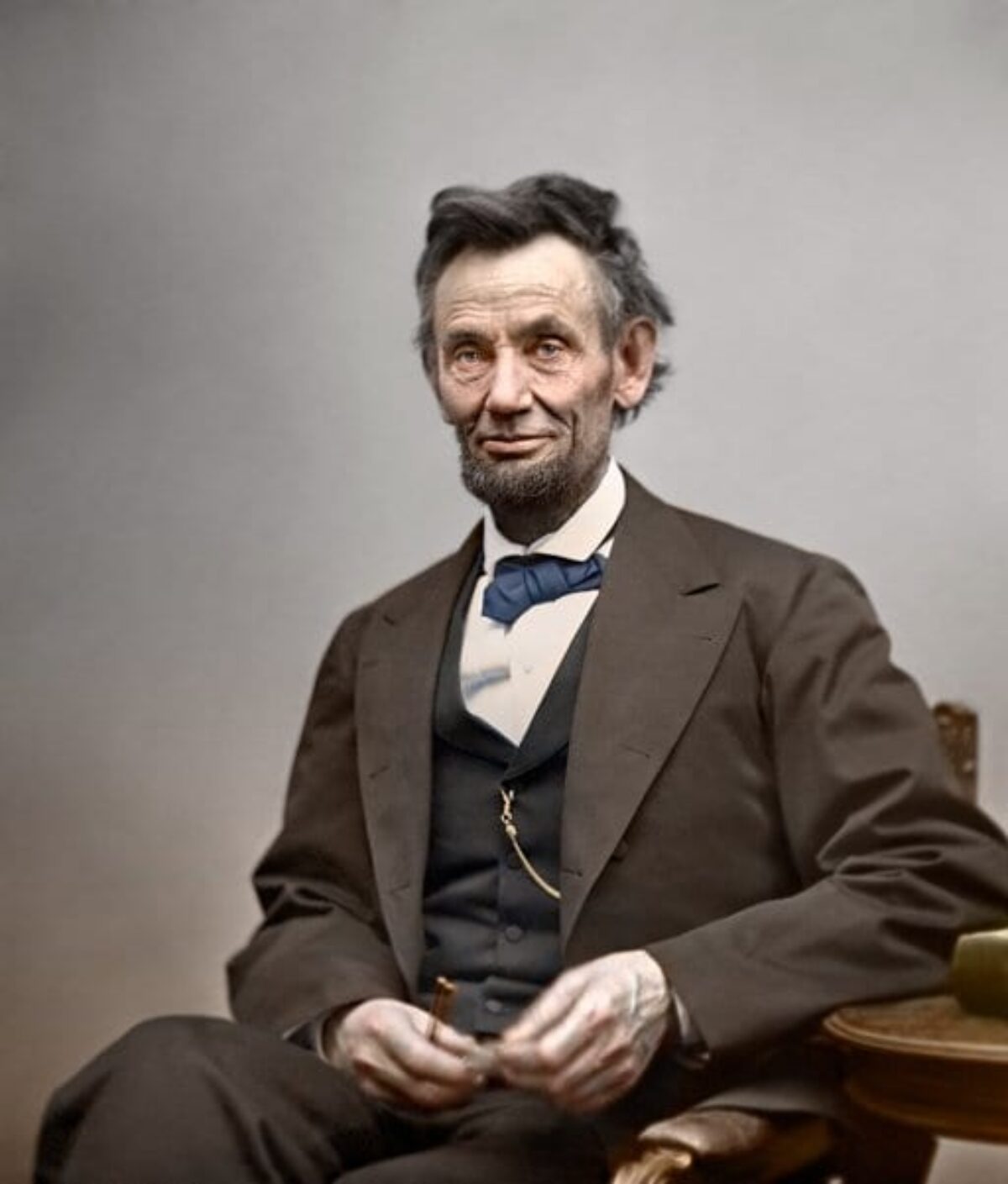
Photo above is a colorized version of a B&W photo of our 16th U.S. President Abraham Lincoln.

Abraham Lincoln has always been one of my favorite U.S. Presidents. When I traveled to Washington, D.C. in the spring of 2000, I made sure to visit the Lincoln Monument, Ford’s Theater, and the house across the street where he died. So, I was quite thrilled to discover my connection to him.

This link to Abraham Lincoln is something that I only recently discovered. Partly because it was previously thought by many that my 10th great-grandmother’s maiden name was Clark, and I didn’t make the Gilman connection. She had been confused with Mary Gilman, daughter of emigrants Edward and Mary (Clark) Gilman who was baptized in 1615, but the following evidence indicates she was a sister to Edward Gilman:

Proof that Nicholas Jacob’s wife was Edward Gilman’s sister is found in the Proprietors’ Records of Hingham, Mass., Book A., folio 32. Nicholas Jacob, in 1638, gave one of the tracts granted to him by the town ‘unto Edward Gillman his brother-in-law.’ Edward Gilman’s wife was Mary Clark. Nicholas Jacob’s wife was also named Mary. Hence, if we dismiss the very unlikely hypothesis that Mary Clark had a sister who was also named Mary, the wife of Nicolas Jacob must have been Mary Gilman, sister of Edward. (1)

My maternal 10th great-grandparents are Mary Gilman and Nicholas Jacob.

The parentage of Nicholas Jacob is unknown and unproven. He was born about 1604 in Hingham, Norfolk, England, and died 5 June 1657 in Hingham, Massachusetts. At the time Hingham was in Suffolk County, it is now in Plymouth County, Massachusetts. He and Mary Gilman married about 1628 in Hingham, England.

Mary Gilman was the daughter of Edward Gilman and Margaret James. She was born in Hingham, Norfolk, England, and died 15 June 1681 in Hingham, Massachusetts.

In the 1600s, Hingham, England was an agricultural town in the countryside. It was located near Wymondham and had many windmills and inland water traffic. 

Her father Edward Gilman was baptized on 20 April 1557 in Caston, Norfolk, England, the family was of Hingham and Caston, which are a distance of 6.4 miles away from each other. The baptism record reads as follows:

Edward Gyllman ye sonn of Edward gyllman was baptised ye xxth day of Aprill A[nn]o predicto (2)

The Gilman surname is derived from the baptismal name Gilmyn. It indicated that the bearer of the name was the son of (or descended from) someone named Gilmyn. The name is of Norman origin, and was brought to England in the wake of the conquest after the Battle of Hastings in 1066. (5)

He died before 15 May 1621 at about age 64 in Caston, Norfolk, England. He was the son of Edward Gilman and Rose (Ryse) Snell. His father, the elder Edward Gilman, is the furthest we can take the Gilman line back in England.

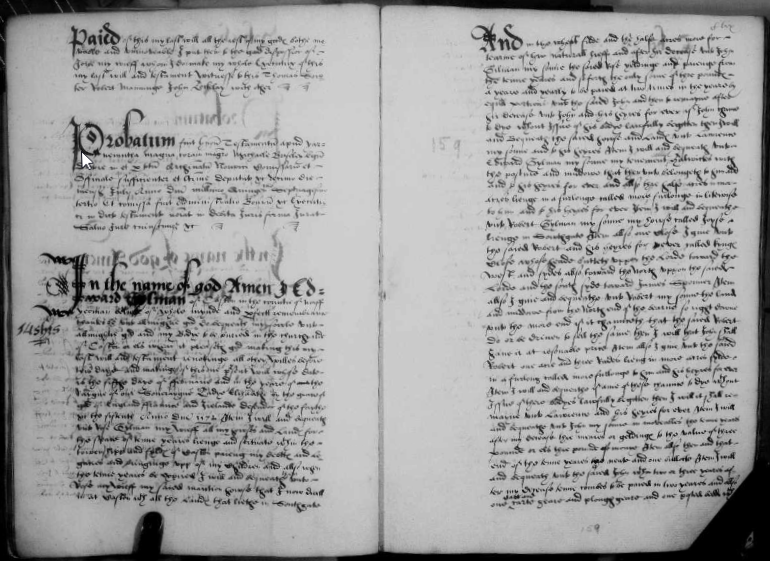
Photo above is of the will of the elder Edward Gilman.

The will of the elder Edward Gilman was dated 5 February 1572/3 and proved by his widow on 7 July 1573 at the Archdeaconry Court of Norwich. In this will he, “devised his mansion house in Gaston (sic.) to his eldest son John, and his other estates were divided among his three other sons and five daughters.” Lands at Saham Toney are mentioned in the will as well. (3 & 4)

In the 1600s, Caston, Norfolk, England was home to Edward Gilman, a prosperous yeoman. Puritans also had a presence in the area, and the village green’s medieval stone cross was damaged by them.

Although we don’t know much else about the Edward Gilman, we can glean from his will that he was a man of some means, for he left his mansion house in Caston to his eldest son John and other lands are mentioned in the village of Saham Toney. The distance between Saham Toney and Caston is 5.5 miles.

His son, my direct ancestor, Edward Gilman was the second born son, meaning that his older brother John Gilman is the one that inherited the mansion house and the main lands. Although the will does divide the remaining lands between all the siblings.

Edward Gilman and Margaret James had several children:

  1. Bridget Gilman, born about 1582; married Edward Lincoln of Hingham.
  2. Edward Gilman (known as the Emigrant), born about 1587 (he was age 50 in 1637), married Mary Clark.
  3. Robert Gilman, son of Edward Gylmmynne of Hingham, married 1st in Hingham on 14 May 1611 to Rose Hawes; married 2nd to widow, Mary Bruen.
  4. John Gilman, married Ann Guerney.
  5. Mary Gilman, born between 1599 and 1604, married Nicholas Jacob.
  6. Margaret Gilman, baptized Hingham, Norfolk, 1 August 1602.
  7. Sarah Gilman, baptized Hingham, England on 4 October or December 1603.

Bridget Gilman who married Edward Lincoln are the ancestors of Abraham Lincoln. My ancestors are Mary Gilman and Nicholas Jacob. His ancestors stayed in Hingam, England for one more generation, whereas mine migrated to Massachusetts earlier.

President Abraham Lincoln’s direct line from Edward Gilman and Margaret James:

  1. Edward Gilman and Margaret James.
  2. Bridget Gilman and Edward Lincoln.
  3. Samuel Lincoln and Mary Lyford.
  4. Mordecai Lincoln and Sarah Jones.
  5. Mordecai Lincoln, Jr. and Hannah Salter.
  6. John Lincoln and Rebecca Flowers.
  7. Capt. Abraham Lincoln and Bathsheba _____.
  8. Thomas Lincoln and Nancy Hanks.
  9. Pres. Abraham Lincoln.

My direct line from Edward Gilman and Margaret James:

  1. Edward Gilman and Margaret James.
  2. Mary Gilman and Nicholas Jacob.
  3. Capt. John Jacob and Mary Russell.
  4. Jael Jacob and Matthew Cushing.
  5. Jael Cushing and John Lassell.
  6. Jael Lassell and Christopher Davison.
  7. Asa Davidson and Hopestill Hawley.
  8. Asa Davidson, Jr. and Catherine Cunningham.
  9. Mary Ann Davidson and Jacob (John Jacob) Doman.
  10. Sarah Jane “Jennie” Doman and Daniel Prindle.
  11. Anna Cora Prindle and Joseph Edward Cole (my maternal great-grandparents).

This means that Pres. Abraham Lincoln and I are 7th cousins, 5x removed. My ancestor Mary Ann Davidson Doman and Abraham Lincoln were direct 7th cousins. It is not a super close connection, I have much closer connections to other politicians and people in history, but it brings me great joy none the less. 😊

References:

  1. Clarence Almon Torrey, “English Origin of Edward1 Gilman” in The American Genealogist, 11 (1934):137-138, at 138; digital images by subscription, AmericanAncestors.
  2. Baptism: “Norfolk, England, Church of England Baptism, Marriages, and Burials, 1535-1812”
    Norfolk > Caston > 1539-1720 > image 8 of 36 Norfolk Record Office; Norwich, Norfolk, England; Norfolk Church of England Registers.
  3. Will of Edward Gillman, yeoman of Caston: Archdeaconry Court of Norwich, register copy will 1573, volume Bussell, folio 158. Norfolk Record Office, Norwich, Norfolk, England.
  4.  Scott, Nadine Gilman. 2000. Edward Gilman Jr. Begat…. 711 p.
  5. Etymology of Gilman, House of Names.

If you use any information from my blog posts as a reference or source, please give credit and provide a link back to my work that you are referencing. Unless otherwise noted, my work is © Anna A. Kasper 2011-2025. All rights reserved. Thank you.

Posted in Famous Kin, Genealogy | Tagged , , , , , , , , , , , , , , , , , , , , , , , , , , , , , , , , , , , , , , | 1 Comment

Surname Saturday: My Fünfstück ancestors of Gleiszellen and Klingenmünster, Germany

I have a TON of paternal German ancestors from in and around Klingenmünster, Germany. There was lots of intermarriage among the same families, and thus I descend twice from several of the same couples. Many of the surnames are more common ones such as Weiss, Wendel, Fried, Hacker/Hecker, Bohrer, Ohl, Willem, etc. But there are some surnames that are less common such as Propheter, Weinmann, Sartor, Sambach, LeBeau, etc. Then there are the ones that are actually much rarer, such as Fünfstück.

How we get back to my Fünfstück ancestors is via my paternal fifth great-grandmother Maria Katharina Sambach.

Maria Katharina Sambach was born 1 June 1765 and died 29 January 1832 in Gleiszellen. She was baptized in Klingenmünster. Gleiszellen is 1.1 miles from Klingenmünster. She married on 11 Oct 1785 in Klingenmünster to Peter Wendel, who was the son of Johannes Wendel and Anna Maria _____.

Maria Katharina Sambach was the daughter of Johannes Sambach and Maria Magdalena Fünfstück. Maria Magdalena Fünfstück was born about 1742. She was the daughter of Georg Fünfstück. Nothing more is known about Georg Fünfstück and that is the furthest I can take the line back in my tree.

The Fünfstück surname was misread and mistranslated by many researchers attempting to read German church records (the church records often being quite difficult to read!) as Funstrocks/Funstercke. It was a cousin in Germany that correctly read and listed her maiden name in his tree as Fünfstuck/Fünfstocks.

The surname Fünfstück is a rare surname, in German the word means five pieces or five parts. Fünf is the word for the number five in the German language. The word stück has multiple meanings, including piece, item, and part.  It comes from the Middle High German word stücke and the Old High German word stucchi. It is related to the word stock and likely means “that which is cut off or hewn to pieces“.

The exact meaning of the surname Fünfstück has been lost to time, but it thought to be a nickname related to something involving the number five. 

Spelled with umlauts as Fünfstück, it is found mainly in Germany where there are 422 people with the surname, six in Austria, and one in Switzerland. Without the umlaut, spelled as Funfstuck, it is found only in the United States, where twenty-seven people carry the surname.

The beautiful photo above is of the charming wine village of Klingenmünster, Germany at the foot of the mountains. The photo is from a YouTube video Klingenmünster, Germany! Charming wine village 🍇 at the foot of the mountains 🏔️ /Autumn 4k walk from the GERMANIA 4K Youtube channel.

Currently, Klingenmünster has 2,400 inhabitants and is part of the municipality of Bad Bergzabern in the Südliche Weinstraße (Southern Wine Route) district in the southern part of Rhineland-Palatinate, Germany. It’s located along the German Wine Route and is known for its vineyards, rolling hills, and picturesque villages. The region is also a popular destination for hiking. The village of Klingenmünster is located directly at the transition of the Palatinate Forest to the Rhineland plain, and is surrounded by vineyards. The center of the village was once the important Benedictine abbey “Clinga Monasterium”, which is one of the oldest abbeys in Germany. High above Klingenmünster towers majestically the Landeck Castle, a ruined hill castle, accessible via hiking trails, the castle ruins of Heidenschuh and Schlössel can also be explored.

My direct line:

  1. George Fünfstück
  2. Maria Magdalena Fünfstück and Johannes Sambach 
  3. Maria Katharina Sambach and Peter Wendel
  4. Kathrina Wendel and Johann Jakob Weiß
  5. Heinrich Weiß and Margaretha Fried
  6. Margaret (Margarethe) Weiss and Elias “Eli” (Wegt) Nutick (my 2nd great-grandparents).

If you use any information from my blog posts as a reference or source, please give credit and provide a link back to my work that you are referencing. Unless otherwise noted, my work is © Anna A. Kasper 2011-2025. All rights reserved. Thank you.

Posted in Genealogy | Tagged , , , , , , , , , , , , , , , , , , , , , , , , , , , , , , , | Leave a comment

My English Borodell Ancestors. The Truth is Much More Interesting Than the Fictitious Stories. Our Real Link to Regicide Andrew Broughton. 52 Ancestors, Week 42: Lost Contact.

I am writing this a few days early. I am sure the writing prompt Lost Contact can obviously relate to losing contact with a family member. Although the definition of and how we use the weekly prompts is always open to our individual interpretations. I decided to write about how we, as descendants and researchers, had lost contact with the true origins of my Borodell ancestors, the real family history, the real story. It got bogged down with fanciful stories that eventually were taken as truth.

I am thrilled that a genealogical researcher named Travis Dodge Miscia took on the task of parsing truth from fiction. His results were recently published in the summer of 2024. You can find it in The Cumbrian Origins and Puritan Connections of Ann (Borodell) Denison and Margaret (Borodell) (Shepard) Mitchell, NEHGS (New England Historic Genealogical Society) Vol. 178 No. 3, Page 256 & Page 252.

Above is a newspaper clipping from 1968, with fanciful notions about Ann Borodell.

Prior to his findings being published, there was much written about my ancestor John Borodell and his family, especially stories about his daughter Ann Borodell and her courtship and marriage to Capt. George Denison. The newspaper clipping above is an example of the stories attached to her.

In her own lifetime, Ann (Borodell) Denison left little impression on the historical record. And yet, she has since become one of the more lavishly mythologized figures in the history of New England. How many colonials can boast a 1968 “Ripley’s Believe it or Not” newspaper blurb carried in forty-two countries? In many nineteenth-century sources, she’s “Lady Ann,” the daughter, variously, of an Irish lord, a soldier in Cromwell’s army, a leather merchant, or a cordwainer. (1)

Above image is of a painting of Ann Borrodell at the Denison Homestead Museum in Stonington, CT.

Margaret Borodell Shepard, Ann’s sister, is my direct ancestor. I have to admit, every time I read one of these tales about the remarkable Ann, I became a little jealous. Even a beautiful mirror compact featuring her picture (from the picture above) is available for purchase. In contrast, there were no imaginative tales about my ancestor Margaret, Ann’s sister; instead, there were only dry facts, no artwork, no family museum, and no fancy newspaper articles written about her.

The above photo is of a reenactment of the wedding of Ann Borodell and George Denison.

The Myth

Although much more is known about George Denison, there are fanciful elements added to his backstory as well. It was said that he was severely wounded at the Battle of Naseby, and that he was sent to Cork, Ireland, for some reason, to recover, at the home of John Borodell, a wealthy Anglo-Irish leather merchant. There he was nursed by Borodell’s daughter, “Lady” Ann, whom he later married.

A related version of the story of the meeting of Ann Borodell and George Denison:

Captain George Denison was wounded and was carried to the house of Mr. John Borodell of Cork, Ireland, (but who was then residing in England,) a gentleman of high social position, and an earnest sympathizer with the cause of the new republic. Here the wounded soldier was cared for by Ann Borodell, the daughter. (3)

Even later, Ann Borodell and her husband George Denison have been described in a way more akin to a myth:

They were both remarkable for magnificent personal appearance, and for force of mind and character. She was always called “Lady Ann.” They held a foremost place in Stonington [Connecticut]. At the time of their marriage, in 1645, she was 30 years old and he 27. He has been described as “the Miles Standish of the settlement,” but he was a greater and more brilliant soldier than Miles Standish. He had no equal in any of the colonies, for conducting a war against the Indians, excepting, perhaps, Captain John Mason. When they moved to Stonington in 1654, they moved to a rocky knoll overlooking a great meadow with a glimpse of the ocean beyond. (2)

The Truth

Ann Borodell was the daughter of John Borodell. But he was not an Irish Lord or a soldier in Cromwell’s army. He could have been a leather merchant or a cordwainer, but the truth is we do not know his occupation. George Denison did return to England after the death of his first wife, Brigid Thompson, and it was in England that he married Ann Borodell.

We know that John Borodell had four children: Ann, Margaret, John, Jr., and Alice.

Most of what is known about John Borodell is in reference to his children. We can be sure he died before 1640, when his brother-in-law Robert Patrickson took guardianship of his minor children. As to his adventures in Ireland, if he was there, we know it was before the Ulster Rebellion, because he was dead before it happened. No reference to his wife or wives has been found, though assuming only one, she most likely died before 1640 as well. (1)

John Borodell had two sisters. His sister Dorothy Borodell married first to Robert Patrickson, second to Rev. Jeremiah Burroughs, and thirdly to Rev. John Yates. She had no children and is known in records as widow Patrickson and widow Burroughs. It is with she and her husband that John’s minor children were placed after his death.

His sister Alice Borodell, married Francis Morden, a yeoman of Egremont, Cumberland. Egremont is near Gosforth and Santon.

Previous sources indicated his wife was Ann Broughton of Cork, Ireland. There is no proof found regarding his wife or any prior adventures in Ireland. It was his son John Borodell, Jr., who married Ann Broughton. But she was of Kent, England, rather than Cork, Ireland, and she was the daughter of the regicide Andrew Broughton! This gives us our family link to Andrew Broughton.

The meaning of regicide is a person who kills or takes part in killing a king

Above photo is of a commemorative plaque in Maidstone, England.

Andrew Broughton is an interesting figure in English history. Broughton was the Mayor of Maidstone, England. He also was the Clerk of the Court at the High Court of Justice of the trial King Charles I of England. As Clerk of the Court, he read out the charge against the king and required him to plead. At the end of the trial, he declared the court’s sentence of death. (3)

At the restoration of the English Monarchy, Andrew Broughton fled England and escaped to Switzerland in 1663. He died there in 1687.

A monument in St. Martin’s Church, Vevey, Switzerland reads as follows:

In Mermoriam Of Him who being with Andrew Broughton joint clerk of the Court which tried and condemned Charles the First of England, had such zeal to accept the full responsibility of his act, that he signed each record with his full name John Phelps. He came to Vevey, and died like the associates whose memorials are about us, an exile in the cause of human freedom. This slab is placed at the request of William Walter Phelps of New Jersey, and Charles A. Phelps of Massachusetts, descendants from across the seas.

Photo above is of Crag House Bridge, near the village of Santon Bridge. (6)

Our Borodell family roots actually take us to English farm country and the village of Santon, which at the time was part of Cumberland County. Cumberland is a historic county in northern England; it became part of Cumbria in 1974. It is an area of England that is predominantly rural and is known for its farming.

Historically, the people of Cumberland County, England, had a significant Scottish heritage due to the area’s long-disputed border with Scotland, meaning the region frequently changed hands between the two kingdoms, leaving a strong imprint of Scottish culture on the local population; the name “Cumberland” itself is derived from the Celtic inhabitants of the region, known as the Cumbri.

What is known is that John Borodell was born in England about 1600 and died there before 1640, when his brother-in-law Robert Patrickson took guardianship of his minor children. We know he was the son of Robert Borodell. He most likely was born in Cumberland County, now part of Cumbria. The family connections to this area are strong ones. His father lived in Gosforth, and his grandfather owned land and lived in Cragg House in Santon. His sister Alice married a man that lived in Egremont, Cumberland. Egremont is near Gosforth and Santon.

His father Robert Borodell was born about 1556 in Cumberland (now Cumbria) County, England; he died before 6 November 1634 (the date of the inventory of estate), leaving an estate of roughly L202, including L139 owed to him. In or around 1576 he was surely the yeoman “Robert Boadell” of Gosforth who putatively owned money to the estate of Lancelot Fletch of Cockermouth. In 1608 Robert sued his landlords in chancery concerning a messuage [a dwelling house with outbuildings and land assigned to its use] called Tottlerigg which Robert held by the custom of tenant right. Nothing is known about his wife or wives. (1)

The Gosforth mentioned above is a village near Santon.

Robert Borodell was the third born son of Nicolas Borodell.

Nicolas Borodell was born about 1530 and died 18 October 1597. He lived in Cragg House in Santon, Cumberland (now Cumbria) County, England. It is believed he may have acquired Cragg House on 6 October 1561, when he bought property from John Irton, a gentleman, and Anne, his wife. (1)

On the same day he made his will, Nicholas sold his property “Cragg House” in trust to Walter More of St. Bees, Nicholas Copeland, rector of Gosforth, and John Cote of Woodend (likely the testator’s son-in-law), to be held in trust for his widow during her lifetime, and finally to pass to his son John for his lifetime, then finally to pass to the longest liver of the remaining three sons (and his heirs males). He was married to Ellice ___, who survived him. (1)

His will was dated 10 Oct 1597, and it was proved 18 Oct 1597.

A bit about Cumberland County, now in Cumbria, and Santon:

The most north-western county in England is Cumbria, which is known to many as The Lake District. In centuries past there was no such county, and the area now known as Cumbria consisted of the two counties of Cumberland and Westmorland the latter of which included northern parts of both the West Riding of Yorkshire and Lancashire. Today it remains a largely rural county whose economy now is based on sheep farming on the rough uplands, with crops being grown in the fertile lowlands, and of course tourism. (5)

In the English county of Cumbria sits the small village of Santon. It is located near the Scottish border in the county’s northern region. The village is surrounded by beautiful countryside, with rolling hills and lush green fields. Travelers flock there frequently to take in the breathtaking beauty and serene ambiance. (7)

The village’s history is extensive and dates back to the Roman era. Numerous Roman ruins can be seen nearby, such as a bathhouse and fort. The village also played an important role in the medieval period, with a castle and a church dating back to the 12th century. Visitors can now explore these historic locations and discover more about the intriguing history of the village. (7)

Santon Bridge is a small village in Cumbria, England, located at a bridge over the River Irt.

Santon refers to the broader area encompassing the village of Santon Bridge, within the civil parish of “Irton with Santon”.

The meaning of the surname Borodell:

Borodell would appear to be a corruption or alternate spelling of Borrowdale, a small area in the English county of Cumberland (now Cumbria), which happens to be near the origins of my ancestor John Borodell. Gosforth and Santon are both in Cumberland County (now Cumbria), the family also had dealings with those from Cockermouth, which is near Grange in Borrowdale.

The surname Borrowdale is from Cumberland [now Cumbria] where they derived their name from the village of Borrowdale, in the parish of Crosthwaite, often called Grange in Borrowdale. The village dates back to at least c. 1170 when it was listed as Borgordale and meant “valley of the fort river” derived from the Old Scandinavian word “berg” + “by. (8)

I would be remiss if I did not discuss my direct ancestor Margaret Borodell, sister of Ann. Margaret was the second born daughter of John Borodell. She was born about 1625 in England.

She married, first, on 8 September 1647 at Cambridge, Massachusetts to Rev. Thomas Shepard, as his third wife. They had one child: Rev. Jeremiah Shepard, who is my direct ancestor. There is much written about Rev. Thomas Shepard, I have written about him in my blog twice. He was an American Puritan minister and a significant figure in early colonial New England.

After his death, she married second to Rev. Jonathan Mitchell on 19 November 1650 at Cambridge, Massachusetts. The Hartford church had asked Jonathan Mitchell to become their pastor, but he declined wanting to return to Cambridge where Rev. Shephard was the pastor. After his death, it was unanimously voted that Jonathan Mitchell should be their pastor which he accepted. He was ordained 21 August 1650. At about the same time, his fiancé, Sarah Cotton, the daughter of Rev. John Cotton, minister of Boston, unexpectedly died. So, he married Margaret Shephard, widow of his predecessor at Cambridge church, Rev. Shephard.

She and Rev. Jonthan Mitchell had numerous children. Her second husband died 9 Jul 1668 at Cambridge.  

Margaret was evidently living amidst great tribulation in December 1678, when Reverend Daniel Russell of Charleston left six pounds to ‘the Relict of the Reverend Mr. Jonathan Mitchel of Cambridge, and Simpathezing with her many straits‘. (1)

Margaret likely died at Cambridge in early 1691. Her inventory was taken 4 Apr 1691, her son Jonathan Mitchell administering the estate. Although I am sure her family buried her in Cambridge, her exact place of burial is unknown. Unlike her sister, she does not have a fancy headstone. Her first husband Rev. Thomas Shepard is buried in the Cambridge Cemetery in Cambridge, her second husband Rev. Jonathan Mitchell is buried in the Old Burying Ground in Cambridge. She most likely was buried near one of her husbands.

References:

  1.  Miscia, Travis Dodge, The Cumbrian Origins and Puritan Connections of Ann (Borodell) Denison and Margaret (Borodell) (Shepard) Mitchell, NEHGS (New England Historic Genealogical Society) Vol. 178 No. 3, Page 256 & Page 252.
  2. Ann “Lady Ann” Denison formerly Borodell. Wikitree.
  3. Benton, Charles Edward, Ezra Reed and Esther Edgerton: Their Life and Ancestry, A.V. Haight Company, 1912, https://archive.org/stream/ezrareedandesth00bentgoog#page/n58/mode/2up/
  4. Andrew Broughton (1603-1688). OpenPlaques.org
  5. Scot, Mary. What Happened to Cumberland County (England)? Why is it not considered its own county anymore? quora.com
  6. Mark Walters. The Wildflower Notebook A diary of visits to wildflower locations in the UK. River Irt – Crag House to Santon Bridge, Cumbria – 14th June 2015. A WordPress Blog.
  7. Welcome to Santon. Town and Village Guide.com.
  8. Borrowdale Name Meaning, Family History, Family Crest & Coats of Arms (houseofnames.com)

To learn more about the trial of Charles I and the regicides including Andrew Broughton:

  1. Reluctant regicides? The trial of Charles I revisited. Friday 30 May 2014 | Andrew Hopper. media.nationalarchives.gov.uk
  2. Regicides of King Charles I. wikitree.com
  3. Murder in Lausanne: The Death of an English Regicide in Exile. The History Woman’s Blog. A WordPress Blog.

If you’d like to learn more about the 52 Ancestors in 52 Weeks project, please visit here:

52 Ancestors in 52 Weeks.

Or join the Facebook group Generations Cafe.

If you use any information from my blog posts as a reference or source, please give credit. Give a link back to my work that you are referencing. Unless otherwise noted, my work is © Anna A. Kasper 2011-2025. All rights reserved. Thank you.

Posted in 52 Ancestors in 52 Weeks, Famous Kin, Genealogy, Religious | Tagged , , , , , , , , , , , , , , , , , , , , , , , , , , , , , , , , , , , , , , , , , , , , | 1 Comment

My 39th (and 40th) Great-grandfather Charlemagne, Holy Roman Emperor. 52 Ancestors, Week 41: Most.

Above painting is by Antoine-Jean Gros, aka Baron Gros (1771-1835), Charlemagne and Hildegard, sketch for the dome of the Panthéon, original canvas.

This week’s writing prompt is most. I decided to discuss my 39th (and 40th) great-grandfather, Charlemagne, who was a Holy Roman Emperor in the 9th century. I am only one of his innumerable descendants. He has countless offspring. I venture to guess he has the most known descendants of any of my ancestors. He had at least 18 children with his wives and concubines, including Charles the Younger, Pippin the Hunchback, and Drogo of Metz. 

Many Europeans and Americans trace their ancestry back to Charlemagne. Some of the Mayflower Pilgrims in America, being of British ancestry, are included in his descendants. The primary line of his Carolingian family became extinct in 987, however, the secondary branches were very fruitful, leading to the belief that around 30% of individuals with European ancestry are related to Charlemagne.

Charlemagne is renowned for his achievements in uniting Western Europe, leading the Carolingian Renaissance, implementing religious reforms, and creating the seignorial system. He is frequently mentioned as the Originator of Western Culture.

Photo above is from Cindy Crawford’s Instagram. My Trowbridge/Marshall cousin and fellow descendant of Charlemagne.

My ancestry can be traced back to Charlemagne (Charles the Great) and his spouse Hildegard, the daughter of Gerold of Anglachgau. Hildegard had a noble background, with Frankish and Alemannian ancestry. I discovered my connection to Charlemagne when Cindy Crawford was revealed to be his descendant on the TV show Who Do You Think You Are? I share in common with her, English and Colonial American Trowbridge/Marshall ancestors.

The list of famous descendants of Charlemagne is HUGE! Some famous royal descendants include Henry VIII and four of his wives: Anne Boleyn, Jane Seymour, Catherine Howard and Catherine Parr. Also Charles, the current King of England (via his mother Elizabeth II), Princess Diana (via a different line than Charles), Catherine Middleton, Princess of Wales, and Megan Markle.

The list comprises numerous US Presidents such as George Washington, William Henry Harrison, Thomas Jefferson, James Madison, John Quincy Adams, Benjamin Harrison, Zachary Taylor, Grover Cleveland, Calvin Coolidge, Theodore Roosevelt, Rutherford B. Hayes, Ulysses S. Grant, William Howard Taft, Warren G. Harding, Herbert Hoover, Franklin D. Roosevelt, Richard Nixson, Gerald Ford, George H.W. Bush, George W. Bush, and Barack Obama.

Photo above is by Andrew Eccles via Getty. Dancing siblings of Dancing with the Stars fame, Derek and Julianne Hough are descendants of Charlemagne.

The list also features numerous First Ladies and U.S. Vice Presidents, along with writers, actors, inventors, politicians, astronauts, athletes, and other well-known individuals. Some of the performers included in the roster are Humphrey Bogart, Lillian Gish, Orson Welles, Steve McQueen, Judy Garland, Bette Davis, Joanne Woodward, Christopher Reeves, Matt Damon, siblings Jake and Maggie Gyllenhaal, Vincent Price, Bing Crosby, sisters Olivia De Havilland and Joan Fontaine, Katharine Hepburn, Marilyn Monroe, Lucille Ball, Elizabeth Montgomery, Geena Davis, Kyra Sedgwick, Tilda Swinton, Jodie Foster, Jennifer Lawrence, Tim Robbins, Tom Hanks, Richard Gere, Glenn Close, Angelina Jolie, Kevin Bacon, Ben Affleck, Hugh Grant, Kit Harington, and Brad Pitt.

The descendency lines from Charlemagne that I know of are both on my mother’s side, with one being closer than the other. Here is the first line:

  1. Charlemagne, Holy Roman Emperor and Queen Hildegard.
  2. Holy Roman Emperor Louis I and Ermengarde of Haspengau.
  3. Lothair I, Emperor of the Carolingian Empire and Ermengarde of Tours.
  4. Ermengarde of Lorraine and Gilbert, Count of Maasgau.
  5. Rainier I, Duke of Lorraine and Alberade.
  6. Giselbert, Duke of Lorraine and Gerberga of Saxony.
  7. Alberade of Lorraine and Renaud, Count of Rheims and Roucy.
  8. Giselbert, Count of Roucy.
  9. Ebles I, Count of Rheims and Roucy, Archbishop of Rheims and Beatrix of Hainaut.
  10. Adelaide (Alice) de Roucy and Hilduin IV, Count of Montdidier.
  11. Marguerite (Margaret) de Roucy (aka Margaret of Montdidier) and Hugh I, Count of Clermont.
  12. Adeliza (Adelise/Alix) de Clermont-en-Beauvaisis and Gilbert Fitz Richard, Lord of Clare
  13. Richard Fitz Gilbert de Clare and Alice (Adeliza) (daughter of Ranulf Meschin, 3rd Earl of Chester and Lucy of Bolingbroke).
  14. Roger de Clare, 2nd Earl of Hertford and Maud de St. Hilary (daughter of James de St. Hilary and Aveline).
  15. Aveline de Clare, Countess of Essex and Geoffrey Fitz Peter, 1st Earl of Essex.
  16. Hawise Fitz Geoffrey and Reynold De Mohun, II, Lord of Dunster, Somerset.
  17. Alice de Mohun and Robert de Beauchamp, Lord of Hatch.
  18. Humphrey de Beauchamp, Lord of Ryme, Intrinseca, Dorset and Oburnford and Sybil Oliver.
  19. Eleanor Beauchamp and John Bamfield.
  20. John Bamfield and Isabel Cobham.
  21. John Bamfield and Joan Gilbert.
  22. Thomas Bamfield and Agnes Coplestone.
  23. Agnes Bamfield and John Prowse.
  24. Richard Prowse, Gentleman and Margaret Norton.
  25. John Prowse, Lord of Chagford and Joan Orchard.
  26. Robert Prowse and Christian ____.
  27. John Prowse and Alice White.
  28. John Prowse and Elizabeth Colwick/Collack.
  29. Agnes Prowse and John Trowbridge.
  30. Thomas Trowbridge and Elizabeth Marshall. (At this point, my shared ancestry with Cindy Crawford ends. Her line continues with the son Deacon James Trowbridge and his wife Margaret Jackson, mine continues with the son William Trowbridge, Sr. and his wife Elizabeth Lamberton).
  31. William Trowbridge and Elizabeth Lamberton.
  32. Elizabeth Trowbridge and Peter Mallory.
  33. Judith Mallory and Jeremiah Canfield, II.
  34. Pvt. David Canfield and Mary Northrup.
  35. David Canfield, Jr. and Sarah Gray.
  36. Esther Canfield and Amos Prindle.
  37. David Prindle, Sr. and Hannah Elizabeth Greatsinger/Kritsinger.
  38. Daniel Prindle and Sarah Jane “Jennie” Doman.
  39. Anna Cora Prindle and Joseph Edward Cole (my great-grandparents).

The ancestry above demonstrates that Charlemagne is my thirty-ninth great-grandfather. I am the offspring of two of his sons. My ancestry on this first line is via Louis I, Holy Roman Emperor, and his wife Ermengarde of Haspengau. Pepin I, King of Italy, another son of Charlemagne, is also my ancestor, he and one of his unnamed mistresses/concubines. They are the forebears of Beatrix Hainaut (spouse of Ebles I, Count of Rheims and Roucy), located in line #9 mentioned above.

Hugh Capet and his wife Adelaide of Aquitaine. This above image is public domain.

My second line of descendancy is as follows:

  1. Charlemagne, Holy Roman Emperor and Queen Hildegard.
  2. Pepin I, King of Italy and unknown named mistress/concubine.
  3. Bernard, King of Italy and Cunigunda of Laon.
  4. Pepin II, Count of Vermandois and unknown named wife.
  5. Herbert I, Count of Vermandois and unknown partner.
  6. Beatrice of Vermandois and Robert I, King of West Francia.
  7. Hugh the Great, Duke of Franks and Count of Paris and Hedwige of Saxony, daughter of the German king Henry the Fowler.
  8. Hugh Capet, King of the Franks and Adelaide of Aquitaine.
  9. Hedwig of France and Reginar IV, Count of Mons.
  10. Beatrix of Hainaut and Ebles I, Count of Rheims and Roucy, Archbishop of Rheims.

At this point both lines link up together with Beatrix of Hainaut and Ebles I, Count of Rheims and Roucy, Archbishop of Rheims.

To learn more about Charlemagne:

  1. History. Charlemagne (c. 747 – c. 814). BBC (British Broadcasting Corporation).
  2. Charlemagne. By: History.com Editors. Updated: July 22, 2022 | Original: November 9, 2009.
  3. #203: Life of Charlemagne. Christian History Institute.
  4. Catholic Encyclopedia – Charlemagne. newadvent.org
  5. Charlemagne – Wikipedia.

If you’d like to learn more about the 52 Ancestors in 52 Weeks project, please visit here:

52 Ancestors in 52 Weeks.

Or join the Facebook group Generations Cafe.

If you use any information from my blog posts as a reference or source, please give credit. Give a link back to my work that you are referencing. Unless otherwise noted, my work is © Anna A. Kasper 2011-2025. All rights reserved. Thank you.

Posted in 52 Ancestors in 52 Weeks, Catholic, Classic Hollywood Actors, Famous Kin, Genealogy, Religious | Tagged , , , , , , , , , , , , , , , , , , , , , , , , , , , , , , , , , , , , , , , , , , , , , , , , , , , , , , , , , , , | Leave a comment

Gravestone of Sarah Cooper Woodruff. 52 Ancestors, Week 37 & 38, Tombstone & Symbols.

The gravestone of Sarah Cooper Woodruff.

This week’s writing prompt is Tombstone, the following week is Symbol. I decided to write about the interesting gravestone of Sarah Cooper Woodruff. It is pictured above. The combination of the cross bones effigy with an hourglass flanked by doves is a rarely seen arrangement. These symbols on tombstones from this time period are unique.

Sarah was born 17 March 1666 in Springfield, Hampden County, Massachusetts. The daughter of Timothy Cooper and Elizabeth Munson. She married 25 October 1683 in Jamaica, Queens County, New York, to John Woodruff. She died 3 June 1727 in Elizabeth, Union County, New Jersey. She is buried in the First Presbyterian Churchyard in Elizabeth.

Up-close details of the symbols carved on Sarah’s gravestone.

Her brown sandstone grave marker was carved by a craftsman whose name is not known. He was only known as The Old Elizabethtown Soul Carver I. He was active during the 1720’s-30’s. His work is distinguished by highly detailed mortality imagery. This includes the use of skull-with-crossbones soul effigies. Her gravestone shows the Puritanical emphasis on the brevity and fragility of life on earth. The harsh Puritan imagery often included skulls and crossed bones. They also included winged death’s heads and the accouterments of the grave, like the casket or coffin. Burial instruments, like the pick and ax, were also common. Nevertheless, the combination of the cross bones effigy together with an hourglass flanked by doves, is a rarely seen arrangement of symbols. Birds have universally been used to represent spirituality since ancient times. In medieval Europe, the dove represented the Holy Spirit and peace, often appearing in religious art and literature. The peacock, with its resplendent feathers, was a symbol of immortality and resurrection, often found in Christian iconography. In Colonial America, a bird in vines symbolized the soul partaking of celestial food. The dove was a Christian icon of constancy and devotion. To the Puritans the vine also represented fruitfulness, the vine providing refreshment and gladness. The hourglass served as a stark reminder of the shortness of life and the inevitability of death. (1, 2, 3, 4, & 5)

References:

  1. The Profound Symbolism of Birds Across Cultures, Wayne Clark. July 08, 2024.
  2. Sarah Cooper Woodruff, Find-A-Grave.com.
  3. 5 Reasons the Puritans Were So Joyful, Joel R. Beeke. March 30, 2019.
  4. The Symbolism of the Winged Hourglass on 18th-Century Tombstones, Devant La Mort. April 03, 2024.
  5. Winged Soul Effigy, gravleyspeaking (WordPress blog). July 11, 2014

If you’d like to learn more about the 52 Ancestors in 52 Weeks project, please visit here:

52 Ancestors in 52 Weeks.

Or join the Facebook group Generations Cafe.

If you use any information from my blog posts as a reference or source, please give credit. Give a link back to my work that you are referencing. Unless otherwise noted, my work is © Anna A. Kasper 2011-2025. All rights reserved. Thank you.

Posted in 52 Ancestors in 52 Weeks, Genealogy, Religious | Tagged , , , , , , , , , , , , , , , , , , , , , , , , , , , , , , , , , , , , , , , | 1 Comment

My Dutch/German Ancestor Stubble Stubbleson, His Origins, and His Cows 🐄 

This week’s 52 Ancestors in 52 Weeks writing prompt is free space, meaning we can write about anything we want to! I choose to write about my ancestor Stubble Stubbleson in general, and how cool it is that we know the name of two of his 🐄 cows. How often do we know the names of the animals our ancestors had as stock, farm animals, and pets? Especially in Colonial Virginia in the year 1665!

I love cows and think it’s all kinds of cool that I know the names of the cows 🐮 of my 9th great-grandfather!

Luckily, there are some existing records from Colonial Virginia about my ancestor. We know that he was a Dutch (or Deutsch aka German) man, who, if Dutch, probably came to Virginia from the Dutch settlement of New Amsterdam, now known as New York. New Amsterdam was settled by the Dutch in 1624, it was conquered by the English in 1664, recaptured by the Dutch in 1673, and relinquished to the English in 1674. Or he was a German man that migrated to Virginia from New York, Pennsylvania, or Maryland. It is thought that he was a Dutch merchant, but he equally could have been German. He was declared an alien in the 1660s. When he came to Colonial Virginia, as an unnaturalized citizen, he would have been considered an alien, and as thus, he could buy and own property, but when he died, any acquired real property reverted to the English crown.

Aliens (non-citizens) could neither inherit nor pass on real property. Subjects born in England were considered citizens in the colonies, this usually extended to those born in Scotland and Wales. (1)

Above graphic is the Dutch and German flags.

People variously list him as born in the Netherlands, Sweden, and Denmark. But he is listed in one Colonial American Virginia record as a Dutch man (or Deutsch man). The surname Stubble is most likely from a surname found in the Netherlands and Germany. Probably the surname Stubbe, which is an English, North German, and Dutch surname. Obviously, he was not an English man, for his lands were reverted to the English crown when he died due to him being an alien, a non-citizen, and thus we know he was not English.

There are a few options for the roots of the surname Stubble, it most likely from the surname Stubbe, from the Middle Low German, and Middle Dutch stubbe meaning ‘tree stump’ or ‘tree trunk’, hence a nickname for a short, stout man. (2) A second option is that it comes from the German and Dutch word stoppel, which when translated into the English language is stubble. Although, Stoppel is known as a German surname, not Dutch.

The word for Stubble in Swedish is stubb. The surname Stubb is found in Sweden and Finland, although much more commonly in Germany. There is a chance he was from a Scandanavian country. I cannot rule that out, but it’s much more likely he was Dutch or German.

What we can assume is that he was the son of a man named Stubbe, or Stoppel, and was given his father’s first name, giving him the name Stubble Stubbleson aka Stubbe Stubbeson/Stoppel Stoppelson. Stoppel is a North German surname from Middle Low German stoppel ‘thorn’, hence a nickname for someone with a prickly personality, or for someone with a stubbly beard. Whether his name was originally German or Dutch, or even Scandanavian, his roots were Germanic.

The name of his wife has been lost to time. He had many dealings with Thomas Rawson, including ones that give the names of his 🐮 cows! It is possible he married kin to Thomas Rawson. His wife may have died in childbirth or shortly after, for we know that Stubble only had one heir, and one known child, a daughter, Ann Stubbleson Ferguson (Farguson).

Photo above is of a red heifer.

Stubble had some financial means when he arrived in Colonial Virginia.

For on 29 October 1665, Thomas Rawson of the County of Rappahannock, planter, sold to Stuble Stubbleson of the same County, planter, for 1,000 pounds of tobacco with cask, land patented 18 November 1663, 513 acres and four perches except for a small parcell of Woodland adjacent. The land was in the parish of Sittenbourne and on the north side of the mill branch. Signed Thomas Rason [sic]. Witnesses: WMoseley, John Deane. Recorded 3 November 1665. [(Old) Rappahannock County, Virginia, Wills & Deeds 1, pages 41–42.]

We learn the names of his cows in the next record, Dary, a black cow with a little white under her belly, and Cherry, a red heifer.

On 29 October 1665, Stubble Stubbleson sold to Thomas Rawson: “Know all men by these presents that I Stuble Stubleson of the County of rappa. planter do hereby acknowledge to have sold to Thomas Rawson one black Cow with a Little white under her belly named Dary cropt on the Left ear & cheek under the Crop & a swallow ford & hole on ye right & one red heiffer three years old named Cherry cropt on the Left ear & a nick under the Crop & the right ear whole them to be & to belong with their Increase to the sd Rawson or his order & I do hereby warr’t the said Sale to be good honest & Lawfull & that the sd. Cal he did at ye Subscribing hereof properly belong unto me & no person else as witness my hand this 29th:8ber 1665” Signum Stubles his ++ mark Stubleson. Test W Moseley. Recorded on 20 November 1665. [(Old) Rappahannock County, Virginia, Deed Book 1, page 45.]

On 7 December 1667 Stable Stubleson, planter of Rappahannock County, settled a dispute with Thomas Rawson over some property. He signed with a mark. [(Old) Rappahannock County, Virginia, Deed Book 3, page 457.]

On 29 June 1668, Thomas Rawson sold to Stuble Stubleson, for 1,000 pounds of tobacco and caske, land on the North side of the mill Branch at the Head of Tigners Creek, except for a small part of woods. Signed Tho: Rason. Witnesses: Tho. Freshwater, Thomas Sadler. Recorded 1 July 1668. [(Old) Rappahannock County, Virginia, Deed Book 3, page 459–461.]

In 1669, an inquisition on escheated land found that Stuble Stubbleson was an alien: Rappahannock Co., Va. 5 May 1669. John Weire, deputy escheator, by commission 29 Sept. 1668. Writ Feb. 1668/9. Jury find that Stuble Stubbleson was at the time of his decease seazed of about a hundred acres of land in Rappahannock County, also that Stuble was an alien by birth and therefor the land escheat. [Abstract by John Frederick Dorman in The Virginia Genealogist, Volume 19, Number 4, October-December 1975, page 259.]

Between 1 July 1668, when that sale was recorded and 1669, Stubble had died.

Stubble’s land had been left to his daughter Ann Stubbleson. She married John Fargisson (Fargison/Ferguson). We find the following record:

 . . . I, the said John Fargisson as marrying Ann, the only surviving daughter and heir of Stubble Stubbleson, deceased, do hereby . . . make over unto . . . William Jewill . . . with . . . the voluntary consent of the said Ann, my now wife . . . a certain piece of land . . . formerly sold by one Thomas Rawson unto the said Stubble Stubbleson . . .

On 30 March 1674, Theophilus Wheele sold to William Jewill a tract of land “formerly belonging to Stubble Stubbleston aliene and after the decease of the said Stubbleston Escheated by me”. [(Old) Rappahannock County, Virginia, Deed Book 5, page 298.]

In a deed of 1 November 1715, Thomas Jewell, planter of St. Annes Parish, sold John Bagge of the same parish 149 acres in St. Anns Parish it being part of a tract first granted 22 November 1653 to Andrew Gilson and sold by him, 6 May 1657, to Thomas Reson or Roson, and by him sold to Stubble Stubbleson on 29 June 1668, “wch sd Tract of Land upon the death of sd Stubble Stubbleson an alien by an Inquisition taken in the County of Rappahannock the first day of May one thousand Six hundred & Sixty nine, being found Escheat was granted by patent…” Recorded 21 December 1715. [Essex County, Virginia, Deed Book 14, pages 449–450.] Beverley Fleet surmises that he was Dutch.

To learn more about my ancestors Ann Stubbleson and her husband John Fargisson (Fargison/Ferguson) and my related Rogers lines, go here.

My direct line from Stubble Stubbleson:

  1. Stubble Stubbleson and possibly ____ Rawson.
  2. Ann Stubbleson and John Fargisson (Fargison/Ferguson).
  3. Mary Ferguson (Fargeson) and Joseph Rogers.
  4. Isham Rogers and Prudence _____.
  5. Shadrach Rogers.
  6. Peleg Rogers and Mary Ellen Stafford.
  7. Nancy Anna Rogers and Aden Barrett.
  8. Cynthia Ann Barrett and John Lewis Doughty (my great-great grandparents).

References:

  1. Library of Virginia Research Notes #9. Library of Virginia.
  2. Stubbe Family History Stubbe Name Meaning. familysearch.org
  3. Stoppel Family History Stoppel Name Meaning. familysearch.org

Further reading:

  1. Empty Branches on the Family Tree. Blog of a Stubbleson/Fargison (Ferguson) cousin.

If you’d like to learn more about the 52 Ancestors in 52 Weeks project, please visit here:

52 Ancestors in 52 Weeks.

Or join the Facebook group Generations Cafe.

If you use any information from my blog posts as a reference or source, please give credit and provide a link back to my work that you are referencing. Unless otherwise noted, my work is © Anna A. Kasper 2011-2025. All rights reserved. Thank you.
Posted in 52 Ancestors in 52 Weeks, Genealogy | Tagged , , , , , , , , , , , , , , , , , , , , , , , , , , , , | 2 Comments

Surnames in My Tree, Stafford. 52 Ancestors, Week 30. Boats.

This week’s writing prompt is Boats. I could have linked my prior writings about my paternal Cogswell ancestors that survived a hurricane, or prior writings about my maternal ancestor Mary Wheldon Taylor that died on a small boat, or about other ancestors that arrived via boats and ships, or a myriad of other boat-related stories. But I opted to keep it simple and write about the surname Stafford, which has a nautical related meaning.

The furthest I can take my Stafford lines back are to my sixth great-grandfather, Henry Stafford. He is believed to have been born around 1725. His place of birth is unknown but is thought to be in Sussex, Delaware, where he married and all his children were born, and where his will was written and probated. Sussex County, Delaware, is on the Atlantic Coastal Plain.

There is no doubt that my Stafford ancestors came to America via a boat or ship. Whether Henry was actually born in England, or his line was in America a few generations longer, they arrived here by way of a nautical route.

Some list his name as Henry Nathaniel Stafford to try and make a baptism record in England fit for him, and an unproven parentage based upon this record. In land records in Delaware, he is always listed as Henry Stafford. In his will and probate records, he is only listed as Henry Stafford, Planter. Although middle names were not unheard of in the 1700s, they were not common among English settlers. It was much more common with the Germans, Scandinavians, and Dutch.

He married a woman named Elizabeth. We know this because she is listed in his will. Her maiden name is unknown. Some have tried to give her the maiden names: Cook, Eaton, and Grayfox, adding a middle name of Ann. None of these maiden names are proven, and in no record is she given the middle name Ann.

Stafford is an English first name and surname.

The meaning of the surname is from the English city of Stafford, Staffordshire, but occasionally from other places with similar names, such as Stafford House in Ifield (Sussex), possibly East and West Stowford in East Down (Devon), and three minor places in Devon called Stafford, in Dolton, Broadhembury, and Colyton parishes. The places are all named for the Old English word ford ‘ford’ as the final element but have different initial elements. In general, the surname is taken from Old English stæð meaning wharf, landing place and ford meaning ford, river crossing, i.e. landing stage by the ford. Sidenote, the surname is now far more familiar to the United States than to England. (1 & 2)

The Cambridge Dictionary lists the meaning of wharf and landing place/stage as: an area like a wide wall built near the edge of the ocean or a river where ships can be tied, and goods can be taken off them. The meaning of a ford or river crossing is a shallow place with good footing where a river or stream may be crossed by wading.

You may learn more about my Stafford and related McLinn ancestors here.

My direct line:

  1. Henry Stafford and Elizabeth ____.
  2. Zorababel Stafford and Hester/Esther McLin.
  3. Mary Ellen Stafford and Peleg Rogers.
  4. Nancy Anna Rogers and Aden Barrett.
  5. Cynthia Barrett and John Louis Doughty.
  6. Mary Adalaide “Mame” Doughty and James Francis Fay. (My great-grandparents).

References:

  1. The meaning of Stafford. 23andme.com
  2. Stafford (surname). en.wikipedia.org

If you’d like to learn more about the 52 Ancestors in 52 Weeks project, please visit here:

52 Ancestors in 52 Weeks.

Or join the Facebook group Generations Cafe.

If you use any information from my blog posts as a reference or source, please give credit and provide a link back to my work that you are referencing. Unless otherwise noted, my work is © Anna A. Kasper 2011-2025. All rights reserved. Thank you.
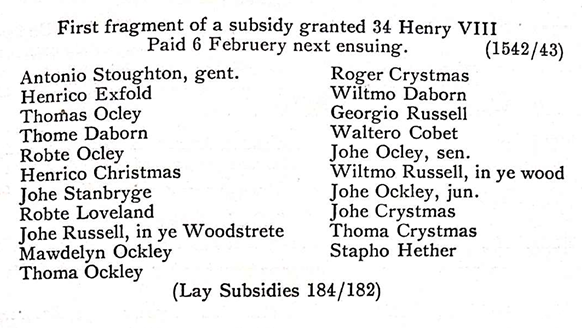
Posted in 52 Ancestors in 52 Weeks, Genealogy | Tagged , , , , , , , , , , , , , , | 1 Comment