52 Ancestors in 52 Weeks. Week 8: Courting. My Ancestor Mary Wheldon Taylor. Her Life and Death.

The writing prompt for this week is “Courting”. Either as in courting in the law or courting as in romance. I could write about the myriad of ancestors that are found in Colonial American court records, including the ancestor I wrote about last week, My Contentious and Quarrelsome (and litigious!) Mayflower Pilgrim Ancestor Edward Doty or The Courtship of my Ancestors William Durkee and Martha Cross – which was detailed quite well in court records. Or I could write about more recent ancestors, their siblings, and kin, that have had brushes with the law. But I chose to write about my Colonial Massachusetts ancestor Mary Wheldon Taylor.
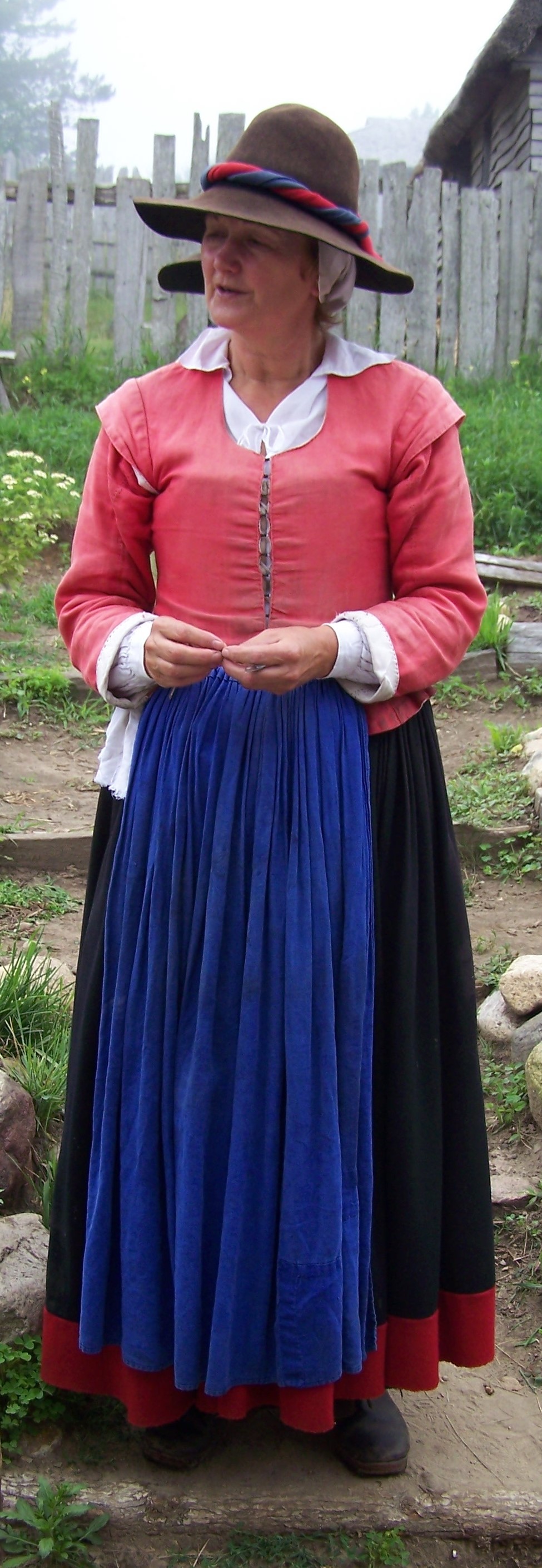
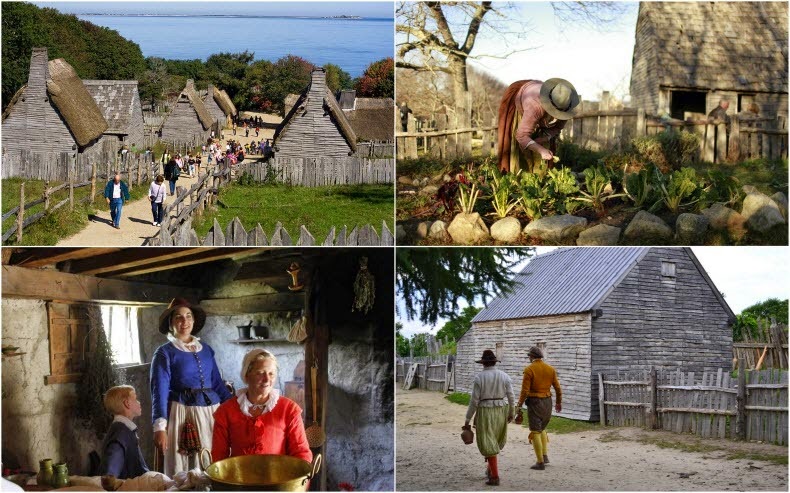
Living roleplay reenactor at the Plimoth Plantation in Plymouth, Massachusetts.

And in doing so, I am writing about her accidental death and the jury of inquest that was formed to investigate it.

But first I want to tell you a bit about her life.

Mary Wheldon was born in 1621 in Arnold, Nottinghamshire, England, to Gabriel Wheldon and his wife Jane. She was baptized in the nearby parish of Basford on 23 December 1621.

The village of Arnold stands near Sherwood Forest. Basford and Arnold in Nottinghamshire, England, are now adjoining suburbs just north of Nottingham, and about 10 miles south of Sherwood Forest. Sherwood Forest is a royal forest in Nottinghamshire, England, famous because of its historic association with the legend of Robin Hood. It was the traditional homeplace to Robin Hood, some 400 hundred years earlier. (3 & 4)

Mary came to New England with her father and siblings. “Gabriel Whelden was one of the first settlers in what is now the Township of Dennis in Barnstable County on Cape Cod. He was given permission on 3 Sep 1638 by Plymouth officials to settle on Cape Cod, which included a land grant. At the time the area was called “Mattacheeset”.  It was organized into Yarmouth in 1639. Gabriel appears in the Yarmouth records, 6 Oct 1639, so he settled in Yarmouth between Sep 1638 and Oct 1639.” (3)

Mary Wheldon married Richard Taylor “The Tailor” in Yarmouth, Massachusetts, between 1645-1647. Their first known child was born in December of 1648. Her husband was called Richard Taylor “The Tailor” due to his occupation and also to differentiate him from another man of the same name, Richard Taylor “of the Rock”, who was also living in Yarmouth. This other Richard Taylor was given this nickname “of the Rock” “either because his house was made of stone, or because he lived near the boundary stone between Hockanom and  Nobscusset in the northeastern part of town.” (3) This other Richard Taylor “of the Rock” married Mary’s sister, Ruth Wheldon.

The children of Richard “The Tailor” Taylor and Mary Wheldon are listed below.

  1. Ann Taylor born 2 December 1648 in Yarmouth, Plymouth Colony; died 1648 in Yarmouth.
  2. Ruth Taylor born 11 Apr 1649 in Yarmouth, Plymouth Colony; died 28 Jan 1728 in Barnstable, Massachusetts Colony. She married Joseph Bearse (the son of Augustine Bearse AKA Austin Bearce).
  3. Mary Taylor born 18 December 1650 in Yarmouth, Plymouth Colony; died 1 February 1718 in Massachusetts. She married Abishai Marchant (the son of John Marchant of Martha’s Vineyard). – My direct ancestors.
  4. John Taylor born about 1652 in Yarmouth, Plymouth Colony; Will proved 18 Jan 1722 at Chatham, Massachusetts. He married Sarah Matthews (the daughter of James Matthews of Yarmouth).
  5. Elizabeth Taylor born about 1655 in Barnstable, Plymouth Colony; died 4 May 1721 in Barnstable, Massachusetts. She married Samuel Cobb (the son of Henry Cobb and Sarah Hinckley).
  6. Hannah Taylor born 16 September 1661 at Yarmouth, Plymouth Colony; died 14 May 1743 in Barnstable, Massachusetts. She married Deacon Job Crocker (the son of William Crocker and Alice Hoyt).
  7. Ann Taylor born about 1659 in Yarmouth, Plymouth Colony; died after 1679. She married Josiah Davis (the son of Robert Davis and Ann).
  8. Joseph Taylor born 1660 in Yarmouth, Plymouth Colony; died 13 September 1727 in Marshfield, Massachusetts. He married Experience Williamson, of Marshfield.
  9. Sarah Taylor born 1662 in Yarmouth, Plymouth Colony; died 31 July 1695 in Barnstable, Massachusetts. She never married.

On a winter day in early December of 1673, Mary found herself on a small boat, it is assumed she intended to go from Yarmouth to Duxbury or to Plymouth. On this day she was a woman in her early fifties and had been married to her husband Richard “The Tailor’ Taylor for about twenty-eight years. Her children were aged between eleven and twenty-five years old. Only her oldest two children, Ann and Mary, were married.

Map of Plymouth Colony from FamilySearch.org

You can see in the map of the Plymouth Colony above where she was traveling from at Yarmouth and going by water up to either Plymouth or Duxbury. At some point on her journey, most-likely when she was close to Duxbury Bay, her boat cast adrift, and she was found dead in the wrecked boat.

Mary’s death was quite tragic. Her body was found in a small, wrecked boat near Duxbury Bay. A jury of inquest was formed in Duxbury.

Meaning of an inquest: judicial inquiry by a group of persons appointed by a court. The most common type is the inquest set up to investigate a death apparently occasioned by unnatural means. Witnesses are examined, and a special jury returns a verdict on the cause of death. (1)

Coroners’ Inquests in Colonial Massachusetts: “Coroners had many duties. They officiated at inquests — lay jury investigations — not only into deaths but also into shipwrecks, felonies, housebreaks, and fires.” (2)

We do not know how long the jury of inquest lasted; it appears only a matter of days. But on 4th of December 1673, it rendered its verdict.

The following was their verdict: “The jury of inquest appointed to view a corpes found in a boate now racked, and being supposed to be the wife of Richard Taylor, somtimes of Yarmouth, and to make dilligent serch how the said woman came by her death, doe judge, that the boate being cast away, the woman was drowned in the boate.” (5)

Her husband died, grief stricken, within 9 days of hearing the verdict.

This sad tale of the death of Mary Wheldon Taylor was not the only grief engendered by drowning within the Wheldon family. Many years earlier in 1639, Mary’s sister Martha Wheldon also died by drowning at the age of seventeen.

We know about this because of a letter their sister Katherine Wheldon composed back to England reporting the death of her sister Martha. The letter is summarized in Thomas Lechford’s Note-Book as follows:

“A letter by Katherine Weelden to Mr. John Shanvat of Nottingham dated 29.4.1639.
touching the Death &c. of Martha Weelden of Dedham who was Drowned about 12
Dayes before. She was a godly mayde by all probabilites in this letter testified.” (3, 6, & 7)

Side note: The surname Shanvat (or Shamvat) has not been found in English records reviewed. It is possible that the surname was actually Chamlet, and that the recipient of Katherine Wheldon’s letter John “Shanvat” was related to Gabriel Whelden’s aunt by marriage, Christobel (_) (Whelden) Hewitt . . . (7)

Mary Wheldon and Richard “The Tailor” Taylor are my ninth great-grandparents.

Famous Kin of Gabriel Wheldon (and wife Jane), Great Migration Immigrant 1638:

Edwin Grozier, Owner of The Boston Post.

Charles Dawes, 30th U.S. Vice-President.

Merrill C. Meigs, Publisher, Chicago Herald & Examiner.

American Artist Norman Rockwell.

Bill Richardson, 30th Governor of New Mexico.

Tennessee Williams, Author and Playwriter.

Sydney Biddle Barrows, The Mayflower Madam.

Priscilla Presley, Actress, Businesswoman, and ex-wife of Elvis Presley.

Orrin Hatch, U.S. Senator from Utah.

Annie Proulx, Novelist and Short Story Writer.

Sarah Palin, 9th Governor of Alaska & U.S. Vice Presidential Canidate.

Mizuo Peck, TV and Movie Actress.

Don Winslow, Author and Screenwriter.

Kristine Rolofson, Harlequin Novelist.

Lisa Marie Presley, Singer and Songwriter. Daughter of Elvis Presley and Priscilla Presley.

Avril Lavigne, Singer and Songwriter.

Ethan Hawke, Actor, Director, Screenwriter, and Novelist.
References:

  1. Inquest – Law. Britannica.com
  2. Mellen, Paul F., Coroner’s Inquests in Colonial Massachusetts. Journal of the History of Medicine and Allied Sciences, Volume 40, Issue 4, October 1985, Page 462. https://doi.org/10.1093/jhmas/40.4.462.
  3. Minor Descent – Gabriel Wheldon (and Family). WordPress.com.
  4. Sherwood Forest. Wikipedia.org.
  5. Mary Whelton Taylor – FindAGrave.com
  6. Edward Everett Hale, Jr., ed., Note-Book Kept by Thomas Lechford, Esq., Lawyer, in Boston, Massachusetts Bay, from June 27, 1638 to July 29, 1641 (Cambridge, Mass., 1885; repr. Camden, Maine: Picton Press, 1988), p. 102.
  7. THE ORIGIN OF GABRIEL1 WHELDEN OF YARMOUTH AND MALDEN, MASSACHUSETTS by Jan Porter and Daniel F. Stramara, Jr.

If you’d like to learn more about the 52 Ancestors in 52 Weeks project, please visit here:

52 Ancestors in 52 Weeks.

Or join the Facebook group Generations Cafe.

If you use any information from my blog posts as a reference or source, please give credit and provide a link back to my work that you are referencing. Unless otherwise noted, my work is © Anna A. Kasper 2011-2026. All rights reserved. Thank you.
Posted in Uncategorized | Tagged , , , , , , , , , , , , , , , , , , , , , , , , , , , , , , , | 4 Comments

52 Ancestors in 52 Weeks. Week 7: Landed. February Theme: Branching Out. My Contentious and Quarrelsome Mayflower Pilgrim Ancestor Edward Doty.

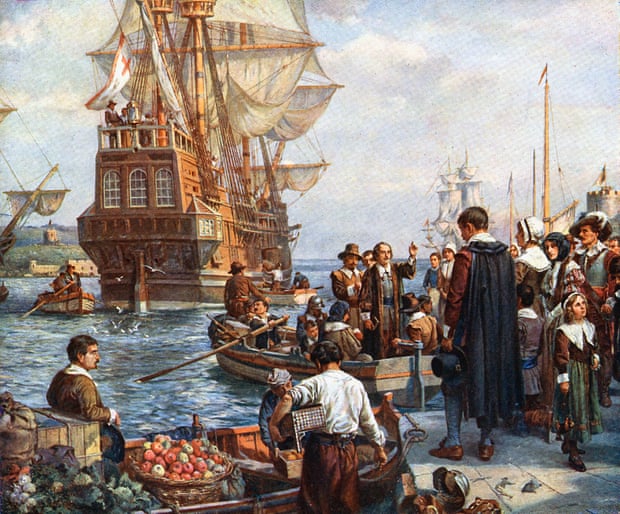
A painting by Bernard Gribble of the Pilgrim fathers boarding the Mayflower in 1620 for their voyage to America. Photograph: Print Collector/Getty Images.

When I received the writing prompt for this week, Landed, I considered taking it in several various directions, I do have some British ancestors that were considered Landed Gentry, as well as owners of large amounts of land in early Colonial Maryland. I also have many stories I could share about my ancestors landing in America, including at least three Mayflower Pilgrim ancestors, including Edward Doty. But I decided to go in a different direction, as in landing a blow, inflicting (landing) a wound on another person via hand, sword, or dagger, etc. This invited a clear path to write about my contentious and often quarrelsome paternal ancestor Edward Doty who not only landed on Plymouth Rock but also landed many a punch and even a dagger blow! The Edward Doty Society calls him fractious.

Little is known of Edward’s life prior to boarding the Mayflower. His parentage is unproven and all we truly know of his origins is that he was English and of London, England. He traveled on The Mayflower as an apprentice – indentured servant – of Londoner, Stephen Hopkins. Hopkins was making his second journey to the New World as he had served about ten years prior under Capt. John Smith at Jamestown, Virginia Colony. We know that Edward was at least 20 years old on November 11, 1620, when he signed the Mayflower Compact. In August 1643, his name appears on the list of men, ages 16-60, able to bear arms, so he wasn’t born before 1583. Most sources believe he was a young man at the time of the Mayflower voyage from England to America, so probably not born much before 1599. The passenger lists indicate he was “of London” but it’s not known if this was his place of birth in England. (1 & 2)

Interesting genealogical side note: I am a descendant of Edward Doty on my paternal side, I am also a descendant of the above-mentioned Stephen Hopkins on my maternal side. Other Mayflower passengers that I descend from include Stephen Hopkins’ daughter Constance Hopkins Snow, and his second wife Elizabeth Fisher.

A bit about Stephen Hopkins:

Stephen Hopkins, Edward’s master, himself was a colorful figure. Historians believe that he was the same Stephen Hopkins who was aboard the Sea Venture in 1609, when it shipwrecked in Bermuda enroute to the new Virginia colony. (William Shakespeare based the plot of his 1610-11 play, The Tempest, at least partly on this event.) Thereafter, Hopkins eventually arrived and settled in Virginia. However, by 1617 he was summoned back to England by the death of his wife and the plight of his children, all of whom he had left behind. (3)

Hopkins remarried in Whitechapel, London, England to Elizabeth Fisher, and in 1620 he boarded the Mayflower with his pregnant second wife, small children, and two servants. He just could not stay away from the New World, it seems. Their son, Oceanus, was born during the voyage. Hopkins was a tanner by trade and a some-times leader of the Colony. Among other roles, he sat on the Board of Assistants until 1636. However, thereafter he became an innkeeper and from time to time he ran afoul of the law in connection with his sale of liquor. (3)

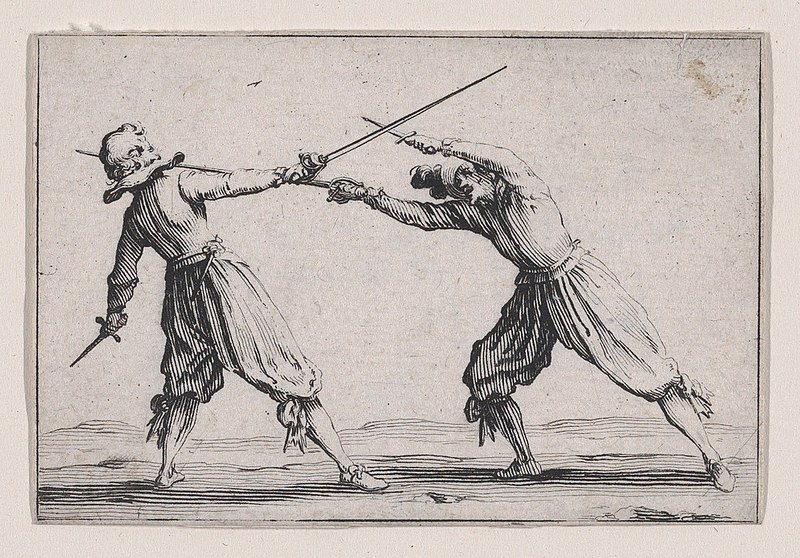
Le Duel a l’Épée et au Poignard (The Duel with the Sword and Dagger), from Les Caprices Series A, The Florence Set. 1617. Public Domain.

The Dueling Edwards:

Another indentured servant in the household of Stephen Hopkins was Edward Leister. On the 18th of June 1621, the two Edwards, fellow indentured servants Edward Doty and Edward Leister, fought the first (and only) duel in the Plymouth Colony. A challenge of single combat with sword and dagger. Both were wounded, the one in the hand, the other in the thigh. Historians have speculated that it was fought over one of Hopkins’ daughters. They were adjudged by the whole Plymouth company to be punished by having their head and feet tied together for twenty-four hours, without meat or drink. But within an hour of the punishment being inflicted, their master Stephen Hopkins took pity upon them, and their “great pains” and he made a “humble request, upon promise of a better carriage” and they were released by the governor. (3, 4, 5, & 6)

Reenactment Plimouth Plantation Living Museum. (3)

But Edward Doty did not always make good on that promise of “a better carriage.” He did not like to pay his servants, he just let his cattle kind of wander around, he got into fights and is found in the Plymouth Court records numerous times!

To say that Edward was notably a contentious man would be correct.

The post-1632 records of the Plymouth Court, which has no existing records prior to that year, has twenty-three cases over the 20 years between January 1632 and October 1651 that involve Edward Doty. The records include suits/countersuits, and charges such as fraud, slander, fighting, assault, debt, trespass, theft, etc. These included five counts of assault, three of them against George Clarke, 20 years his junior. (5, 6, 7, & 8)

On 2 January 1632/3, Edward Doty was sued by three different people: John Washburn, Joseph Rogers, and William Bennett.  It all appears to have been a disagreement about a trade of some hogs; John Washburn’s case was thrown out; Joseph Rogers was awarded four bushels of corn.  In William Bennett’s case, Edward Doty was found guilty of slander and fined 50 shillings. (9)

Two years later, on 24th of March 1633/4, Edward Doty was fined 9 shillings and 11 pence for drawing blood in a fight with Josias Cooke.  (9)

On 28 March 1634, Edward Doty won a suit against Francis Sprague. (7)

On 7 March 1636/7, Edward Doty was found guilty of a “deceitful bargain” over a lot of land and restored the lot to George Clarke. The controversy continued when George Clarke won damages and costs from Doty on 2 October 1637, Clarke charging him with denying liberty to hold land for the term he had taken it. Things escalated, for that same day Clarke also charged Doty for assault and battery, and Doty was further fined. (7)

Doty was sued in less sanguinary encounters between 1638 and 1651 with Richard Derby, John Shaw, widow Bridget Fuller and John Holmes over debt and trespass, and lost them all. On 7 December 1641, he successfully sued James Luxford for trespass. (7)

On 1 February 1641/2, Thomas Symons charged “Edward Dotey” with carelessly allowing cattle put in his hands to “break into men’s com” endangering the cattle and other property, and Doty was ordered to put his cattle in a “keep”. (7)

He also sued his own father-in-law, Thurston Clarke, over money. But although Doty appeared before the court numerous times, he was never punished for criminal activities beyond small fines. So even though he was charged with fighting and was sued by many persons for fraudulent trading and goods sales, almost all were civil cases and were not of a criminal nature. And other than his duel in 1621, he never received any physical punishment that was commonly given for crimes such as theft, serious assault and adultery. He was quite fortunate in this regard as typical punishments at that time included whipping, branding, banishment and the stocks. (5, 6, & 8)

Even with his periodic court cases, in which he accepted the outcome of all such actions, Edward Doty lived a normal life as a freeman, paying his taxes and all his debts. He periodically received land grants from court as with other residents and received other property rights and benefits from being classed as a “first comer.” (5 & 8)

Records do not show that Edward Doty ever served on any juries or held any political office nor was ever appointed to any governmental committees, which was unusual for a Purchaser and early freeman. The only recorded instance of his involvement in anything of a community nature was from a town meeting of February 10, 1643, when he was assigned with George Clarke, John Shaw, Francis Billington and others to build a wolf trap in the town of Plain Dealing.” In March 1657 he was midway down the list of “those that have interest and proprieties in the town’s land at Punckateeset over against Rhode Island”. (5, 6, 7, & 8)

On the August 1643 Able to Bear Arms (ATBA) List “Males that are able to bear Armes”, his name appears as “Edward Dotey”. (6 & 8)

Photo from: Plimoth Plantation: A Living Museum of a 17th Century English Colony in America by KAUSHIK PATOWARY. www.amusingplanet.com

Fellow Mayflower Pilgrim William Bradford, and Governor of the Plymouth Colony, mentioned that Edward had a first wife, but said nothing more about her. Historians surmise that she might have arrived in the Colony in about 1630, married Edward soon thereafter, and died in an epidemic in 1633. No record of any children of this marriage ever has been found. (3 & 6)

He married Faith Clarke on January 9, 1635. Faith was the daughter of Thurston (Tristram) and Faith Clarke, having arrived on the ship “Francis” in 1634.

From the Plymouth Colony Records, Vol. 1, page 32: “January 6, 1634. Edward Doten and Fayth Clarke were married.”

Since several of Doty’s court cases involved Thurston and George Clarke, it would appear that some of his legal situations, including fights, were the result of in-law domestic problems. Bradford stated that Doty “by a second wife hath seven children, and both he and they are living.” They later had two more children. (8, 10, & 11)

Edward Doty made out his will on May 20, 1655, calling himself “sicke and yet by the mercye of God in perfect memory.” His will was witnessed by John Howland, John Cooke, James Hurst, and William Hoskins. Doty signed his will with a mark. This was how he signed all his property deeds as he never learned to write. (6 & 8)

Edward Doty Memorial Stone.

Doty died on August 23, 1655, in Plymouth, Massachusetts Bay Colony and was buried at Burial Hill Cemetery where there is a memorial stone (pictured above) for him.

After Edward Doty’s death, his widow Faith married John Philips on March 14, 1666/7, as his second wife. She moved to Marshfield and died there December 21, 1675. She was buried at Winslow Cemetery in Marshfield, Massachusetts. (6, 8, & 10)

Famous descendants of Mayflower Pilgrim Edward Doty and wife Faith Clarke:

Eliphalet Remington, founder of the Remington Arms Company; Lavinia Warren, Dwarf Circus Performer; Calvin Coolidge, 30th U.S. President; Actress Raquel Welch; Bill Weld, 68th Governor of Massachusetts; Actress Tuesday Weld; Actor Dick Van Dyke; Chairman and CEO Warren Buffett; Actress Jordana Brewster; and Actor Orsen Bean.

My direct line from Mayflower Pilgrim Edward Doty:

  1. Edward Doty and Faith Clarke.
  2. Samuel Doty and Jane Harmon.
  3. Edward Doty and Sarah Davis.
  4. John Doty and Mary ____ (Her full maiden name is thought to be Mary (Martjie) Schermerhorn).
  5. Jeremiah Doty and Sarah B. ___.
  6. Samuel Doty/Doughty and Mary Ann “Polly” Lamb.
  7. Rev. John M. Doughty and Jane McGuire.
  8. Maguire/McGuire Doughty and Mary Ann Gooden.
  9. John Lewis Doughty and Cynthia Ann Barrett.
  10. Mary Adalaide “Mame” Doughty and James Francis Fay (my great-grandparents).

Our Doughty line is accepted by The Mayflower Society.

To learn more about my Lamb ancestors visit my blog post My Quaker Lamb and Moore Ancestors in Virginia and North Carolina. Later Doty/Doughty Primitive Baptists in Kentucky, Indiana and Illinois.

To learn more about my McGuire ancestors visit my blog post My McGuire/Maguire Ancestors from Fermanagh, No. Ireland and McElliogott Parish – near Tralee, County Kerry, Ireland. In Virginia, Kentucky, and Indiana in USA.

To learn more about my Gooden ancestors visit my blog post Urquhart – Some of my Scottish Ancestors. And Related English Watts and Goodwin/Gooden Lines.

To learn more about my Irish Fahey/Fahy (Fay) ancestors visit my blog posts 52 Ancestors in 52 Weeks. Week 48: Strength. My Irish Ancestor Daniel Wolfetone Fahey (Fay) from County Galway, Ireland and 52 Ancestors in 52 Weeks. Week 1. Foundations. Fahy/ Fahey Ancestors.

References:

  1. Johnson, Caleb H. (2006). The Mayflower and Her passengers. Indiana: Xlibris. p. 132.
  2. Edward Doty My Mayflower Ancestor – Nancy Lee Jackson Brister, WordPress.
  3. Pilgrim Edward Doty Society – A Family History Society. Edward Doty & Kin. WordPress.
  4. Edward Leister and Edward Doty, Biography of Edward Leister. mayflower.americanancestors.org
  5. Caleb H. Johnson, The Mayflower and her passengers (Indiana: Xlibris Corp., 2006), pp. 132–133.
  6. Eugene Aubrey Stratton. Plymouth Colony: Its History and People, 1620–1691 (Salt Lake City: Ancestry Publishing, 1986), p. 264, pp. 283–284  p. 285, p. 336 & pp. 439–440.
  7. Amercian Ancestors. Biography of Edward Doty. mayflower.americanancestors.org
  8. Edward Doty. Wikipedia.org
  9. MILLER/DERSCHEID Family Tree. Edward Doty.
  10. “A genealogical profile of Edward Doty: A collaboration of Plimoth Plantation and New England Historic Genealogical Society”
  11. Bradfords’s History of Plymouth Plantation, p. 414.

If you’d like to learn more about the 52 Ancestors in 52 Weeks project, please visit here:

52 Ancestors in 52 Weeks.

Or join the Facebook group Generations Cafe.

If you use any information from my blog posts as a reference or source, please give credit and provide a link back to my work that you are referencing. Unless otherwise noted, my work is © Anna A. Kasper 2011-2026. All rights reserved. Thank you.

Posted in 52 Ancestors in 52 Weeks, Famous Kin, Genealogy | Tagged , , , , , , , , , , , , , , , , , , , , , , , , , , , , , , , , , , , , , , , , , , , , , , | 12 Comments

52 Ancestors in 52 Weeks. Week 6: Maps. February Theme: Branching Out. Anneken (Annetje) Hendricks (Henriksen) Vanderbilt from Bergen, Norway.

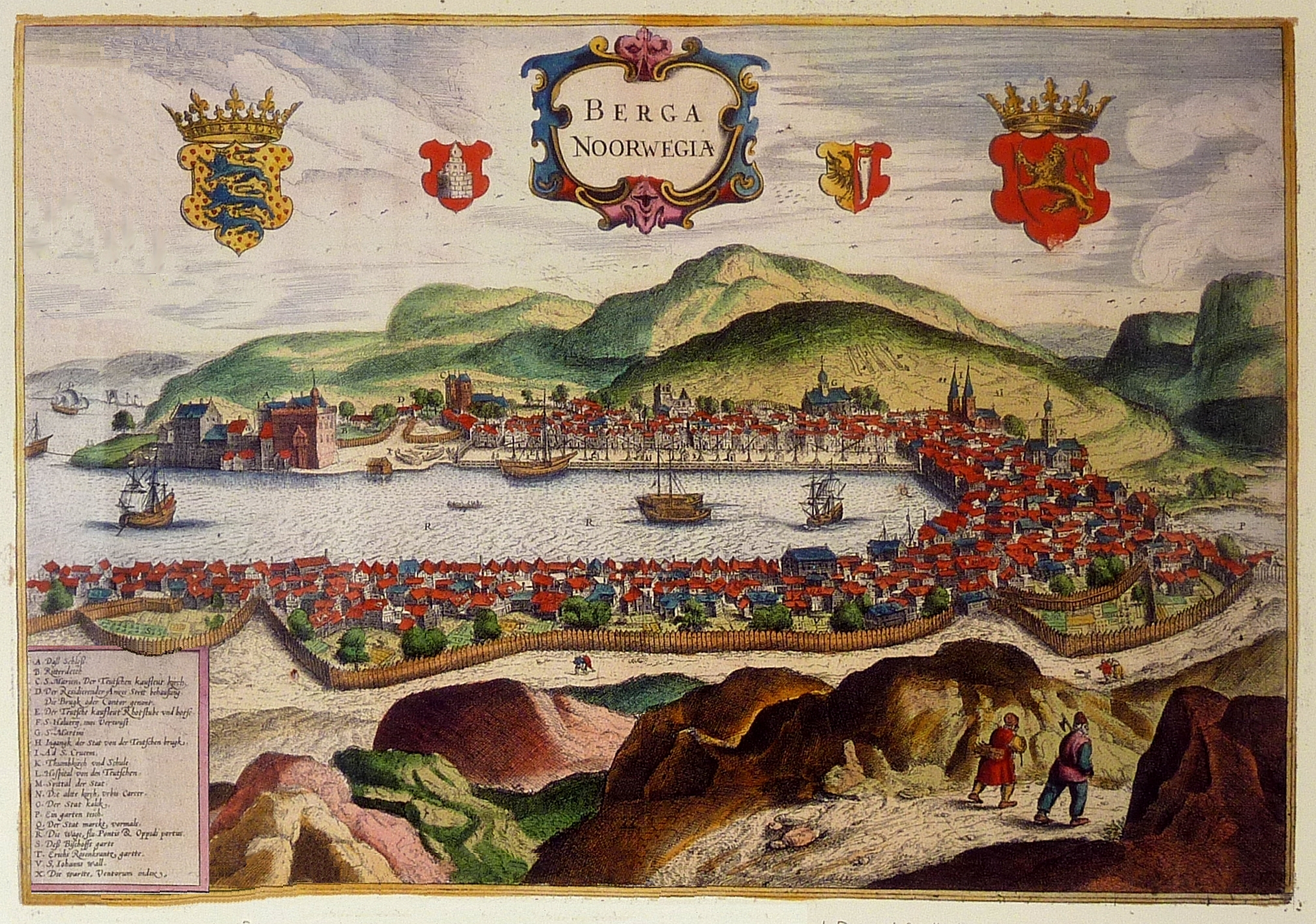
Map of Bergen, from ‘Civitates Orbis Terrarum’ by Georg Brau (1541-1622) and Franz Hogenberg (1535-90) c.1571-1600 

Above is a painting of an old map of Bergen, Norway. Hieronimus Scholaeus’ prospect of Bergen was painted about 1580 and published in Cologne in 1588 in a large atlas with pictures of “cities from the whole world” The Civitates orbis terrarum (Bergen, Norway), by Georg Braun & Frans Hogenberg. 1590 – the edition which is presented above was published in Amsterdam in 1657. Although the picture of the city is the same as on prospect from 1580, the original Hanseatic cargo ships are replaced with more up to date Dutch fløytskip, a flat-bottomed, three-masted trading vessel with an ample hull. The low houses portrayed here with the red roofs would mostly have had turf roofs. (1)

I was quite intrigued with the above map. If you click on it and view the larger image, you can see the key on the bottom left more clearly and see each one as it corresponds to the place on the map.

Commentary by Braun: “Most of the finest buildings in the city, be they houses of worship or domiciles, belong to the Hanseatic merchants, the Osterlingen, as they are called there. The rest are shoddily made, with walls of timber pieced together and roofed over with green moss. Nevertheless, the German merchants have a splendid outpost in Bergen because it is excellently suited for trade and commerce. For it encompasses a whole side of the harbour […]. They have separate trading posts corresponding to the diversity of their cities and countries of origin. Hence the merchants from Lübeck, Danzig, Cologne, Brunswick and Hamburg each have a site of their own by the shore, on which they unload the ships from their cities and load them again and send them back to Germany.” (2)

Bergen – the first royal residence city – has for centuries been Norway’s, and for long periods, Scandinavia’s biggest city. The historical monuments round the Vågen bay tell us that the city has been of national, historical significance. In the well-known view of Bergen from the 1580s by Hieronimus Scholeus we can recognize Håkonhallen’s characteristic stepped gables and feudal lord Erik Rosenkrantz’ proud building from the 1560s; what we today call the Rosenkrantz Tower. That is not so strange, because both buildings have been restored with that engraving as a model. Erik Rosenkrantz built together Magnus Lagabøtes castle gatehouse from the 13th century and captain Jørgen Hanssøns defense works into a powerful defense tower – a “donjon” – and equipped it with a Renaissance façade looking out over the city. Behind today’s construction at Bergenshus we can make out the contours of the medieval royal estate at Holmen, which at that time was linked to the mainland by a low, marshy neck of land. (1)

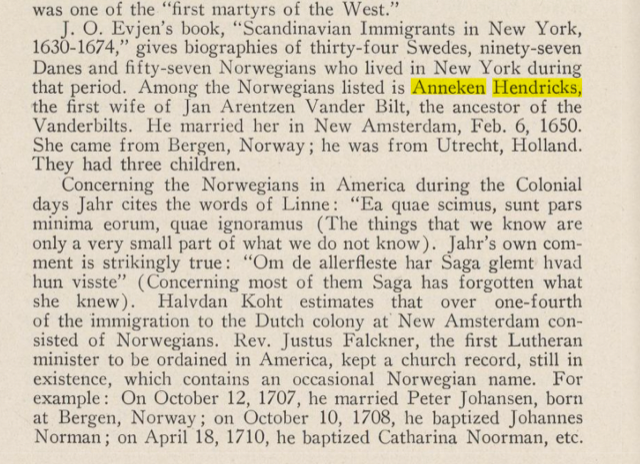
My quite recent interest in the town of Bergen, Norway is engendered by the recent discovery that I may be descended from Anneken (Annetje) Hendricks (Henriksen) Vanderbilt. I have several Dutch ancestors that were in New York very early in its settlement. It would have been assumed by later researchers that Anneken was Dutch except for the fact that in her marriage banns it states she is from Bergen, Norway. In her marriage banns in the Reformed Dutch Church, New Amsterdam (now New York), it states “Jan Arentszen Van der Bilt, j.m. en Anneken Hendricks, Van Bergen en Noorwegen.” She married Jan Arentszen Van der Bilt on 6 February 1650 in what is now Brooklyn, Kings County, New York. She was born about 1630-1632 and would have lived in Bergan in a time when it looked very much like the image above.

This led me to do a bit of research into Norwegian families in early New York. I had previously not even considered the fact that Norwegians may have migrated to America so early.

I found that Norwegians have been in New York since the 1600’s. Dutch ships trading and colonizing in what would become present day New York, had Norwegian sailors as part of their crews. Norwegians were considered some of the best sailors. (3)

General information about Norwegian immigration to America. There was a Norwegian presence in New Amsterdam (New York after 1664) in the early part of the 17th century. Hans Hansen Bergen, a native of Bergen, Norway, was one of the earliest settlers of the Dutch colony of New Amsterdam having immigrated in 1633. (See more about him below). Another of the first Norwegian settlers was Albert Andriessen Bradt who arrived in New Amsterdam in 1637. Approximately 60 persons had settled in the Manhattan area before the British take-over in 1664.  Pieter Van Brugh, Mayor of Albany, New York was the grandson of Norwegian immigrants. His mother’s parents were Roelof Janse (1602–1637), born in Marstrandsön, a small island situated in Båhuslen province in Norway (ceded to Sweden in 1658) and Anneke Jans (1605–1663), born on Flekkerøy, an island situated outside the town of Kristiansand, Vest-Agder County, Norway. How many Norwegians settled in New Netherlands (the area up the Hudson River to Fort Oranje—now Albany) is not known. The Netherlands (and especially Amsterdam and Hoorn) had strong commercial ties with the coastal lumber trade of Norway during the 17th century, and many Norwegians emigrated to Amsterdam. Some of them settled in Dutch colonies, although never in large numbers. (4, 7, & 8)

One of the earliest Norwegian sailors to settle in Dutch New Amsterdam (New York) was Hans Hansen Bergen of Bergen, Norway. Hans Hansen Bergen emigrated to New Netherland in 1633 in a company with the Director-General of New Netherland, Wouter Van Twiller, and Bergen was initially known in early New Amsterdam records by various names, but chiefly Hans Hansen Noorman and Hans Hansen Boer. He was also sometimes referred to in early records as Hans Noorman, Hans Hanszen, Hans Hanszen Noorman, Hans Hanszen de Noorman, Hans Hanszen Van Bergen in Norweegan or simply Hans Hansen. A shipwright by trade, he became a large property owner in Brooklyn. He served as overseer of an early tobacco plantation on Manhattan Island, before eventually removing to Brooklyn’s Wallabout Bay, where he was one of the earliest settlers and founded a prominent Brooklyn clan. He married Sarah Rapelje – the first female of European descent born in New Amsterdam. Both family names live on as street names in Brooklyn. (4, 5, 7, & 8) His wife Sarah Rapelje was a sister of Jannetje Rapalje who married Rem Jansen (AKA Remsen) Vanderbeek – The Blacksmith.

Sarah and Jennetje were the daughters of Joris Jansen Rapalje and Catalyntje Jeronimus Trico. Some famous descendants of this couple are:

Arthur Ryerson – RMS Titanic Victim; Actress Paget Brewster; Actor Humphrey Bogart; Retired Politician Howard Dean; and Actor James Spader.

American socialite, and amateur soprano Florence Foster Jenkins is a descendant of theirs through their daughter Sarah Rapelje and Hans Hansen. Some may remember the 2016 biographical film Florence Foster Jenkins starring Meryl Streep and Hugh Grant.

There was also Claes Carstensen (possibly originally Klaus Kristenson). Claes Carstensen’s name appears variously as Claes Noorman, Claes Carstensen Noorman and Claes Van Sant, the latter being the Norwegian name Sande in Jarlsberg, where Claes Carstensen was born in 1607. He came to America about 1640 and settled a few years later on fifty-eight acres of land on the site of the present Williamsburg. The ministerial records of the old Dutch Reformed Church in New York state that Claes Carstensen was married April 15, 1646, to Helletje Hendricks. (3, 5, 6, & 10)

Some have asserted that Claes Carstensen’s wife Helletje Hendricks may have been a sister to my ancestor Anneken Hendricks. Her husband was from Norway, but she was most likely Dutch. She is listed as Helletje Noomian in some records, but some argue it was because her husband was Norwegian. There is no note to be found in her marriage record indicating she was Norwegian, so she most likely was Dutch and not a sister of my Anneken Hendricks. Claes Carstensen died November 6, 1679. (5 & 10)

Albert Andriessen (Albert Andriessen Bradt) was twenty-nine when he made an agreement with Kiliaen Van Rensselaer, and it is assumed based on this information that he was born about 1607. Pursuant to the stipulation in the agreement, he sailed, accompanied by his wife, Annetje Barents of “Rolmers,” and as it would seem by two children, October 8, 1636, on the Rensselaerswyck,” which arrived at New Amsterdam March 4, 1637. In the following centuries Norwegian sailors and captains continued to be hired to sail to the area, and some of them stayed. (3, 5, 6, & 7).

By the year 1700 there were a number of families of Norwegian and Danish descent living in New York. In 1704 a stone church was erected by them on the corner of Broadway and Rector Streets. The property was later sold to Trinity Church, the present churchyard occupying the site of the original church. Prof. Rev. Rasmus Anderson, speaking of these people, says, that they were probably mostly Norwegians and not Danes, for those of their descendants with whom he has spoken have all claimed Norwegian descent. The pastor who ministered to the spiritual wants of this first Scandinavian Lutheran congregation in America was a Dane by the name of Rasmus Jensen Aarhus. He died on the southwest coast of Hudson Bay, February 20, 1720. (10)

So, who was Anneken Hendricks (Henriksen)? In addition to the sailors there were some Norwegian adventurers that accompanied Dutch colonists to New Amsterdam. As noted above in the case of Albert Andreesen, there were those that sailed with their wife and children. Her parentage is unknown, but I must assume she sailed with a family member or parent to New Amsterdam. Her surname gives some clues and most likely the name was actually the Norwegian surname Henriksen. Her surname indicates that she was descended from a man named Henrik. See note below, it appears she was a daughter or granddaughter of a man named Henrik. The surname Henriksen is a Norwegian surname (also found in Denmark).

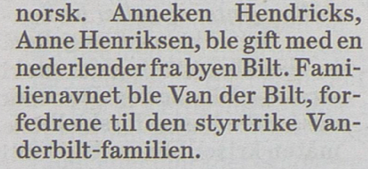
Update: The above newspaper article in Norwegian was sent to me by a Norwegian DNA cousin (with a different connection to me) and it shows that Anniken’s Norwegian name was Anneken Henriksen. This section translated into English reads:

Norwegian. Anneken Hendricks, Anne Henriksen, was married to Dutchman from the city of Bilt. The family name was Van der Bilt. The family name was Van der Bilt, for the fathers [fore-fathers/ancestor] of the wealthy Vanderbilt family.

Here is another one above that she sent me. In English this section translated reads:

By marriage dated 6 February 1650 in new Amsterdam (New York), Anneken Hendricks from Bergen became a Hollander, whereby Norwegian blood came into a family that later and still is one of the most prominent American family names today. What family is it?

The question being asked at the end is in relation to what Norwegian family does Anneken Henriksen come from? A question that has yet to have an answer and may remain a forever mystery.

Side note: Hendricks and Hendrickszen/Hendricksen, are surnames found in Dutch church, land, and legal records in Colonial America. There are numerous brides and grooms with the name Henricks and some with Hendricksen in Dutch Reformed Church records in New York and some in New Jersey, but only Anneken Hendricks’ (Henriksen) marriage record has the note of her being Norwegian and from Bergen, Norway. Most have Dutch roots, and the families came from the Netherlands, with a few being English that intermarried with the Dutch. (11 & 12) But Henriksen is a uniquely Scandinavian surname. Henricks and Hendricksen are Dutch and German surnames.

Many have incorrectly listed her as the daughter of Dutch immigrant Jiles (Giles) Douwesz Fonda and his wife Hester Douwdre Jansen. There is quite a bit known about Jiles Douwesz Fonda, He was a brewer and a blacksmith’s assistant in Amsterdam, North Holland, Netherlands. After 1645 he was involved in the whaling industry in the Netherlands. He married Hester Douwdre Jansen on 10 February 1641 in Diemen, North Holland, Netherlands. He arrived in Fort Orange, New Netherland (now Albany, New York) in 1651. Jiles died in the year 1659 in Beverwyck, New Netherland Colony (New York). There is no record of him ever being in Norway, and his marriage takes place in the Netherlands at least ten years after Anneken Hendricks was born. I have seen no documentation as to why they are linking her to this couple, except that a few list the maiden name of Hester as Henricks. Anneken Hendricks (Henriksen) married in February 1650 in what is now Brooklyn, New York. She was living in New Amsterdam and married there prior to Jilies Douwesz Fonda even immigrating to America. Also, the Dutch very much listed additional information in their records if a person was not Dutch or from the Netherlands. The fact that they listed her as from Bergan, Norway is telling, it tells us that she was Norwegian and not Dutch. There is no evidence or historical records linking her to this couple. I believe that one person decided to incorrectly link her to them, and then multitudes of people have repeatedly shared the incorrect data.

Anniken is a Nordic girl’s name found in Norway, Sweden, and Denmark. Her name is listed as Anniken in her marriage banns, in the baptism records of her children in the Dutch Reformed Church it is listed as the Dutch variant of the name as Annetje. One of the earliest recorded forms of the name Anneken, is found in a Swedish document from 1387, and listed as Anneken. This developed into the names: Anneke, Annecke and Anneka, and all four were used throughout the 15th century in Scandinavia, Germany and Holland. (9)

As noted in a prior paragraph, it is not known how many Norwegians settled in New Netherlands (the area up the Hudson River to Fort Oranje—now Albany). We know that Norwegians settled in Dutch Colonies, although never in large numbers. She would have been part of that unknown number of Norwegians that settled in New Netherlands (New York).

Part of Anneken (Annetje) Henriksen’s story has been lost to time. But what we know for sure is that she was from Bergen, Norway and came to be in the Dutch New Amsterdam (New Netherlands) Colony in America, in what is today, New York, and she married a man of Dutch stock named Jan Aertsen VanDerBilt (Vanderbilt).

References:

  1. Nynorsk – Grind – Norwegian for «Gate» A gate to the landscape. Bergen – The Urban Community.
  2. SANDERUS Antique Maps & Books. Bergen (Norway), by Georg Braun & Frans Hogenberg. 1590.
  3. REHOOK WAR STORIES – Full Article: Norwegians
  4. FamilySearch. New York: Norwegian Settlements
  5.  Evjen, John O. (1916). Scandinavian Immigrants in New York, 1630–1674. K. C. Holter Publishing Company, Minneapolis, Minnesota. Including appendices on Scandinavians in Mexico and South America, 1532-1640, Scandinavians in Canada, 1619-1620, Some Scandinavians in New York in the eighteenth century, German immigrants in New York, 1630-1674 (Volume 2) online.
  6. The New York Genealogical and Biographical Record, Volumes 11-13. Google Books.
  7. John O. Evjen. “Roelof (Roeloffse) Jansen Archived June 7, 2009, at the Wayback Machine,” Scandinavian Immigrants In New York 1630 – 1674.
  8. Norwegian Americans – Wikipedia.
  9. British Baby Names – Annika – Name of the Week (Anneken)
  10. Flom, Ph. D., George T. (Professor of Scandinavian Languages and Literatures and Acting Professor of English Philology, State University of Iowa) (1909). A History of Norwegian Immigration to the United States: From Earliest Beginning down to the Year 1848. Privately Printed (Self-published), Iowa City, IA. pgs. 35-36. Online.
  11. Bergen, Teunis G. (1881). Register in Alphabetical Order, of the Early Settlers of Kings County, Long Island, N.Y., from its First Settlement by Europeans to 1700. S.W. Green’s Son, Printer, Electrotyper and Binder, New York. Online.
  12. Marriage Records of New Amsterdam & New York 1639-1801. Assembled by Robert C. Billard. Online. ancestraltrackers.org

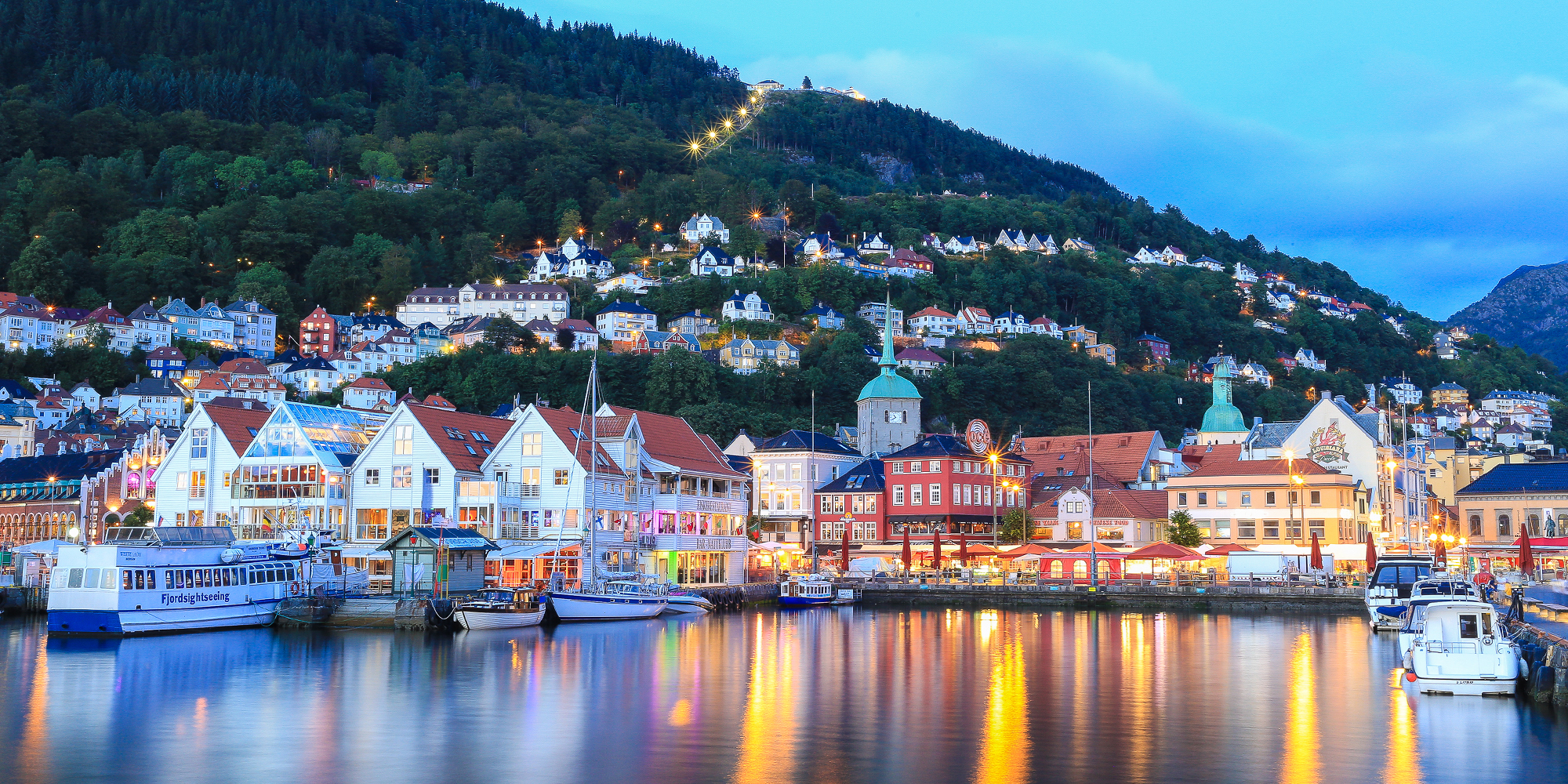
The banner image is Bryggen Bergen ⓒ Gene Inman Photography. Please visit his page on Flickr or visit his website – Gene Inman Photography.

For a detailed history of Begen, Norway visit: I Love Bergen – The History of Bergan by Emma Vestrheim.

If you’d like to learn more about the 52 Ancestors in 52 Weeks project, please visit here:

52 Ancestors in 52 Weeks.

Or join the Facebook group Generations Cafe.

If you use any information from my blog posts as a reference or source, please give credit and provide a link back to my work that you are referencing. Unless otherwise noted, my work is © Anna A. Kasper 2011-2026. All rights reserved. Thank you.

Posted in 52 Ancestors in 52 Weeks, Famous Kin, Genealogy, Uncategorized | Tagged , , , , , , , , , , , , , , , , , | 3 Comments

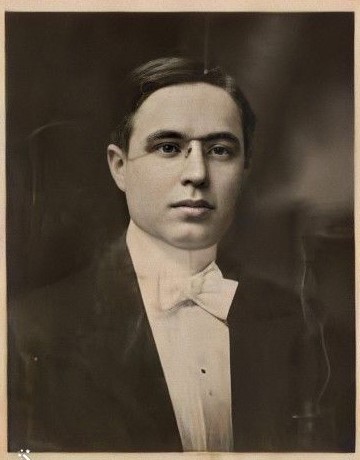
Ragtime Composer (Cousin) Percy Wenrich. 52 Ancestors – Week 5 and February Theme – Branching Out

The theme for February 52 Ancestors in 52 Weeks is Branching Out.

One way to take this week and month’s theme of branching out is to write about collateral relatives – those that share the same family descent as me but by a different line. I have many historical and famous kin that descend from collateral lines, but I chose to write about my lesser-known Cousin Percy Wenrich. He is my fourth cousin, three times removed. Meaning that he and my great-grandfather Abraham G. Kennedy were direct fourth cousins. We share ancestors Johann Matthias Wenrich (Weinrich) and Judith Schauer.

Although today most-likely only those that are fans of ragtime music or study music of this time period would recognize his name. He and his wife Dolly Connolly were Ragtime superstars in their own time! Actually, Percy Wenrich was a quite well-known composer of Ragtime and popular music of the time. When I discovered my kinship to him, I sought out his music. I am a fan of Ragtime music and remember playing Ragtime songs on the piano from the film The Sting. I have to say that I truly am a fan of his and I have a playlist devoted to the music of Percy Wenrich.

Perry Wenrich – 1910

Percy Wenrich was born on 23 January 1887 in Joplin, Missouri. He was later known as the “The Joplin Kid” due to his links to Joplin.

He was the son of Daniel K. Wenrich and Mary L. Ray. He came from a musical family. His father Daniel “according to a 1912 [Jopin] Globe article, [he was known] for his musical ability as a quartet singer and “composer of campaign songs in the days of President William McKinley.” Percy’s mother, Mary, was an accomplished pianist and organist and his first teacher.” (1)

Percy published his first piece, titled “L’Inconnu,” in 1897 when he was 17. He had a thousand copies printed, which he sold one at a time in the district. While he was busy working up music, he was employed as an assistant postal clerk by his father. He also performed for friends at the YMCA at 418 Main St. [Joplin, Missouri] in 1901. Young Percy began writing his own melodies for which his father provided lyrics. Many of these songs were used locally at political rallies and conventions. He continued to be interested in music and enrolled in the Chicago Musical College to be trained as a “serious” musician. Chicago Musical College was run by Florenz Ziegfield, Sr., the father of the Broadway producer Florenz Ziegfeld Jr. He continued his efforts in writing popular song and while in Chicago, succeeded in having two of his works published, Ashy Africa and Just Because I’m From Missouri. Interestingly perhaps, both titles were suggested to him by Frank Buck, a Chicago music publisher who went on to become a famous producer of African travel and adventure films. While in Chicago, he worked for McKinley Music Company writing melodies for lyrics sent to McKinley. He composed various works including waltzes, songs, intermezzi and rags. He also worked in a Milwaukee department store’s music department where he published another song, Under A Tropical Moon. He later noted that working in the department store kept him from working in “the district” — an area that was home to many brothels. (1, 2)

His first best-seller without lyrics was “The Smiler,” published in 1907. He subtitled it “A Joplin Rag” in honor of his hometown. As I write this, I am currently listening to “The Smiler” as played by Sue Keller below.

He met his wife Catherine Ann “Dolly” Connolly, a vaudeville singer, in 1905, and a year later they wed. Dolly lists her place of birth as Chicago, Illinois and Michigan in various records, but she was actually born in County Caven, Ireland. Percy and Dolly toured as a vaudeville song and dance act for fifteen years.

Dolly was considered by many to be the most beautiful of the famous ragtime singers and had marked out a steady career for herself in vaudeville when she met up and coming composer and accompanist Percy Wenrich, a handsome but rather shy and nerdy fellow who became a pop music genius. The unlikely couple hit it off instantly and became inseparable, living as well as touring together and Wenrich began to write music for her including the 1911 mega-hit Red Rose Rag which became one of Dolly’s signature songs along with Alamo Rag, also written by Wenrich. (3)

“As many successful songwriters did during that time, Wenrich teamed up with Homer Howard to form his own music publishing house, the Wenrich-Howard Company. Together they published a number of his songs, including, Kentucky Days, Whipped Cream Rag and Snow Deer in 1913. Within only a year, Wenrich gave up the publishing business as it was taking him away from song writing and performing. So, in 1914, he gave it up to devote all of his time to composing and performing with Dolly in vaudeville. He connected with Leo Feist that year as his publisher and that same year he scored what may be his greatest hit of all time, When You Wore A Tulip And I Wore A Big Red Rose. For several years, perhaps fifteen or so, Connolly and Wenrich toured vaudeville singing mostly his songs. Connolly’s success also carried over to recording and she became a huge star recording songs for Columbia.” (2)

Dolly Connolly

Dolly had a contralto voice which allowed her to go down for some rather low notes while still having considerable power and she also possessed a wide vocal range. She could sing melodies precisely and exactly on pitch which was essential for vocal versions of rags. She didn’t impose too much emotion in her songs and never did scat singing or even fairly simple deviations from the melody but preferred to sing the music as written, especially when written by her husband who was writing for her range and vocal character.

She also was stunningly beautiful and always dressed in the latest, most elaborate fashions of the time, similar to a Ziegfeld star such as Lillian Lorraine and was not above posing in a saucy manner smoking a cigarette and hiking up her skirt to show off a little leg. After her marriage to Wenrich she continued her career and actually expanded it as her fame grew and she and her husband became a major vaudeville attraction as either he or she or both put out hit after hit. In 1912 Wenrich and lyricist Edward Madden put out Moonlight Bay, which was an enormous hit and made the Connolly-Wenrich team an even bigger attraction in vaudeville. (3)

The [Joplin] Globe reprinted a Chicago Tribune review of their act from Aug. 27, 1912. “Seated idly at the piano at the Majestic this week is Mr. Percy Wenrich, a plump and pleasing young fellow who plays with great expression and effect the melodies of his own composition. These works include such musical necessities as ‘Moonlight Bay’ and ‘Put on Your Old Gray Bonnet,’ ‘The Skeleton Rag’ and ‘Rainbow,’ to say nothing of a score of other sentimental tunes, which insist on being whistled. (1)

Just back of Mr. Wenrich and the piano is Miss Dolly Connolly, an expert at the rhythmical rendition of Mr. Wenrich’s ballads. She sings most attractively while Mr. Wenrich helps out with the chords and both of them do about all that can be done for minor music. Ere the act is over, and while Miss Connolly is making one of her bewildering changes of costume, Mr. Wenrich plays a segment from each of his most popular ditties. Whereupon those in the audience applaud their favorites and Mr. Wenrich smiles benignly like a benefactor, which he probably is. (1)

In the 1920s Percy devoted himself to creating and contributing to Broadway shows both with and without Dolly with some success, the operetta Some Party, a strong performer in 1925 but without Dolly in the cast. Although Dolly had a successful career with Columbia Records and was  continuing in vaudeville, her star had faded by the later 1920s (although she and Percy toured in vaudeville up to 1929 and Dolly and Percy hit Broadway with several shows in which she starred with mild success) with changing musical tastes and Percy also retired from composing and performing in the 1930s, apparently to care for Dolly who suffered from an undisclosed illness, apparently Alzheimer’s Disease, which caused Percy at first to limit their theatrical and radio performances and then to confine her to a sanitarium in 1947 where she stayed until his death in 1952.  In 1939 Percy had put together a revue featuring classic songwriters which was called Songwriters on Parade but that seems to be his last venture into major entertainment. Dolly lived with her sister until her death in 1965 at age 77, by that time long forgotten by the general public. (3)

A few more facts about Percy Wenrich: He was the founding member of the American Society of Composers, Authors and Publishers. And he was inducted into the Songwriters Hall of Fame in 1970.

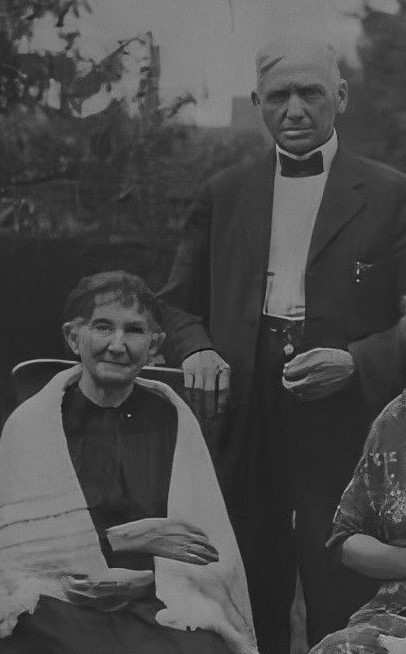
My great-grandfather Abraham G. Kennedy with his mother, my great-great grandmother, Susan Palmer Kennedy – 1922.

Side note: My great-grandfather Abraham G. “Abe” Kennedy worked many years as a public-school teacher, then as a principal. But after he retired, he worked in a music store and a piano store. He was musical and I truly believe he would have enjoyed knowing that he and Percy Wenrich were cousins and shared an affinity for music. In the photo above is Abe with his mother Susan Palmer Kennedy. Susan would have been a direct third cousin to Percy Wenrich’s father Daniel K. Wenrich.

Percy Wenrich’s direct line:

  1. Johann Matthias Wenrich (son of Balthazar Wenrich/Weinrich and Maria Elisabeth Magdalena ____) and Judith Schauer (daughter of Johannes Michael Schauer and Anna Magdalena ____).
  2. Matthias Wenrich and Eva Ephrosina “Rosine” Schauer (daughter of Johann Hans Michael Schauer and Elisabeth Catharina Lauck/Laux).
  3. Thomas Wenrich and Anna Margaretha Lingle (daughter of Thomas H. Lingle, Sr. and Anna Mary Feggen).
  4. David Wenrich and Catherine Kinports (daughter of John Kinports and Barbara Huber).
  5. David K. Wenrich and Mary L. Ray (daughter of William Ray and Elizabeth Jane Rodgers).
  6. Percy Wenrich.

My direct line:

  1. Johann Matthias Wenrich (son of son of Balthazar Wenrich/Weinrich and Maria Elisabeth Magdalena ____) and Judith Schauer (daughter of Johannes Michael Schauer and Anna Magdalena ____).
  2. Maria Esther Wenrich and Johann Jacob Spatz (son of Lorentz Spatz and Anna Maria Kirchenbauer)
  3. David Spatz and Hannah Hafer (daughter of Andrew Hafer and Elizabeth (Mary Elizabeth) Druckenmiller).
  4. Mary Ann Spotts and John Palmer (son of Floyd Palmer and Barbara Wolf).
  5. Susan Palmer and John Davis Kennedy (son of John Kennedy and Jane Williams).
  6. Abraham G. Kennedy and Mary Elizabeth Price (daughter of James Price and Julia Ann Mateer/Meteer). My great-grandparents.

I thought as an ending note that I’d include below one of my favorites by Percy Wenrich “Peaches and Cream”.

Peaces and Cream by Cousin Percy Wenrich.

Resources:

  1. Bill Caldwell: Ragtime composer Percy Wenrich was known as ‘The Joplin Kid’ – Bill Caldwell, The Joplin Globe online.
  2. Percy Wenrich – “The Joplin Kid” – Composer Biographies – The Parlor Songs Academy website.
  3. Dolly Connolly and Percy Wenrich: Ragtime Superstars by David Soren – The American Vaudeville Museum & UA Collection – The University of Arizona.

If you’d like to learn more about the 52 Ancestors in 52 Weeks project, please visit here:

52 Ancestors in 52 Weeks.

Or join the Facebook group Generations Cafe.

If you use any information from my blog posts as a reference or source, please give credit and provide a link back to my work that you are referencing. Unless otherwise noted, my work is © Anna A. Kasper 2011-2026. All rights reserved. Thank you.

Posted in 52 Ancestors in 52 Weeks, Famous Kin, Genealogy | Tagged , , , , , , , , , , , , , , , , , , , , , , , , , , , , , , , , , , , , , , , , , , , , , , , , , | 4 Comments

My Greatsinger (Gretzinger) and Bonnett ancestors of Berlin, Germany and Related Lines.

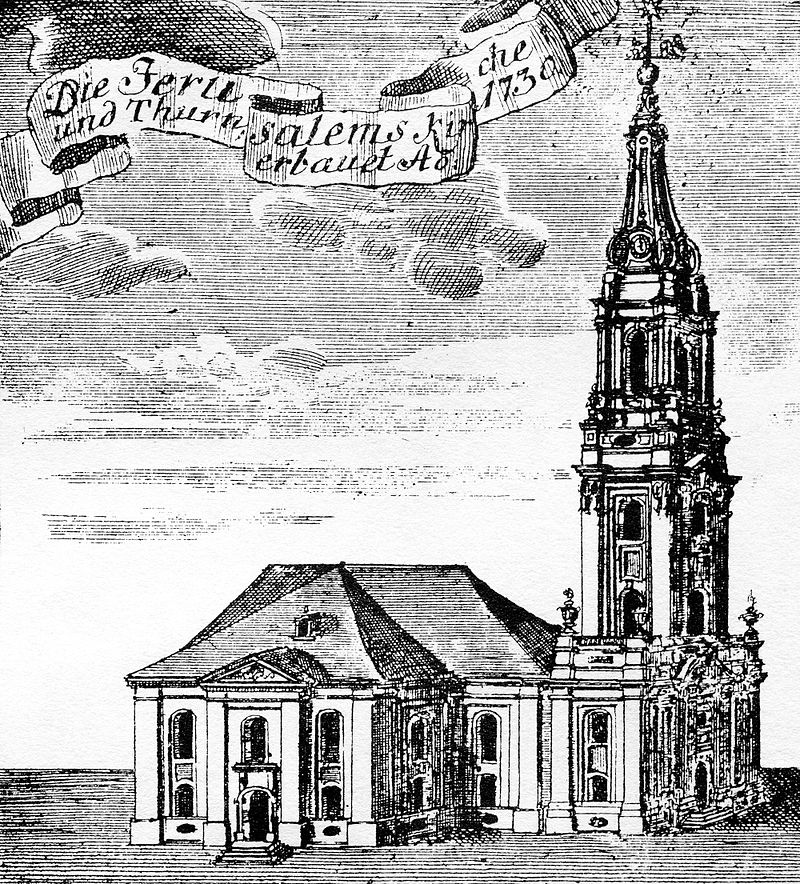
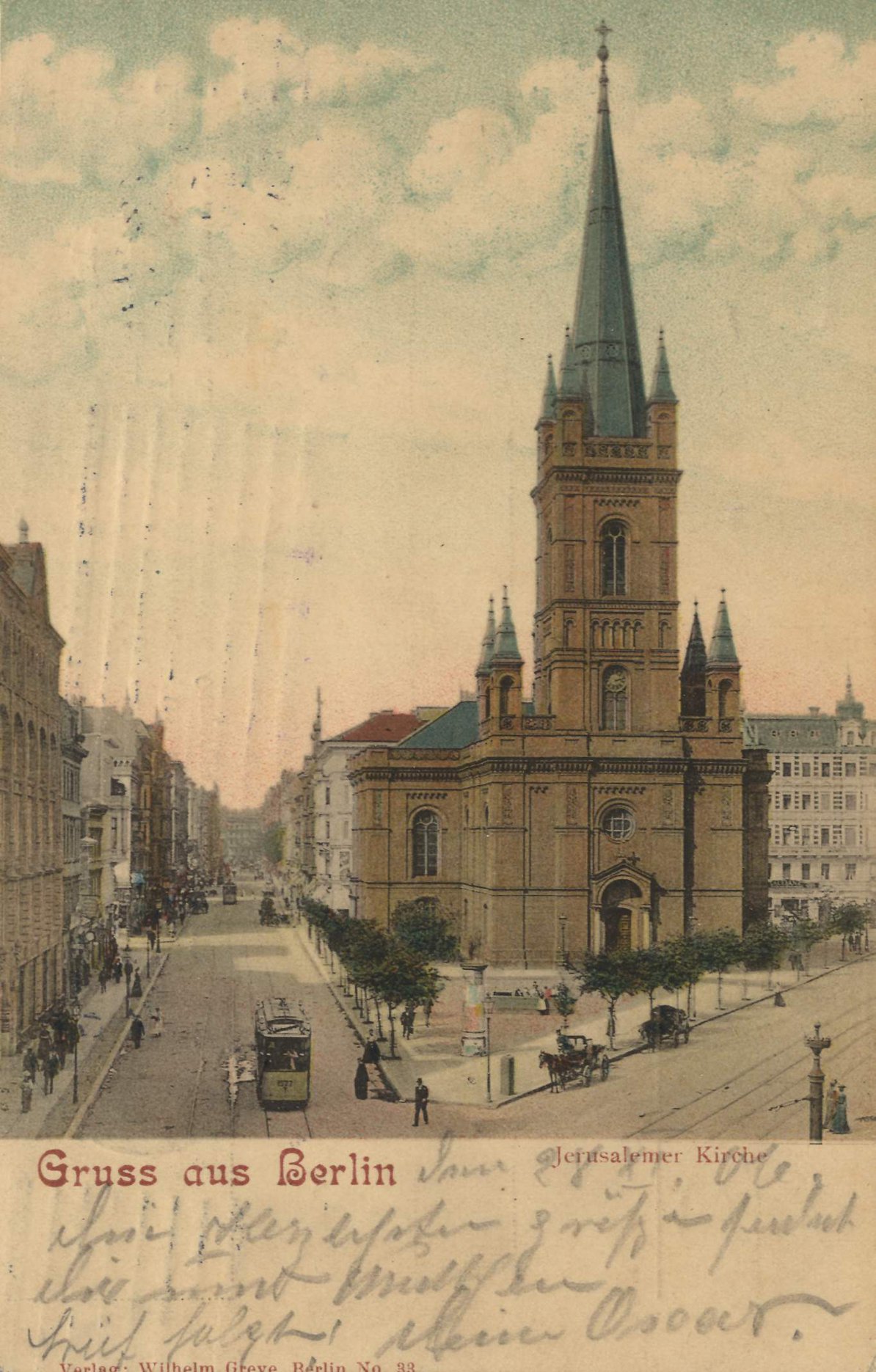
Jerusalem Chapel

Update of 27 December 2025: Please see my new blog post specifically about My Bonnet Ancestors of Alpes-de-Haute-Provence, France and Berlin, Germany.

Update of 29 August 2025: I spent a significant amount of time painstakingly going through many additional German church records, and as well as records found in Colonial America in the 1700s. My sixth great-grandfather’s surname is listed many various ways, making it a bit more work to locate him in all the applicable church records.

I discovered the parentage of my sixth great-grandfather Johann Jacob Gretzinger. He was the son of Jacob Gretzinger and Barbara Scheüchzer. His mother was the daughter of Samuel Scheüchzer. His parents married on 17 August 1702 at the Jerusalem Chapel in Berlin, Germany.

The surname Scheüchzer is a Swiss German name, and its origin is Swiss. The name is a variant of the Swiss German surname Schwyzer, which is a habitational name for someone from the city or canton of Schwyz in Switzerland. “Schwyzer” is a Swiss German dialectical term that means “Swiss person”. Over time, the name evolved into various forms, including Scheuchzer. A famous bearer of this name was Johann Jakob Scheuchzer, a Swiss natural scientist and physician.

How my Scheüchzer ancestors came to be in Berlin is unknown. It is a considerable distance from Berlin to the Swiss border.

The surname of Johann Jacob is found in church records in Germany as Gritzinger, Gretzinger, Ertzinger, Götzinger, as well as some other weird variations of the spelling of the name.

Johann Jacob Gretzinger and Barbara Scheüchzer had the following children:

  1. Anna Barbara Gretzinger, baptized 1 October 1702 at the Jerusalem Church in Berlin, Germany. In her baptism record the surname is misspelled as Jetsinger.
  2. Johann Jacob Gretzinger was born 1 November 1703 in Berlin, Germany. In his birth record the surname is misspelled as Jetzinger. He married Loisa (Louisa) Antoneta Bonnett on 30 November 1725 at the Jerusalem Church in Berlin, Germany. (my direct ancestors). After her death, he married second to Eva Elisabeth Geschken on 13 March 1735 at the Jerusalem Chapel in Berlin.
  3. Anna Barbara Regina Gretzinger was born 29 November 1705 in Berlin, Germany, and was baptized on 2 December 1705 at the Jerusalem Church in Berlin, Germany. In her birth and baptism record the surname is misspelled as Jetzmeyer and Jotzingers.
  4. Anna Maria Barbara Gertzinger, baptized on 29 June 1710 at the Jerusalem Church in Berlin, Germany. In her baptism record the surname is listed incorrectly as Schirtzinger.
  5. Johann Jacob Wilhelm Ertzinger, baptized on 5 July 1711 at the Jerusalem Church in Berlin, Germany.
  6. Johann Heinrich Ertzinger, baptized on 6 September 1713 at the Jerusalem Church in Berlin, Germany.
  7. Ursula Catharina Elisabetha Ertzinger, baptized on 25 May 1719 at the Jerusalem Church in Berlin, Germany.
  8. Anna Dorothea Elisabetha Ertzinger, baptized on 21 November 1720 at the Jerusalem Church in Berlin, Germany.

Examining my fifth great-grandfather’s will and other documents led to some additional changes. Christian (Johann Christian) Greatsinger (Gretzinger) died on 14 March 1805 in Kingston, Ulster, New York, and is buried in the Freer Cemetery along with his first wife Anne Antje Anna Palmer and two of their daughters. I had previously found his marriage record to Susannah Myers, his second wife. They married on 10 November 1799 in Ulster Park, Ulster, New York. This means that all of his known children were from his first marriage. Anne Antje Anna Palmer is the mother to all of his children. After his death, his second wife Susannah Myers did migrate with family members to Elmira, Chemung, New York, and she is buried in the Greatsinger Cemetery. My fourth great-grandfather John (Johann) Greatsinger/Kritsinger and his wife Lea Litts are also buried in the Greatsinger Cemetery.

It was only last night that I located the marriage record for (Johann Christian) Greatsinger (Gretzinger) and Anne Antje Anna Palmer. Both their surnames were incorrectly spelled, which made for some creative research to locate the record! They were married on 19 July 1762 in Monmouth County, New Jersey. Their names are listed as follows: Palmmar, Anna, Monmouth, and Christen Graten, Monmouth … 1762 July 19 (see image above).

Some have attached Emanuel Palmer, of Lancaster, Pennsylvania as the father of Anne Antje Anna Palmer. I have not found any records to support this link to him. Her parentage, for now, remains unknown. But I believe that she had at least one sibling, a brother, named Christian. According to New Jersey marriage records, Christian Palmer married in 1753 in Monmouth County, New Jersey, to Ann Williams. I have not been able to locate any additional information regarding Christian Palmer and, his wife, Ann Williams.

Via church records, I also discovered two additional children for Johann Jacob Gretzinger with his second wife Eva Elisabeth Geschken.

My Greatsinger (Gretzinger) and Bonnett ancestors are through my 3rd great-grandmother Hannah Elizabeth Kritsinger/Greatsinger (she married David Prindle, Sr.).

Her grandfather was Johann Christian Gretzinger (Greatsinger), who was the son of Johann Jacob Gretzinger and Loisa (Louisa) Antoneta Bonnett. He was baptized 17 Jun 1729 in the Jerusalem Chapel (Church of the Archangels Michael and Gabriel) in Berlin Stadt, Brandenburg, Prussia, Germany.

Loisa (Louisa) Antoneta Bonnett was the daughter of Francois Jean (Johann Frantz) Bonnet and Anna Dorothea Steiner.

Johann Frantz Bonnett is listed in German church records as Johann Franciscus Bonnet, Johann Frantz Bonet, Frantz Bonet, and with surname listed as both Bonnet and Bonnetts. On his marriage record his father is listed as Johann Bonnet. His French name was Francois Jean and his father’s French name was Jean.

History of the religious affiliation of the Jerusalem Church: United Protestant since its reconstruction in 1968, originally Roman Catholic, Lutheran from 1539 until deserted in the Thirty Years War, Calvinist (1658–1662), the Calvinists and Lutherans shared the church (1682–1830), Evangelical Protestant (1830–1941), Romanian Orthodox (1944–1945), then destroyed. (4)

Johann Jacob Gretzinger married to Loisa (Louisa) Antoneta Bonnett married 30 Nov 1725 at the Jerusalem Church in Berlin, Germany.

Johann Jacob Gretzinger and Loisa (Louisa) Antoneta Bonnett had the following children:

  1. Abraham Friedrich Gertzinger baptized 23 January 1727 at the Jerusalem Church in Berlin, Germany. He may be the Friederich Gatzinger that came to Philadelphia, Pennsylvania in 1749, who is found as Fredk Getzinger in the 1780 US Census for Northern Liberties, Philadelphia, Pennsylvania, and is listed as Frederick Gatzinger in probate records of 1793 in Philadelphia, Pennsylvania. His name is also found in records as Gotzinger.
  2. Christian Greatsinger Gretzinger (baptized Johann Christian Gertzinger) born 12 June 1729 in Berlin, Germany, baptized 17 June 1729 in the Jerusalem Church in Berlin, Gemany. He died 14 March 1805 in Kingston, Ulster County, New York. He married first to Anna Anne Antje Palmer (my ancestors) on 19 July 1762 in Monmouth County, New Jersey. Their names are listed as follows: Palmmar, Anna, Monmouth, and Christen Graten, Monmouth … 1762 July 19. They had 10 children. After her death he married second on 10 November 1799 in Ulster Park, Ulster, New York, to Susannah Myers.
  3. Anna Dorothea Ertzinger baptized 20 August 1730 at the Jerusalem Church, Berlin, Berlin, Germany and died before 1738 in Berlin, Germany.

Loisa (Louisa) Antoneta Bonnett died in December 1730 in Berlin, Germany. After her death, Johann Jacob Gretzinger married second on 13 March 1735 at the Jerusalem Chapel to Eva Elisabeth Geschken, the daughter of Daniel Geschken and Anna ____.

Johann Jacob Gretzinger and second wife Eva Elisabeth Geschken had the following children:

  1. Anna Barbara Elisabeth Ertziner baptized 5 September 1736 at Neue Kirche (The New Church), Berlin, Germany.
  2. Dorothea Louise Ertzinger born 4 June 1738 in Berlin, Germany, and died 8 November 1805 in Berlin, Berlin, Germany. She married Friedrich Willhelm Schellentrager in 1778. She had a least two children, a son and a daughter. The son has descendants. The surname Schellentrager was shorten to Schellin/Schellen. Some of their descendants immigrated to the USA at the end of the 19th century, but most stayed in Germany.
  3. Jacob Benjamin Ertzinger, baptized on 12 June 1740 in Berlin, Germany. He went to South Carolina, where he married Maria Margaretha Marx. His daughter, Maria Magdalena Gitsinger / Gotzinger, married Barnerd Litz Lietz Leitz, a Litts/Litz cousin. He was the son of Barnerd Litz Lietz Leitz and Mary Magdalene Edon. The father, Barnerd/Bernard Litz Lietz Leitz, was born in New York and migrated to South Carolina and was the son of Daniel Litz Letts Litts Lietz and Femmetje Clerk/Klerk.
  4. Johann Jacob Ertzinger was born about 1741 in Berlin, Germany. He married Dorothea Charlotta Kretschmann on 26 December 1763 at Evangelische Stadtkirchen Berlin (Brandenburg) – Evangelical City Churches of Berlin (Brandenburg). She was the daughter of Johann Christoph Kretschmann.
  5. Anna Dorothea Louysa Ertzinger baptized 21 October 1742 at Neue Kirche (The New Church), Berlin, Germany.
  6. Maria Elisabeth Charlotte Ertziner baptized 26 December 1745 Neue Kirche (The New Church) in Berlin, Germany
Photo postcard of the Jerusalem Chapel taken in 1906.

Bonnet Name Meaning

French: from the medieval personal name Bonettus, a diminutive of Latin bonus ‘good’. French: occasionally, a Gascon variant of Bonneau. English and French: metonymic occupational name for a milliner, or a nickname for a wearer of unusual headgear, from Middle English bonet, Old French bon(n)et ‘bonnet’, ‘hat’. This word is found in medieval Latin as abonnis, but is of unknown origin. In Germany the name was borne by Waldensians, of French origin, and French Huguenots. (1)

Gretzinger Name Meaning

One source states the Gretzinger surname means someone from any of the three places named Grötzingen (Old High German Grezzingun) in Baden-Württemberg, Germany. Another source states it is a Swedish and German surname that was a locational name for a dweller on a pebbly or sandstone piece of land, or one who came from Gresse in Germany.  (2) The name could also be related to the surname Kritzinger which originally was Kreutzinger and meaning “Living near the Cross” in German.

Johann Christian Gretzinger (Greatsinger) emigrated to the American Colonies before 1760 and settled in Freehold, Monmouth, New Jersey. He married Anne (Antje) Palmer. Most of his older children’s baptism records are found there in the Dutch Reformed Church Records in Freehold, New Jersey. He migrated to Ulster County, New York by 1774. After the death of his first wife, he marries second to Susannah Myers in Ulster County, New York.

Children of Johann Christian Greatsinger (Gretzinger) and Anna Anne (Antje) Palmer:

  1. Catherina (Catrina) Greatsinger/Kritsinger, she married Johannes John Deyo
  2. John (Johann) Greatsinger/Kritsinger, he married Lea Litts
  3. Stephenus/Stephen Greatsinger, he married Deborah Litts
  4. Susannah M. Greatsinger/Kritsinger, she married Benjamin Deyo
  5. Maria Polly Greatsinger, she married Daniel Litts
  6. Sarah Greatsinger, she married Isaac Sluyter
  7. Anna Greatsinger, she married Ezekiel Rhodes
  8. Eleanor Greatsinger, she married Johannes John Litz/Letts (Litts)
  9. Rev. Christan Greatsinger, he married Anna Mariah Smith
  10. William Greatsinger, he married Phebe Spencer

As you can see, many of the Greatsinger siblings married into the same Litts family, two married into the same Deyo family. One married into the Sluyter family, this is same Sluyter family that I am also descended from, for my ancestor Lea Litts mother’s maiden name was Sluyter (see below).

I am a DNA match to over 100+ people that are all descendants of Christian (Johann Christian) Greatsinger and his wife Anna Anne (Antje) Palmer.

My direct ancestor is John (Johann) Greatsinger, the son of Johann Christian Greatzinger (Greatsinger) and Anna Anne (Antje) Palmer. He was baptized 30 Apr 1764 in the Dutch Reformed Church in Freehold, Monmouth, New Jersey. I have not been able to find his marriage record yet, but he married Lea Litts, the daughter of Roelof Lits/Litts/Litz and Sara (Saartje) Sluyter.

My Litz ancestors came early to America most likely from Germany, although the surname is found to a lesser degree in the Netherlands as well. Roelof Lits/Litts/Litz was the son of Daniel Litz/Letts/Litts and Femmetje Clerk/Klerk.

Daniel Litts was the son of Johannes “John” Litz and Maria Barbara ____. In 1710, Johannes “John” Litz arrived in New York with his pregnant wife Maria Barbara, and their daughter Anna Magdalena. Their son Daniel Litts was born in 1710 after they arrived in New York.

Some list Johannes “John” Litz as the person baptized on 27 May 1660 in Wannweil, Reutlingen, Baden-Württemberg, Germany. While it is not impossible, it makes him quite old, almost 50 years old at the time of the birth of his daughter. I believe that where he was from in Germany, or possibly even in the Netherlands, has yet to be found.

Some change the name of his wife to Maria Elisabetha Völmlin, with a marriage date of 27 Jan 1711 in Adersbach, Baden-Württemberg, to a Johannes Letz. The year of this marriage is after the family had already arrived in New York. So, that is not correct. Also, his wife’s name was Maria Barbara, not Maria Elisabetha.

DNA and the researching of records in Germany and the Netherlands, may shed light on his roots, but for now, his parentage, and place of birth are unproven.

Femmetje Clerk/Klerk was the daughter of Willem Klerk/Clerk and Hilletje in ‘t Veld (Hendricksen). Hilletje in ‘t Veld was the daughter of Roeloff Hendrick in ‘t Veld Hendricksen and Aeltje Lubbers. In the past, there were some that listed her maiden name as Van der Bilt, that is a misreading of her name in church records, it is clearly listed as in ‘t Veld, and once listed as van Veld, but never as Van der Bilt.

Roeloff Hendrick in ‘t Veld Hendricksen was born in Meppen, Coevorden, Drenthe, Netherlands. His parentage is unproven. But it appears he was the son of a man named Henrick. Aeltje Lubbers was born in Elburg, Gelderland, Netherlands. She was the daughter of Lubbert Jansen and Aeltje Wygerts/Wiggers, who were from Heerde, Heerde, Gelderland, Netherlands.

There are those that say Willem Clerk was the son of William Clerke of Leicester, Leics, England who died in Virginia and Mary Spenser. His parentage is unknown and unproven, what is known, based on his marriage record, is that he was born in England.

Roelof Litts married Sara (Saartje) Sluyter, the daughter of Edward Sluyter (Sluiter) and Lea Van Schuyven. My Sluyter ancestors were originally from Oldenburg, Niedersachsen, Germany, but Sluyter/Sluiter is exclusively a Dutch surname. Variants are Sluiters, Sluijter(s) and Sluyter(s). Literally meaning “one who closes”, it is an occupational surname, originating from people with the profession of doorkeeper, gateman, warden, jailor, etc. Prior to being in Germany, their roots no doubt were in the Netherlands, possibly in Groningen. My Van Schuyven ancestors were from ‘s-Hertogenbosch (now called Den Bosch), Noord-Brabant, Netherlands. The name Roelof is a given name of Dutch origin, it is the Dutch cognate of Rudolph. (3)

You may read more about my Dutch ancestors related to my ancestors Edward Sluyter and Lea Van Schuyven here: My Dutch Gardenier (Flodder) Ancestors and Related Lines. And Cousin Hannah Hoes Van Buren (wife of Pres. Van Buren).

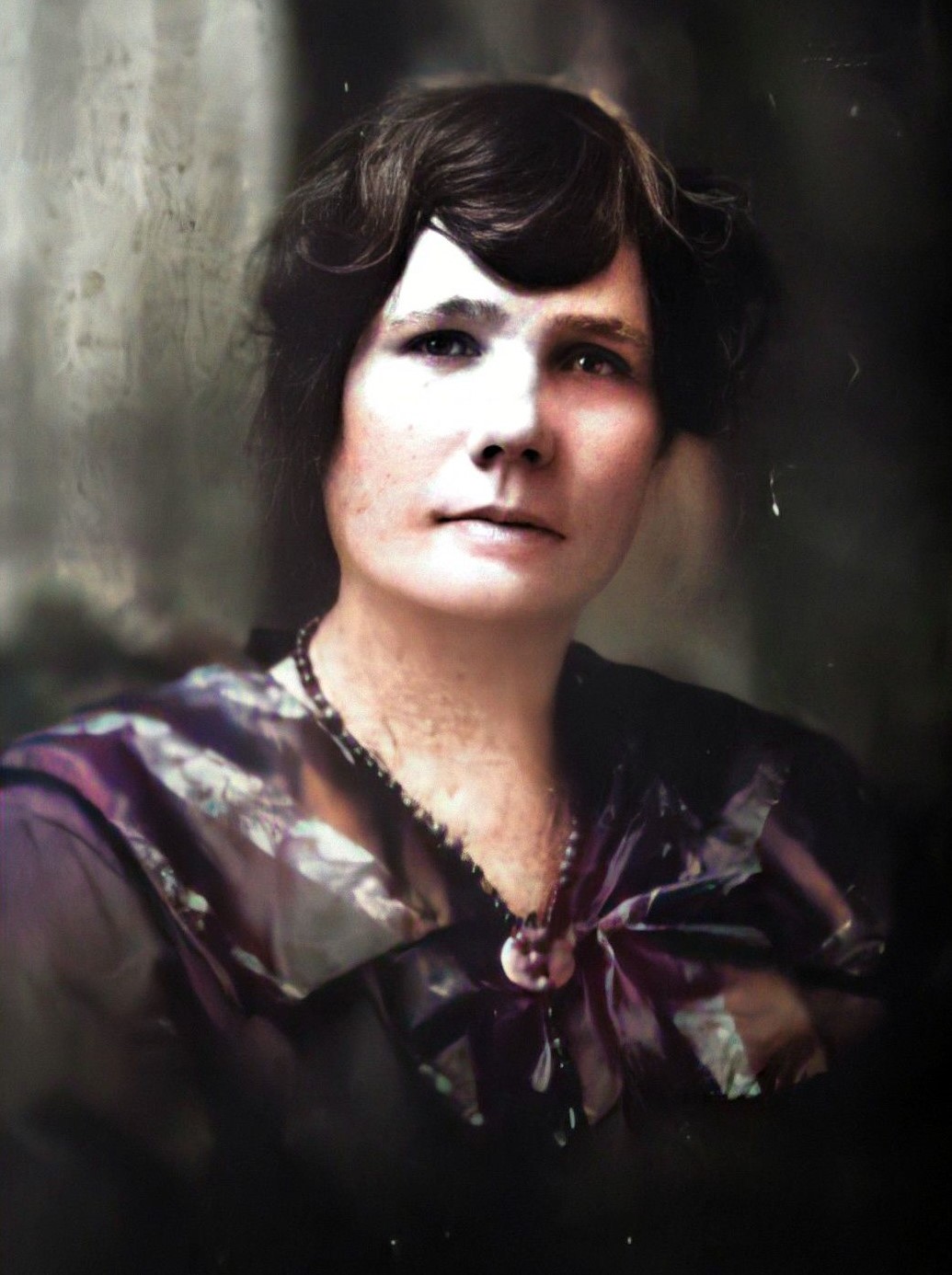
Pictured is my great-grandmother Anna Cora Prindle Cole.

My direct line:

  1. Jacob Ertzinger Gertzinger Götzinger and Barbara Scheüchzer.
  2. Johann Jacob Gretzinger Gritzinger Ertzinger and Loisa (Louisa) Antoneta Bonnett (daughter of Francois Jean (Johann Frantz) Bonnet and Dorothy Steiner).
  3. Johann Christian Gretzinger Gertzinger Greatsinger and Anna Anne (Antje) Palmer.
  4. John (Johann) Kristinger/Greatsinger and Lea Litts (daughter of Roelof Litts and Sara (Saartje) Sluyter).
  5. Hannah Elizabeth Greatsinger/Kritsinger and David M. Prindle, Sr. (son of Amos Prindle and Esther Canfield).
  6. Daniel Prindle and Sarah Jane “Jennie” Doman (daughter of Jacob Doman and Mary Ann Davison/Davidson).
  7. Anna Cora Prindle and Joseph Edward Cole (son of Lorin Richard Cole and Nancy M. Losure). My great-grandparents.

References:

  1. Bonnet Name Meaning – Ancestry.com
  2. Gretzinger Name Meaning – Ancestry.com
  3. Origins of the Given Name Roelof
  4. Rabe Family Genealogy Blog

If you use any information from my blog posts as a reference or source, please give credit and provide a link back to my work that you are referencing. Unless otherwise noted, my work is © Anna A. Kasper 2011-2026. All rights reserved. Thank you.

Posted in Uncategorized | Tagged , , , , , , , , , , , , , , , , , , , , , , , , , , , , , , , , , , , , , , , , , , , , , , , , | 6 Comments

My Ancestor William Durkee – First Irish Catholic to settle in Massachusetts

This week in 52 Ancestors in 52 weeks, the prompt is “Favorite Find” – there are so many stories, photos, and other finds that I could use for this week, but I am deciding to re-blog my post about my ancestor William Durkee, the first Irish Catholic to settle in Massachusetts. He is one of my favorite finds. His courtship and marriage to Martha Cross, the daughter of the quite litigious and very Protestant Robert Cross, are chronicled in detail in Essex County, Massachusetts court records, which includes facts, hearsay, and lots of gossip as testimony!

Anna Kasper, ACDP's avatarAnna's Musings & Writings

My more recent immigrant ancestors were from in and around Gort and Peterswell Parish in Galway, Ireland, and from Klingenmünster in the Südliche Weinstraße(Southwest Wine Route) district in Germany. I have to go back an additional eighty-five years to find my next immigrant ancestors, they were Kennedy and Murray Scots-Irish that came to British Colonial America about 1770 from Ballintoy, Antrim, Ireland. I do have a few German ancestors that came from Germany in the 1750’s. And I have several additional German ancestors that came to British Colonial America via England in 1710. The English transported nearly 3,000 German Palatines in ten ships to New York in 1710. However, I have a huge amount of Colonial American ancestors that were here even earlier, including a few Mayflower Pilgrims. Although many of my Colonial ancestors were from England, I also have some that were from Scotland, Wales, Germany, The Netherlands, France…

View original post 3,427 more words

Posted in Uncategorized | Leave a comment

52 Ancestors in 52 Weeks. Week 1. Foundations. Fahy/ Fahey Ancestors.

I took a few weeks off from my 52 Ancestors in 52 Weeks blog posts. I was quite busy working and volunteering for The Salvation Army during the latter part of December. So, I am now beginning again now that it is a new year and new prompts. This year we have more options; we have a theme each month and prompts each week. For January, the theme is Foundations. Also, this first week of January the prompt is also the word Foundations. Additional information about this week’s prompt: “Some ways you might interpret this include focusing on the person who sparked your interest in family history, a builder in your family tree, or the person who is the bedrock of your family.

I spent quite a bit of time going through all the surnames of my direct ancestors in my family trees (a daunting task!) looking up the meanings of each surname that I had not done this prior. I got to the letter “f” and to the surname Fahey/Fahey (Fay), and I realized that I should have thought of it right away, I already knew that the meaning of the surname is related to the word FOUNDATION!

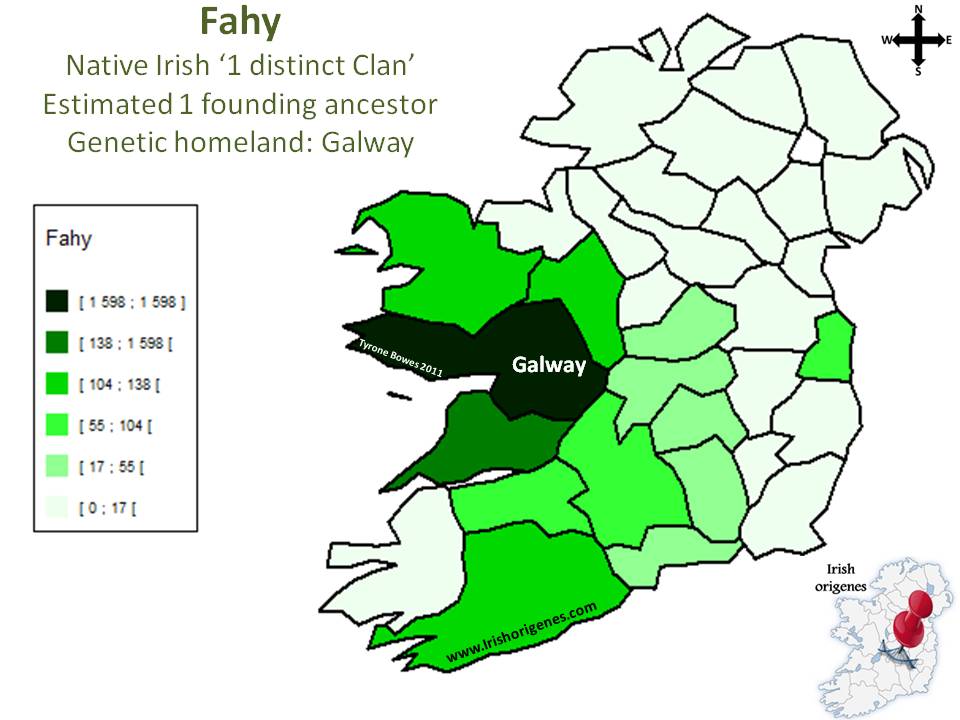
The surname Fahy/Fahey is Irish and is an Anglicized form of the Gaelic Ó Fathaidh or Ó Fathaigh meaning ‘descendant of Fathadh’, which is a personal name derived from fothadh ‘base’, ‘foundation’. This name is sometimes Anglicized as Green(e) as a result of erroneous association with faithche ‘lawn’. (1 & 2)

The name still has a very strong association with County Galway, Ireland, where the historic homeland was situated. The area of the family’s power was around the modern town of Loughrea in the south of the county, and they retained their property in the region until the catastrophe of the seventeenth century. The surname is still most plentiful in this area, despite the upheavals and migrations which have spread the name quite widely throughout Ireland. (2)

Interesting to listen below as to how the surname Fahey/Fahy is pronounced in Irish, whereas in American English it came to be pronounced Fay-He thus why my ancestor, eventually after several decades in America, dropped the ‘h’ and began spelling his surname as Fay.

The words base and foundation refer to anything upon which a structure is built and upon which it rests, the basis or groundwork, the act of founding, setting up, establishing. My ancestor Daniel Wolfetone Fahey/Fahy (Fay) and his kin were certainly our Irish foundation ancestors here in America.

For more information about my Fahy/Fahey ancestors and related lines, I have provided links below to a few other blog entries that I have written about my paternal Irish family.

Strength. My Irish Ancestor Daniel Wolfetone Fahey/Fahy (Fay) from County Galway, Ireland.

My ☘️ Irish ☘️ Joynt and Larkin Ancestors from Galway and Clare. Related Irish lines: Fahy/Fahey, O’Donnell, Nestor, Hanberry/Hansberry.

References:

  1. Fahey Name Meaning – Ancestry.com
  2. Fahey surname history

If you’d like to learn more about the 52 Ancestors in 52 Weeks project, please visit here:

52 Ancestors in 52 Weeks.

Or join the Facebook group Generations Cafe.

If you use any information from my blog posts as a reference or source, please give credit and provide a link back to my work that you are referencing. Unless otherwise noted, my work is © Anna A. Kasper 2011-2026. All rights reserved. Thank you.


Posted in 52 Ancestors in 52 Weeks, Catholic, Genealogy | Tagged , , , , , , , , , , , , , , , , , , , , | 7 Comments

Rosa Mystica. A Christmas Ghazal Poem.

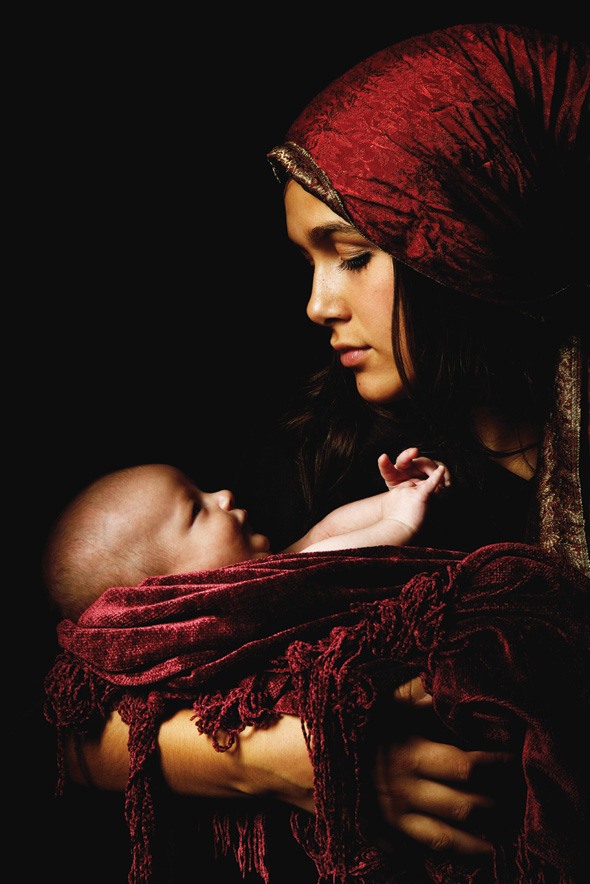
Rosa Mystica

Rosa Mystica
a fragrant secret upon the mouth of God.

Hildegard Von Bingen
Your praises echoed from her saintly lips.

A Rose among thorns
Heavenly chants of medieval monks fill the air.

Garden of God
Your divine place of sweet refrain; rest in the arms of your beloved.

Opening of the sacred petals
The breath of God sighing deeply into your barrenness; a cloistered garden of divinity.

Round Yon Virgin
Mysterious fertility within thy consecrated womb.

Fruit ripens on the blessed vine
The shoots of the stalk of Jesse break into the world.

Rosa Mystica
Awaited Messiah cradled in your loving arms.

Anna A. Kasper – Copyright 2004

The Christmas poem Rosa Mystica found above is one I wrote for a college Creative Writing class. It’s a Ghazal style poem which is an ancient form of poetry from India and Persia. The subject matter is usually mystical spirituality or mystical sensuality. I did receive an A+ for my writings in this course. The professor told me I have a natural gift for writing Ghazal style poetry, and that I understand the form on a mystical level, something he stated that not everyone does. Recently, I studied Ghazal style poetry again when the subject was found in my World Religions course that I completed at Phillips Theological Seminary last fall. 

The history and origins of the Virgin Mary being called Rosa Mystica (Mystical Rose):

In the 5th century she was first called a “rose among thorns” to express Mary’s purity and the fragrance of her grace. In Medieval times she was called rosa mystica or the mystical rose coming from the verse of Sirach 24:14: “like a palm tree in Engedi, like a rosebush in Jericho” which makes reference to God graced fertility and growth, and a reference to the mysterious generation of Christ from the womb of Mary.

The Biblical source of the title is also found in the Song of Songs 2:1, often translated, “I am the Rose of Sharon“. Bishop Robert C. Morlino draws a connection to Isaiah 11:1, “But a shoot shall sprout from the stump of Jesse, and from his roots a bud shall blossom.” This is also reflected in the German Advent hymn Es ist ein Ros entsprungen, known in English as “”Lo, how a rose e’er blooming”, which makes reference to the Old Testament prophecies of Isaiah which in Christian interpretation foretell the Incarnation of Christ, and to the Tree of Jesse, a traditional symbol of the lineage of Jesus.

Christmas Blessings to all!

Sources:

  1. Mary, the Mystical Rose, is link to God – Madison Catholic Herald
  2. Journey into the Heart of God: Living the Liturgical Year – Philip H. Pfatteicher – Google Books
  3. Rosa Mystica – Wikipedia
  4. Mystical Rose (piercedhearts.org)
  5. ANNA KASPER CHRISTMAS NEWSLETTER (2013)

Rosa Mystica poem is © Anna A. Kasper 2004. If you use any information from my blog posts as a reference or source, please give credit and provide a link back to my work that you are referencing. Unless otherwise noted, my work is © Anna A. Kasper 2011-2026. All rights reserved. Thank you.
Posted in Bible Study, Catholic, Christmas, Judaism, Religious, Theology | Tagged , , , , , , , , , , , , , , , , , , , , | Leave a comment

52 Ancestors in 52 Weeks. Week 48: Strength. My Irish Ancestor Daniel Wolfetone Fahey (Fay) from County Galway, Ireland.

The writing prompt this week is strength. “Strength comes in many forms. It can be physical, but it can also be emotional or spiritual. What ancestor has demonstrated strength?” To me strength does indeed take on more than one form. The hardships many of my ancestors endured are countless. But this week I going to discuss some aspects of the hardships in the early life of my Irish ancestor Daniel Wolfetone Fahey (Fay) including famine and loss, and the strength required to endure these hardships.

My great-great grandfather Daniel Wolfetone Fahey (Fay)

My great-great grandfather Daniel Wolfetone Fahey (Fay) was born 1 April 1833 in Mountbellew, in County Galway, Ireland. (In various records at various times, he gives his year of birth between 1831 to 1839 but based on his obituary it appears it was closer to 1833). He was the son of Thomas Fahey and Anna “Annie’ Joynt. His father was from Peterswell Parish in Galway, and his mother from Shanaglish (near Gort) with links just over into County Clare. His older siblings were born near Gort. The family appears to have gone up to Mountbellew possibly for work. I do have some remote DNA matches to those from the areas in and around Mountbellew, but the majority of my paternal Irish related Fahey/Fahy DNA matches are to those originally from Peterswell Parish and from in and around Gort.

How many years the family stayed in Mountbellew I am not sure, but his brother, who was only a few years younger than him, Michael Fahey stayed in the Mountbellew area before migrating to Roscommon. Whereas his sister Mary Fahey, who along with Michael and their sister Honora, stayed in Ireland, lived near Gort. Mary married Edward Flannery. Honora Fahey married Daniel Kearns, and they lived in Peterswell Parish. His brother Edward Fahey also stayed in Ireland but did come to the USA in 1860 and married in 1864 in Maine to Mary Burke. Edward Fahey and Mary Burke are the great-grandparents of actress Myrna Fahey. I have written about her family, click on her name to go to that blog entry.

Most people in America with Irish ancestors are familiar with the horrific tragedy of the Irish Potato Famine years. The Great Famine (Irish: an Gorta Mór) also known as the Great Hunger, the Famine (mostly within Ireland) or the Irish Potato Famine (mostly outside Ireland) was a period of mass starvation and disease in Ireland from 1845 to 1852. With the most severely affected areas in the west and south of Ireland, where the Irish language was dominant, the period was contemporaneously known in Irish as an Drochshaol, loosely translated as “the hard times” (or literally “the bad life”). The worst year of the period was 1847, known as “Black ’47”. During the Great Hunger, about 1 million people died and more than a million fled the country, causing the country’s population to fall by 20–25%, in some towns falling as much as 67% between 1841 and 1851. Between 1845 and 1855, no fewer than 2.1 million people left Ireland, primarily on packet ships but also steamboats and barks—one of the greatest mass exoduses from a single island in history. (1, 2, 3, 4, 5, & 6).

Sadly, I have not been able to locate my Fahey/Fahy ancestors, as a family unit, in ship records. But we know they came into America via Philadelphia, Pennsylvania. My Dan Fahey/Fahy gives his year of immigration as: 1850 and 1853. I do find a Danl Fahey that departed via Liverpool, England and arrived in Philadelphia, Pennsylvania on the ship Wyoming on 13 June 1853. This Danl Fahey is listed as aged 18 and born in 1835 and is not listed with family. His brother Thomas Fahey settled in Pittsburgh, Pennsylvania and married Mary Mooney. Thomas lists his year of arrival, in the one census record it was recorded, as 1847. I do find a Thomas Fahey arriving via Liverpool, England into Philadelphia, Pennsylvania on the ship Beatrice on 8 July 1851. This Thomas is listed as being aged 23 and born in 1828 and is not listed with family members.

Are the two single men listed on these two separate ships my Fahey ancestor and kin? I cannot know for sure. The story that my ancestor Dan Fahey/Fahy told was that the family came together on the ship from Ireland to the USA. Shortly after the family had settled in Pennsylvania his parents were killed by a team of run-away horses. It appears at least one younger sibling was killed as well. I have been unable to locate any newspaper articles about this accident. Did it happen in Philadelphia as the story was relayed? If so, then maybe in such a big city with so many recent immigrants, the story would not have been deemed worthy to include in the newspaper. I have been unable to locate where they are buried. Sadly, they may have been buried in a Potter’s Field cemetery where those without means would have been buried, and sometimes those records were lost, also fires destroyed many vital records. I do not find Daniel, his brother Thomas, their siblings, or their parents in the 1850 Census. This leads me to believe the earliest they arrived in the USA was in 1850, arriving too late in the year to be included in the 1850 U.S. Federal Census. Or they arrived a bit later between 1851-1853.

He stated later in life that his siblings were scattered after the death of their parents, being that he was old enough to take care of himself, migrated after the death of his parents to Louisville, Kentucky. I have been able to piece together that he came to Louisville because his uncle Michael Francis Fahey was most likely already living there with his wife and family, or Dan traveled together with his uncle and his family, and they arrived in Kentucky together. Michael had a child born in Gort, Ireland in 1850 and the next known child was born in Louisville in 1855. Michael Francis Fahey married about 1838 in or near Gort, Galway, Ireland to Bridget Keeley. Between 1842 and 1850 we know that three of his children were born in Gort.

Among Dan’s cousins, the children of Michael Francis Fahey, was a Bridget Fahey. More than fifty-five years later, when cousins Dan Fahey/Fahy and Bridget Fahey Ethell were well into old age, and both widowed, they did marry. But that is a story for a future blog entry.

Daniel lost touch with most of his siblings. We know he was in contact with a brother that went to Canada. DNA has shown that the brother that went to Canada was named John Patrick Fahey. DNA has also shown strong links to his siblings that stayed in Ireland (although in most cases, the descendants of these siblings that stayed in Ireland came to the USA within the next few generations, with a few going to Australia). He had an older brother Patrick Fahey who went to Bangor, Maine and later migrated to Vermillion, Minnesota. His brother Edward Fahey stayed in Ireland but came to the USA in 1860 and settled in Bangor, Maine. He had other siblings including brothers named James “Jim” Fay and Robert Fay that did come to the USA, but nothing more is known about them.

My branch of the Fahy/Fahey family used the spelling Fahey and Fahy in various records in the U.S. for a few decades before they dropped the ‘h’, and it slowly became Fay.

I cannot imagine what it would have been like to live in Ireland during The Great Famine. Or needing to flee your homeland due to starvation. And after making it to America, after a long, difficult voyage on a ship, only to have your parents and at least one of your siblings killed in an accident only a short time later. Then to pick yourself up and migrate 672 miles to Louisville! I must say that my great-great grandfather had great fortitude and strength. I can only hope that I inherited some of those quite worthy traits from him.

References:

  1. Great Famine (Ireland) – Wikipedia
  2. Kinealy, Christine (1994), This Great Calamity. The Irish Famine 1845-52, Gill & Macmillan.
  3. The great famine | dúchas.ie (duchas.ie).
  4. An Gorta Mór – the impact and legacy of the Great Irish Famine Lecture delivered by Mr. Éamon Ó Cuív, TD, Minister for Community, Rural and Gaeltacht Affairs, at St. Michael’s College, University of Toronto, Canada, on Friday 8 May 2009.
  5. Ross, David (2002), Ireland: History of a Nation, New Lanark: Geddes & Grosset.
  6. Reconciling generations of secrets and separations (irishcentral.com).

If you’d like to learn more about the 52 Ancestors in 52 Weeks project, please visit here:

52 Ancestors in 52 Weeks.

Or join the Facebook group Generations Cafe.

If you use any information from my blog posts as a reference or source, please give credit and provide a link back to my work that you are referencing. Unless otherwise noted, my work is © Anna A. Kasper 2011-2026. All rights reserved. Thank you.
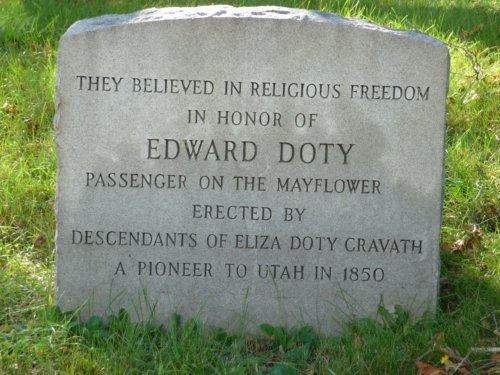
Posted in 52 Ancestors in 52 Weeks, Catholic, Genealogy, Uncategorized | Tagged , , , , , , , , , , , , , , , , , , , , , , , , , , , , , , , , , , , , , | 5 Comments

52 Ancestors in 52 Weeks. Week 47: Thankful. DNA, Genealogy Sites, and finding long-lost cousins.

Week 47: Thankful

This week’s prompt for 52 Ancestors in 52 Weeks is Thankful. “Is there an ancestor you’re especially thankful that you found or a story that you’re thankful you discovered? What about all of the wonderful resources available to us now? What are you thankful for?”

There are so many reasons to be thankful in general. There are many ancestors that I am thankful that I found. But I chose to write about being thankful for how DNA and genealogy sites have brought about finding long-lost cousins.

My Mom only had a few first cousins on her paternal side. She had quite a few on her maternal side, but I doubt she ever knew them. For many years of my family research, I was not sure if she had any first-cousins on that paternal side at all. I had seen a photo of my great-grandfather taken in Michigan with young children running around him. Sadly, that photo was lost in the fire of 2017 when I lost all of my belongings. So, I knew there was a chance there had been at least a few first cousins that my Mom did not remember.

My grandfather Durward Edward Cole.

My grandfather Durward Edward Cole had three siblings that lived into adulthood: Lorin Richard “Dick” Cole, who married twice but had no children, William Jesse “Jessie” Cole who for many years I only knew of his first marriage (see next paragraph), and Goldie May Cole, who was married four times but had no children.

A happy discovery via DNA was finding that William Jesse “Jessie” Cole had married a second time and had children! DNA was a bit confusing at first, until I realized that I was related to both parents of my DNA match! I was a distant cousin to his mother (via German ancestors on a different line) and a Cole second-cousin to his father. I discovered that William Jesse “Jessie” Cole had married second to a woman name Mary Jones (Jonas) the daughter of Polish immigrants with a large extended family.

Jessie Cole and Mary Jones had three children:

Joseph Emmett “Joe” Cole, Mabel Irene Cole Garska, and Marion Jane Cole Hughes. Sadly, Mary died in 1931 leaving her husband a widower with children aged two to eight. The three children were put in an orphanage. Although he later brought the oldest Joseph home to live with him, the two girls remained in the orphanage.

My grand-uncle William Jesse “Jessie” Cole

If not for DNA, I would have most-likely not known about these paternal first cousins of my Mother. She along with her siblings left Michigan when she was but five years old. She would have only known the older two cousins who were a few years older than her, and the youngest would have not been born or a baby when they left Michigan. So, my Mother didn’t really have many memories of family in Michigan. Also, I need to point out here that my Mom was somewhat secretive when talking about her family and was never a fount of information when it came to discussing her kin. But I discovered that although Joseph Emmett “Joe” Cole did marry, he never had any children, but his sisters Mabel and Marion do have descendants today.

I even found a Cole second-cousin close in age to me! A daughter of Marion Cole Hughes. Which is not usually the case. I am almost always much younger than any kin I find. This is due to the fact that I was born when my Mom was over 40 years old, and her mom was the baby in the family, and she struggled with miscarriages and stillborn children for some years before she was able to have six children.

Mabel Cole Garska had several children and it was through one of her sons, my second-cousin, that I discovered the DNA matches where I was related to both their parents, as noted above, distantly on a Germany line to the mother, and a Cole second-cousin to the father.

I have been able to link up with a few of the children of Mabel and one of her grandchildren. And also, to the daughter of Marion.

I am very thankful to have discovered my Cole second-cousins and their descendants. Prior to finding them, my grandfather’s line and my close kin were the only closer related Cole family that I had (or knew about). I hope to venture to Michigan again (I did visit Detroit once twenty years ago when my ex-husband was working there on an out-of-state job. But I didn’t know about my Michigan Cole cousins back then) and meet the Cole kin in Michigan. I also have a few Prindle third-cousins in Michigan that I have never met.

My beautiful Aunt Thelma Cole.

My other find was not DNA related, but was only possible because of genealogy sites on the Internet. I found a family tree online that I knew had connections to my Aunt Thelma. I contacted the owner of the tree, and discovered that she was the stepdaughter of one of my long-lost first cousins, one time removed. My Aunt Thelma May Cole married George Vise “Vise” Henage. They had two daughters: Doris Marie Henage McDade Jones Swift and Mary Louise Henage Frantz Ward Miller.

These Cole first-cousins, Doris and Mary, were old enough to be my mother. After leaving Michigan, my Mom and her siblings went to Oklahoma. It is there that two of my Mom’s older siblings married. My Mom, with her parents and remainder of her siblings, went to Texas briefly before settling in El Cajon, a suburb of San Diego, California. My Mom was a teenager when they migrated to California. My Aunt Thelma was one of the older siblings that married and stayed in Oklahoma. Some years later she divorced and migrated to El Cajon, but her daughters remained in Oklahoma with their father and paternal grandparents. Sadly, my Aunt Thelma was killed by a drunk driver when walking across the street in El Cajon. She died before I was born, so I never knew her. My much older siblings do have memories of her, and also a few memories of first-cousins Doris and Mary when they visited their mom in California.

I am happy to say that I have been able to link up with the son of my first-cousin Mary Henage. I also spent a year researching Mary’s prior marriage and another son I knew she had that had died in the 1980’s. I discovered that she had had two sons from her first marriage and the older one was living. Happily, this brought about the youngest son, that I had found prior, to be able to talk with his, previously unknown to both of us, half-brother.

The youngest son lived in Oklahoma (the older two sons from her first marriage grew up in Salt Lake City) and he believes that his mom Mary had a daughter (that he never met) from a later third marriage. As of yet, I have been unable to discover any information about the daughter. But I remain hopeful.

I am grateful this Thanksgiving week for many things, including family, family I was raised with, family I am DNA kin to, and family in general!

Because my Cole first-cousins, once removed, and my Cole second-cousins and their children and grandchildren are living, I have excluded their names to protect their privacy.

If you’d like to learn more about the 52 Ancestors in 52 Weeks project, please visit here:

52 Ancestors in 52 Weeks.

Or join the Facebook group Generations Cafe.

If you use any information from my blog posts as a reference or source, please give credit and provide a link back to my work that you are referencing. Unless otherwise noted, my work is © Anna A. Kasper 2011-2026. All rights reserved. Thank you.

Posted in 52 Ancestors in 52 Weeks, Genealogy | Tagged , , , , , , , , , , , , , , , , , , , , , , , , , , , , , , | Leave a comment