Margaret Woodrow Wilson, Interesting Kin. First Daughter, Acting First Lady, Suffragette, Greenwich Village Socialite, and Hindu Nun. 52 Ancestors, Week 51: Cousins.

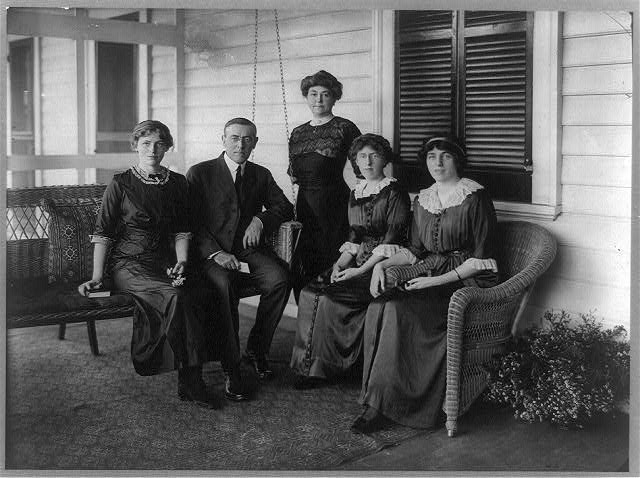
The above photo is of U.S. President Woodrow Wilson with his wife Ellen Axson Wilson and their three daughters. Margaret Woodrow Wilson is second from the right.

With this week’s writing prompt, there were a myriad of cousins I could write about. Famous, well-known, historical, and those that lived simple lives. I was going to write about First Lady Ellen Louise Axson Wilson, the wife of the 28th President of the United States Woodrow Wilson. I knew very little about her. When researching her, I realized that she died 18 months into her role as First Lady, and her eldest daughter Margaret Woodrow Wilson took over the role as acting White House social hostess. After reading more about Margaret, I decided she was quite an interesting person, not as well-known as her parents, and would make for a good subject to write about this week.

First Lady Ellen Wilson considered herself a proud Southerner. So much so that she did not want her daughters born as Yankees! So, she returned to Georgia to give birth to her first two children. Ironically, her maternal grandparents, Rev. Nathan H Hoyt, Jr. and Margaret Bliss, were Yankees! He was born in New Hampshire, and she was born in Connecticut. It is through her grandmother Margaret Bliss that the lines of our cousin kinship are found. We share Colonial Massachusetts ancestors. John Leonard and Sarah Heath.

John Leonard was born in England, he immigrated to British Colonial Massachusetts and settled in Springfield. His parentage is unproven. Preliminary Y-DNA analysis of descendants indicate he may have been related to James Leonard of Taunton and Samuel Leonard of New Jersey, but more research needs to be done.

He married Sarah Heath in Springfield on 12 October 1640. Her last name may have been Heald or Healy but is found as Heath in her marriage record. Although recently, others looking at the actual marriage record and transcription believe it reads Heald. She was born in England. Her parentage is unproven. She was not the daughter of John Heald and Dorothy Royle, as some contend. (2)

Donald Lines Jacobus speculated that she may have been brought by a relative or had been an indentured servant. He notes that Gershom Hale or Heald, son of John Heald of Concord, settled in Springfield a generation later, and it’s possible she was his sister. (1)

John and Sarah had 15 children before his untimely death. He was killed by Indians early in 1676. After his death, Sarah married twice more, on 21 February 1677 to Deacon Benjamin Parsons, who died at Springfield, 24 Aug. 1689, and thirdly at Springfield on 3 November 1690 to Deacon Peter Tilton, who died at Hadley, Massachusetts on 11 July 1696. She outlived all of her husbands and died 23 November 1711 in Springfield.

First Lady Ellen Axson Wilson’s direct line is via daughter Martha Leonard, who married Samuel Bliss. My direct line is via son Josiah Leonard, who married Sarah Dumbleton. After the death of Josiah Leonard, his wife married Thomas Root. Thomas Root is also my direct ancestor with his wife Mary Spencer.

First Lady Ellen Louise Axson Wilson and my great-grandfather Joseph Edward Cole were 6th cousins.

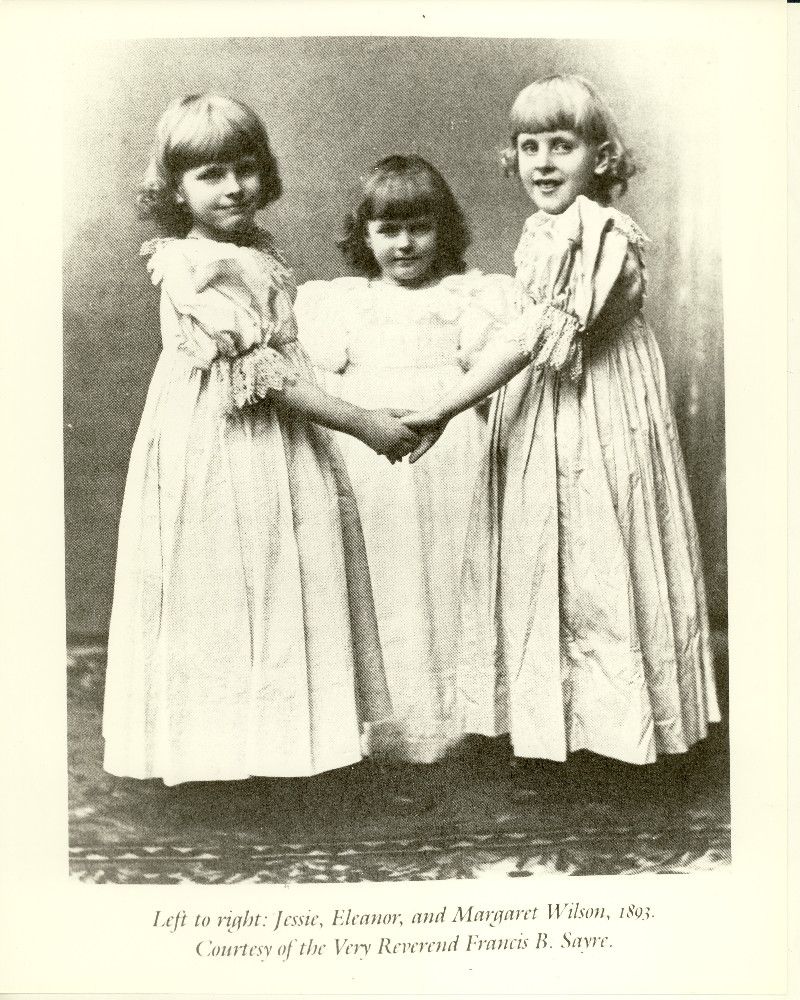
The above photo is of Margaret Woodrow Wilson with her two sisters. She was the first child of President Woodrow Wilson and his first wife, Ellen Louise Axson. She was born on April 16, 1886, in Gainesville, Georgia. The “Woodrow” in her name is from her paternal grandmother’s surname and her father’s middle name. Both of her grandfathers were Presbyterian ministers. (3) She had two younger sisters, Jessie Woodrow Wilson and Sayre Eleanor Randolph Wilson McAdoo.

At the time of her birth, her father was teaching at Bryn Mawr College, a women’s liberal arts college in Pennsylvania. After attending local schools, she opted to study at Goucher College in Baltimore. She trained in piano and voice at the Peabody Institute of Music. She recorded multiple songs, one of them titled “My Laddie” that was released by Columbia Records. There is a photo further down of the Irish harp she played, which is now in the post-Presidency home of President Woodrow Wilson.

The photo above taken of Margaret Woodrow Wilson was in 1910 when she was aged about 24. The photo has been colorized.

Her father was elected as the 28th President of the United States and came into office on 4 March 1913. Her mother Ellen was a supportive wife and an excellent hostess. Though Wilson’s administration was the first not to hold an inaugural ball when he was elected president in 1912, Ellen’s cordiality made future White House parties successful. She also oversaw the weddings of two of their daughters. She continued doing art while living in the White House and even had a studio set up on the third floor. Not only that, but she donated many of her paintings to charity. As First Lady, Ellen Wilson worked tirelessly to improve housing in Washington’s poverty-ridden and largely black slums. (4)

She suffered from Bright’s Disease, a kidney ailment that left her increasing frail. She died at age 54 on 6 August 1914, just two years into Wilson’s first term as president. Her husband was devastated by her death. With his wife’s death and the stress that came with being president, Wilson was left feeling lonely and downhearted. (4) This is when their eldest daughter Margaret stepped in as acting First Lady.

Margaret was quite free-spirited and only a 28-year-old when her mother died. She held the post of acting First Lady for only a matter of months. She did not enjoy the social demands of the position and preferred her soprano singing studies to the role of White House social hostess.

The above photo was taken in the post-Presidency home of President Woodrow Wilson. This Irish harp belonged to his daughter, Margaret, a trained musician and singer. Photo by Daniel Mulhall, Retired Irish Ambassador.

A year after the death of President Wilson’s wife, he met Edith Bolling Galt in the elevator at the White House. They got married at Edith’s Washington townhouse nine months later. (4) When they became engaged in 1915, Margaret eagerly stepped aside and allowed Edith to take over the First Lady duties.

Margaret decided to instead embark on a career as a soprano singer, even traveling to Europe to perform for Allied troops serving in World War I. Below, you can listen to Margaret singing The Star-Spangled Banner in 1915 to raise funds for the Red Cross.

Margaret and her two sisters made their support for women’s suffrage known both before and during their father’s term in office. Margaret seemed to express disagreement with her father on issues of race as well; while he institutionalized segregation of the federal workforce, Margaret, an education advocate, made a point of publicly visiting and calling attention to the poor conditions for African American students in the nation’s segregated capital. All three of Wilson’s daughters were reputed to have lobbied him on the issue of women’s suffrage. His racist policies, and his decision to enter the First World War, were protested by suffragists and others. (4) 

The many other efforts of the Suffragists finally bore fruit in 1918, when President Wilson voiced support for a constitutional amendment allowing women to vote. The President indicated that the Senate should vote in favor of passage of the amendment, which was ultimately key to its success. (6)

After leaving the White House, Margaret moved to Greenwich Village, New York, a place she had frequented in earlier years. Her father died in February 1924, when she was only 37 years old. In his will, he left her an annual allowance of $2500 (which is worth $39,529 today) as long as she remained unmarried, and it didn’t exceed one-third of the estate’s income. She seemed to enjoy her Bohemian lifestyle, but also the stipulations of her father’s will did not lend itself to her leaving her spinsterhood.

circa 1925: Margaret Wilson (1886 – 1944), eldest daughter of the 28th President of the United States Woodrow Wilson. (Photo by Hulton Archive/Getty Images)

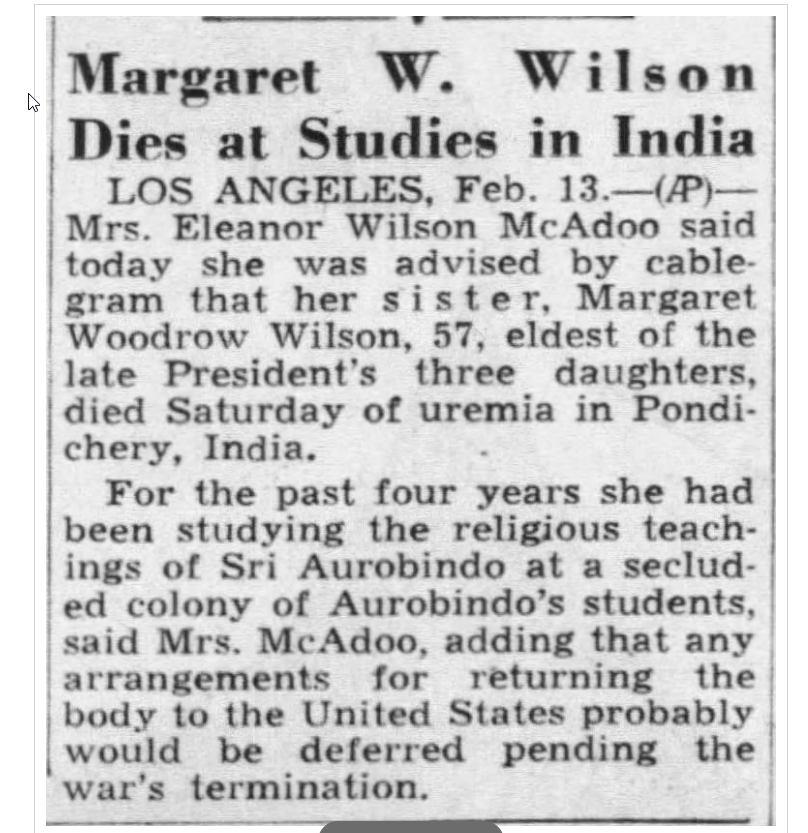
Margaret later worked in advertising and lobbied for various social causes, but in the 1930s during a visit to the New York Public Library, she encountered a book on Eastern mysticism, and soon became deeply enthralled. In 1938, she traveled to the ashram of Sri Aurobindo in Pondicherry, India, where she remained for the rest of her life. As a member of the ashram, she was given the new name ‘Nistha’, meaning “dedication” in Sanskrit, for her devotion to its teachings. She and scholar Jospeh Campbell edited the English translation of the work on the classical Hindu mystic Sri Ramakrishna, The Gospel of Sri Ramakrishna by Swmai Nikhilananda, published in 1942. In spite of entreaties from the U.S. government, Wilson refused to leave India during WWII; she died and was buried in Pondicherry in 1944. (6)

Margaret Woodrow Wilson was a First Daughter, an acting First Lady, an accomplished soprano singer and musician, a suffragette, and a Greenwich Village socialite. But she is perhaps best known for her fascination with Eastern philosophy and Hinduism and her becoming a Hindu nun in the last years of her life.

Above is Margaret Woodrow Wilson’s Obituary.

References:

  1. Jacobus, Donald Lines. Hale, House, and Related Families, Mainly of the Connecticut River Valley (Connecticut Historical Society, Hartford, 1952); Pages 678-9.
  2. A Record of the Descendants of Simon Henry & Rhoda Parsons” by Frederick Augustus Henry page 52a pub 1905 Cleveland, Ohio J. B. Savage Press.
  3. Woodrow Wilson Children at totallyhistory.com.
  4. Woodrow Wilson’s Wives at totallyhistory.com
  5. Not Every First Lady Has Been Married to the President. The role of the United States’ first lady traditionally goes to the president’s spouse, but in instances it falls to others. history.com
  6. Margaret Woodrow Wilson: First Lady, Suffragist, and Village Socialite. POSTED NOVEMBER 3, 2020, BY ARIEL KATES.

Further Reading:

To learn more about US President Woodrow Wilson:

  1. Woodrow Wilson. THE 28TH PRESIDENT OF THE UNITED STATES. whitehouse.gov
  2. Woodrow Wilson Biographical. nobelprize.org

To learn more about First Lady Ellen Louise Axson Wilson:

  1. Ellen Axson Wilson. HOME ABOUT THE WHITE HOUSE FIRST FAMILIES. whitehouse.gov
  2. Ellen Wilson, American first lady. britannica.com

To learn more about Margaret Woodrow Wilson:

  1. Presidents’ Children: Woodrow Wilson’s Daughters. potus-geeks.livejournal.com
  2. Margaret Woodrow Wilson- letters from the Ashram. Extracts of Margaret Woodrow Wilson’s letters to her friend Lois – written from the Sri Aurobindo Ashram, Pondicherry. Posted on December 10, 2011 by sriaurobindocenterla. sriaurobindocenterla.wordpress.com

To learn more about Sri Aurobindo:

  1. Sri Aurobindo en.wikipedia.org
  2. Sri Aurobindo Ashram today. sriaurobindoashram.org
  3. Sri Aurobindo’s Teaching and Spiritual Method. A Radical Approach to Evolution. auroville.org

If you’d like to learn more about the 52 Ancestors in 52 Weeks project, please visit here:

52 Ancestors in 52 Weeks.

Or join the Facebook group Generations Cafe.

If you use any information from my blog posts as a reference or source, please give credit and provide a link back to my work that you are referencing. Unless otherwise noted, my work is © Anna A. Kasper 2011-2026. All rights reserved. Thank you.
Posted in 52 Ancestors in 52 Weeks, Famous Kin, Genealogy | Tagged , , , , , , , , , , , , , , , , , , , , , , , , , , , , , , , , , , , , , , , , , , , , , , , , , , , , , , , , , , | Leave a comment

My Ancestor Martha Willoughby. 52 Ancestors, Week 49: Family Recipe. Blindly Copying Family Information Without Vetting the Research (or Lack Thereof) is a Recipe for a Family Tree Disaster.

This week’s writing prompt is Family Recipe, the suggestions are all related to family cooking recipes. I don’t really have a family cooking recipe to discuss that I can think of. But there are more than one meaning for the word recipe. The meaning that comes to mind first, a set of instructions for making a particular food dish. There are two additional meanings as well. The now archaic use of the word recipe to mean a medical prescription. The third meaning of the word recipe is one that is still used today, to mean something which is likely to lead to a particular outcome. (1) Examples, a recipe for disaster, a recipe for love, etc.

Above image is from the game Recipe for Distaster.

You may think that my use of the phrase a recipe for a family tree disaster, a bit of an exaggeration. But it is not. Once someone enters incorrect, unresearched, mis-researched, or just plain made-up information into a family tree online it gets copied thousands of times and is taken as gospel by some, despite no documentation. Getting people to rescind the incorrect information is a nightmare in itself, for even if you did get the original poster of the information to correct or remove the information, it is already out there being seen by the masses. To get thousands of people to make the correction in their trees or websites is almost impossible.

There is more than one example within my tree that I could use to make this point. But I am choosing to discuss my 4th great-grandmother, Martha Willoughby Norris.

There is GREAT confusion regarding her. I have seen my Martha, the wife of James Norris, given the maiden names: Long, Bunyan, Donaldson, Williamson, Weathersby, and Willoughby!

I have researched all the records that are available and also used DNA to piece together the puzzle of her maiden name.

Furthermore, I have painstakingly gone through all my DNA matches and looked for a connection to any of the other surnames in Maryland that people have listed as a maiden name for my Martha, that are a DNA match to me and my extended family members that are descended from James Norris and his wife Martha.

Looking at all the maiden names linked to her, I will first start with Long, since it’s the name most often listed for her, and has been copied innumerable times. Martha Long was the daughter of Coulbourne Long and Easter/Ester _____. There is a marriage record to be found for Martha Long, who married JOHN Norris, not James Norris! 

John Norris who married Martha Long was distant kin to my James Norris. John Norris was the son of Edward Norris and Hannah Scott.

I have zero DNA matches to the surname Long in Maryland. 

I descend from two related Norris lines. Edward Norris (the father of John Norris who married Martha Long) was a sibling of my ancestor Joseph Norris who married Mary Talbot. Edward Norris and Joseph Norris were both the sons of John Norris and Elizabeth “Eliza” Parsons. But my James Norris who married Martha, was only distant kin to the John Norris who married Martha Long. My James Norris, who was the son of Thomas Norris and Elizabeth McComas, was never married to Martha Long.

Both my direct ancestors (both are my 6th great-grandfathers) John Norris (m. Ann Wheatley) and Joseph Norris, Sr.  (m. Mary Talbot) were the sons of John Norris and Elizabeth “Eliza” Parsons.

I discovered where people were getting the name Bunyan from, a marriage record from the 1800s in London, England! A couple named James Norris and Mary/Martha Bunyan were married on 12 July 1843 in Saint Botolph Without Aldersgate, London, London, England. Obviously, this marriage record and this couple have no connection to Colonial Maryland a century+ earlier! I have zero DNA matches to the surname Bunyan.

Although I have a few DNA matches to the name Williamson, they are not in Maryland nor connected to this Norris line.

I do have DNA matches to the surname Donaldson, but they are ancestors on the other side of my tree, they lived in Pennsylvania, and are not connected to the state of Maryland or to my paternal Norris line.

I believe the surname Weathersby was someone mistakenly listing it incorrectly when it should have been Willoughby. Since the surnames Williamson, Willoughby, and Weathersby, are all taken from old DAR applications of the same root ancestor James Norris, I believe they actually all should be the same surname Willoughby.

I have zero DNA matches in Maryland to the surname Weathersby.

Lastly, I will discuss the surname Willoughby. I have NUMEROUS DNA matches to descendants of Richard Willoughby and Mary Willoughby Hardcastle. Both are the children of Andrew Willoughby and Anne “Annie” ____. These DNA matches descend from these two siblings and also are DNA matches to numerous people that are close and distant kin to me and all descend from James Norris and Martha.

I also have DNA matches to descendants of Mary Willoughby, who married William Wofford. She is a sibling of Andrew Willoughby. Both Andrew Willoughby and his sister Mary Willoughby Wofford are thought to be the children of William Willoughby and Hannah ____.

I went through all the known and possible children of Andrew Willoughby and Anne “Annie” ____, including their son, Richard Willoughby.

Richard Willoughby migrated from Maryland to Johnston, North Carolina. My Martha was born in Maryland and remained in Maryland for most of her life (the family did migrate from Maryland to Kentucky. Her husband James Norris dies in Butler County, Ohio), she does not fit as the child of Richard Willoughby.

But my Martha does fit as the daughter of John J. Willoughby, who married Rachel Diass (Dias/Dyas). He was also a son of Andrew Willoughby and Annie ____. 

Many list Rachel Diass/Dyas as the daughter of John Diass and Mary Sinclair, but I have not seen any sources or documentation as to why they list Mary Sinclair as her mother. There is a good chance she is the daughter of a John Dias/Dyas. His will is proven in Talbot County, Maryland is 1755 and his surname is listed as Dias/Dyas. 

There is a John Dyas, Jr. listed as serving in the Maryland Militia for Talbot County, Maryland, in 1740 and 1748. This could be the same John Dias/Dyas who dies in 1755, or he may have had a son named John Dyas/Dias, Jr. after him.

Rachel Dyas/Diass (and her father John Dias/Dyas and brother John Dias/Dyas, Jr.) may have been relations of Thomas Dyas who is listed as being born before 1640 and died before 1700 in Westmoreland County, Virginia. Thomas Dyas is one of the early colonial settlers of southern Maryland and Virginia’s northern neck counties.

I do have Dyas/Diass DNA matches. 

Some give the maiden name for Anne “Annie” wife of Andrew Willoughby as Dent.

She is not the Annie Dent that is listed as coming to Virginia in 1729. She is not Anne Dent that was the daughter of William Dent and Elizabeth Fowke, that Anne Dent died unmarried and is buried in the Durham Churchyard in Charles County, Maryland. Furthermore, she also is not Annie Dent, who was the daughter of John Dent and Mary Hatch, and married John Cadle.

I don’t believe the maiden name for Anne “Annie” ____, wife of Andrew Willoughby, is truly not known and has not been proven.

Andrew Willoughby is thought to be the son of William Willoughby, who was born in England and died 13 September 1713, in Dorchester, Maryland. But more research needs to be done to substantiate the parentage of Andrew Willoughby.

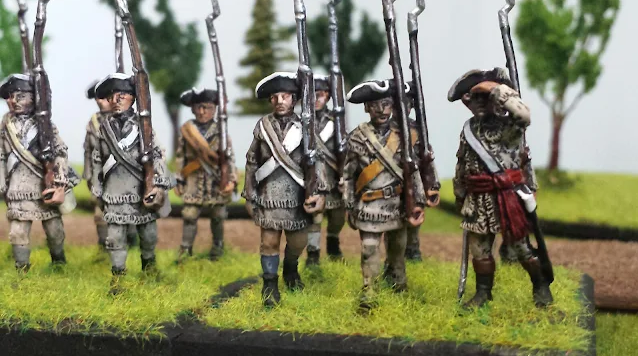
Photo from My Brave Fusiliers! blog. Smallwood’s Maryland Regiment 1776.

A marriage record for James Norris and Martha ____ has not been found. The first name Martha and her maiden name Willoughby are from an old DAR application, which does not always have accurate information, but often it does, and will sometimes give helpful and informative clues, even if it does contain errors.

James Norris was a private in the Continental Troops, Baltimore County, 1st Maryland Regiment (Smallwood’s Regiment) during the American Revolutionary War.

Side note: There are some, like I have quoted below, that have Martha moving to Bracken County, Kentucky, where Joseph and James were living. “James Norris born Baltimore County, Maryland in 1747/8. He was devised a slave in his father’s will in 1761. He was appointed administrator for the estate of Moses Norris in 1783. He migrated to Mason co., Ky with his brother Aquilla & his nephew Abraham Norris & others about 1793. About 1805 Aquilla & James moved to Brown co., Oh. where Aquilla located. Tradition states that James settled near Dayton [Ohio]; no evidence has been discovered to substantiate the tradition. James died at the home of his son, Aquilla, in Butler County, Ohio. Martha moved to Bracken County, Ky where her sons, Joseph & James [lived].” [Harry Alexander Davis, The Norris Family of Maryland & Virginia; Genealogy of Thomas Norris 1361 – 1930 (4 vol. 1941 Washington D.C. Transcript), pg. 352-3,]

In the above quoted passage, the author is confusing the two families of James Norris and John Norris. Some of the information is correct, some is not. The Martha A. Norris who dies in September 1819 in Kentucky (who is mentioned in the book) is Martha A. Long Norris, the wife of John Norris. Although there is some confusion when it comes to the woman named Martha Norris who died in September 1819. There is a Martha A. Norris, who died September 1819 and is buried in Fallston, Harford County, Maryland. This latter Martha was born Martha Amos. So, she is not the same woman as Martha Long Norris.

I would say my analysis of my DNA matches, and available records, when comparing all the surnames given for her maiden name, that Willoughby is the only name that is backed up by a very strong DNA connection.  

My direct line:

  1. John J. Willoughby and Rachel Dyas/Dias.
  2. Martha Willoughby and James Norris.
  3. Sarah “Sally” Norris and John A. Armstrong.
  4. Bradford Carroll Armstrong and Martha Ann Knight Lyons.
  5. George Pendleton Armstrong and Alice Elizabeth Nutick. (my great-grandparents).

Do I believe that my writing here about the confusion regarding the two women named Martha, that both married men of the same Norris family, will solve the nightmare of thousands of family trees that incorrectly list Martha Willoughby as Martha Long? Well, hope springs eternal!

Reference:

  1. OED – Oxford English Dictionary

If you’d like to learn more about the 52 Ancestors in 52 Weeks project, please visit here:

52 Ancestors in 52 Weeks.

Or join the Facebook group Generations Cafe.

If you use any information from my blog posts as a reference or source, please give credit and provide a link back to my work that you are referencing. Unless otherwise noted, my work is © Anna A. Kasper 2011-2026. All rights reserved. Thank you.
Posted in 52 Ancestors in 52 Weeks, Genealogy | Tagged , , , , , , , , , , , , , , , , , , , , , , , , , , , , , , , , , , , , , , | 2 Comments

Abbess Elizabeth Throckmorton, 52 Ancestors, Week 47: This Ancestor Stayed Home

This week’s writing prompt is this ancestor stayed home, some suggestions given were Homemakers, ancestors who lived their entire lives in one place, and someone who lived in a “home,” are just a few possibilities. I decided to throw it way back and talk about my 15th great-grandaunt Elizabeth Throckmorton, Abbess of Denny, and what became of monks and nuns at the dissolution of the monasteries by Henry VIII.

My Throckmorton ancestors are on my maternal side, my Underhill ancestors and family lines that I wrote about a few weeks ago.

Dissolution of the monasteries under Henry VIII.

Michael Carter writes about the dissolution at the English Heritage website:

Between 1536 and 1540, on the orders of Henry VIII, every single abbey and priory in England – some 800 in total – was dissolved, or forcibly closed. The shattered remains of monasteries such as Binham Priory, Buildwas Abbey, Gloucester Greyfriars, White Ladies nunnery and Shap Abbey are enduring witness to four years of willful and targeted destruction that led to permanent changes in the kingdom’s religion, politics, society and economics.

As a result, as many as 14,000 monks, nuns and friars, as well as countless monastic servants and tenants, had their lives changed forever, while about 200 people were executed for opposing the Dissolution.

Monasteries were especially vulnerable to attack, because of what they stood for. Many had close ties with the papacy and were home to monks and nuns who were loyal to traditional religion. Moreover, religious reformers who gained influence under Henry were especially critical of the monasteries. But monasteries were also at risk because many of them were extremely rich – and the king was often desperately short of money.

The Dissolution (also known as the Suppression) of the Monasteries proceeded in stages. The ‘lesser monasteries’ (those with an income of below £200 a year and fewer than 12 inmates) were dissolved in 1536. This was followed by further dissolutions that gathered pace in 1538, and by the middle of 1540 every monastery in England and Wales, many with histories stretching back to the Anglo-Saxons, had been dissolved.

A minority of monks, nuns and canons welcomed the dissolution of their monasteries and release from their vows. They included a small number of Evangelicals who actively embraced the reformers’ cause.

But for most monks and nuns, the arrival of Henry’s commissioners and the destruction of their monasteries was a distressing experience. One modern scholar has even argued that some developed symptoms of what we would now recognize as post-traumatic stress disorder. It is easy to understand why. The monasteries were not only their home; they were also at the center of their belief system. They provided status, self-identity, friendship and security. There are even reports of some monks dying within days of the suppression of their monasteries.  (1)

Generally, at the closure of the monasteries and nunneries, most of the religious accepted the offer of a pension. This award was generally left to the discretion of the commissioners carrying out the closure, rather than being a centrally set sum. The wealth of the monastery would be considered, with those in higher ‘management’ positions, such as an abbot, being offered an increased sum – partly, it has been argued, to entice them to go peacefully. Older members could also receive an increased amount as their chances of future employment were less than the younger members, who could potentially augment their pensions. (2)

Not all went away peacefully, some chose exile; others offered resistance to the changes. Several that resisted were hanged, drawn and quartered, while others ‘disappeared’ in prison and were starved to death. (2)

Not surprisingly, the nuns received smaller pensions, despite having less options for future employment than the monks. Many nuns returned to their family homes.

Elizabeth Throckmorton had been the Abbess of Poor Clares at Denny in Cambridgeshire since at least 1512 and perhaps earlier (3) she and the nuns under her charge were ones left without their religious house they had lived in together for many years. Denny Abbey had existed since the 12th century. It was inhabited by three different religious orders, the last being a convent of Poor Clares (Franciscan nuns).

Denny Abbey was located close to the main road between Ely and Cambridge, and wayfarers and travelers would have sought food and alms from the nuns along their journey.

Today, the main remnants of the Denny Abbey buildings, showing the door to the Templar church at center, and the priest’s house at right.

She was mentioned as “myne suster Dame Elisabeth abbas of Denny” in the 1518 will of her brother Sir Robert Throckmorton, and she received a bequest of 20 shillings. (3)

Elizabeth was renowned for both her piety and her learning. In 1528 when Humphrey Monmouth, alderman of London, ran afoul of the authorities for distributing copies of Tyndale’s translation of Erasmus he was recorded as saying that he had lent his copy to Elizabeth, at her request. (4)

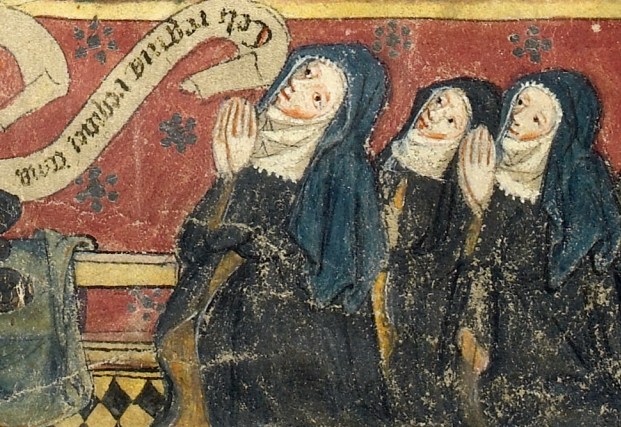
After the closure of the convent in 1539, she, like many other nuns, returned to her family home in Warwickshire. She returned to her family seat of Coughton Court in Warwickshire, which was now the home of her nephew Sir George Throckmorton. The Throckmortons remained a resolutely Catholic family. She and at least two or three nuns, most likely one of whom was her niece Margaret Throckmorton (daughter of Sir Robert Throckmorton) lived quietly in an upper floor at Coughton. They wore their brown monastic habits, they followed the Rule of the Order, and continued their conventual religious life the best they could.

The dole gate from Denny Abbey, preserved at Coughton Court, Warwickshire. The top hatch was used for conversation, and the bottom one for passing food or ‘dole’. (© National Trust/Simon Pickering)

Today you will find at Coughton Court, in the dining room, the ‘dole gate’ from Denny, a wooden hatch formerly set into the abbey’s front door, which is inscribed with the name of Dame Elizabeth and her monastery. At Denny, it was used to distribute charity to the poor while ensuring the seclusion of the nuns. It may have been used at Coughton to provision Dame Elizabeth and her sister nuns while they maintained their strict enclosure. (1)

The actual words on the dole gate are ‘DOMINĀ ELISABETH THROGMARTON ABBATISSA DE DENNE DEVS LVITO’ which translates as ‘God absolve Dame Elisabeth Throgmarton, Abbess of Denny. (5)

Coughton Court, Warwickshire. Photo ©Bob Radlinski.
The Coughton estate has been owned by the Throckmorton family since 1409, but the oldest section of the building is the Tudor gatehouse (shown here) dating from 1530.

Elizabeth Throckmorton was the daughter of Sir Thomas Throckmorton of Coughton Court, Warwickshire, England and Margaret Olney.  The Throckmorton family (originally de Throckmorton) took its surname from the manor of Throckmorton in the parish of Fladbury, Worcestershire, which from the 12th century they held under the overlordship of the Bishop of Worcester. They acquired the manor of Coughton by marriage in the early 15th century. (6) Sir Thomas Throckmorton was the High Sheriff, Knight of the Shire, commissioned for the defense of the kingdom, appointed steward of all castles, manors, etc., controlled by the Bishop of Worcester and high sheriff of the counties of Warwick and Leicester.

Elizabeth Throckmorton, Abbey of Denny, had numerous siblings, including my direct ancestor Margery Throckmorton (married Richard Middlemore). (7)

A brass plaque in the church at Coughton, Warwickshire commemorates the abbess’s death on 13 Jan 1547. (3)

References:

  1. Carter, Michael What Became of the Monks and Nuns at the Dissolution? english-heritage.org.uk
  2. Q&A: Where did the monks go after the dissolution of the monasteries? historyextra.com
  3. Erler, Mary C. Women, Reading, and Piety in Late Medieval England Cambridge University Press, 9 Mar 2006 Google Books.
  4. Peter G. Bietenholz, Thomas Brian Deutscher Contemporaries of Erasmus: A Biographical Register of the Renaissance and Reformation, Volumes 1-3 University of Toronto Press, 1 Jan 2003 pg. 321 Google Books.
  5. National Trust UK, Coughton Court. nationaltrust.org.uk
  6. Sir George Throckmorton. en.wikipedia.org
  7. Roberts, Gary Boyd, The Royal Descents of 600 Immigrants to the American Colonies or the United States (2 vols.), Baltimore: Genealogical Publishing Co. (2008), 558.

To learn more about Denny Abbey:

  1. DENNY ABBEY AND THE FARMLAND MUSEUM. english-heritage.org.uk
  2. Denny Abbey. en.wikipedia.org
  3. Denny Abbey Farmland Museum. dennyfarmlandmuseum.org.uk

To learn more about Coughton Court:

  1. National Trust – Coughton Court. Facebook for Coughton Court.
  2. COUGHTON COURT. coughtoncourt.co.uk
  3. Coughton Court. History, tourist information, and nearby accommodation. britainexpress.com

To learn more about the Throckmorton family:

  1. THE THROCKMORTON FAMILY OF COUGHTON COURT. ourwarwickshire.org.uk
  2. Coughton Court Gunpowder Plot and Gardens. Chapter 4: History of the Throckmortons. tudortimes.co.uk
  3. Browning, Charles Henry. (1898). The Magna Charta Barons and Their American Descendants with the Pedigrees of the Founders of the Order of Runnemede Deduced from the Sureties for the Enforcement of the Statutes of the Magna Charta of King Johnpage 199.

If you’d like to learn more about the 52 Ancestors in 52 Weeks project, please visit here:

52 Ancestors in 52 Weeks.

Or join the Facebook group Generations Cafe.

If you use any information from my blog posts as a reference or source, please give credit and provide a link back to my work that you are referencing. Unless otherwise noted, my work is © Anna A. Kasper 2011-2026. All rights reserved. Thank you.

Posted in 52 Ancestors in 52 Weeks, Catholic, Famous Kin, Genealogy, Religious | Tagged , , , , , , , , , , , , , , , , , , , , , , , , , , , , , , , , , , , , | Leave a comment

Youthful Shoplifters, My Grand-Aunt Goldie Cole & Her Friend Rosie Venck. 52 Ancestors, Week 46: This Ancestor Went to Market.

I wasn’t really sure what to write about this week when I received the prompt of this ancestor went to market, I do have some ancestors that took wool and cloth to market, I have a few siblings of my direct ancestors that worked in the town store, one brother of my great-grandfather owned and operated a bookstore, but the week was passing by and nothing really grabbed my attention to write about, then I happened upon a newspaper article I had shared prior about my grand-aunt Goldie May Cole and her friend Rosie Venck, regarding them shoplifting during the holiday shopping rush. I thought to myself, well they did go to market, or rather stores, it’s just a different take on the writing prompt.

The newspaper clipping is above. It was published on 31 December 1909 in Fort Wayne, Indiana in the local newspaper, The Fort Wayne Daily News. Goldie was aged ten years, and her friend was aged fourteen. They shoplifted three muffs, several yards of silk ribbons, a prayer book, and other articles from downtown Fort Wayne stores during the holiday shopping rush. The high temperature that Christmas in Fort Wayne was 24 ° and the low was 10 ° with no snow or rainfall. I envision carolers singing as the girls mingled in the chilly weather among the multitude of shoppers rushing to get last minute gifts. At least in Goldie’s case, she and her mother would have been quite poor during this Christmas holiday, her mother did have some kin living 27 miles away and a few others living 40 miles away, so if they were able to travel that far, they could have had a Christmas dinner by going to be with relatives, if not, they would have been depending on the goodwill of others, or a charity to provide a Christmas meal. I am sure that all the items in the many downtown stores were like glittering objects she knew she would not be receiving as gifts. I don’t know the full financial situation of Rosie’s family, but the girls couldn’t seem to help themselves. They stored the stolen goods at each of the girl’s houses, Rosie’s parents are the ones that turned them in, knowing their daughter did not have the funds to purchase the items, nor were they gifted to her. Rosie’s older sister found her at Goldie’s home and forced her to return home after being away for a few days. They were brought to the police station and the girl’s confessed, and they were put in the charge of Probation Officer Patton until they could be sent to The Indiana Industrial School for Girls.

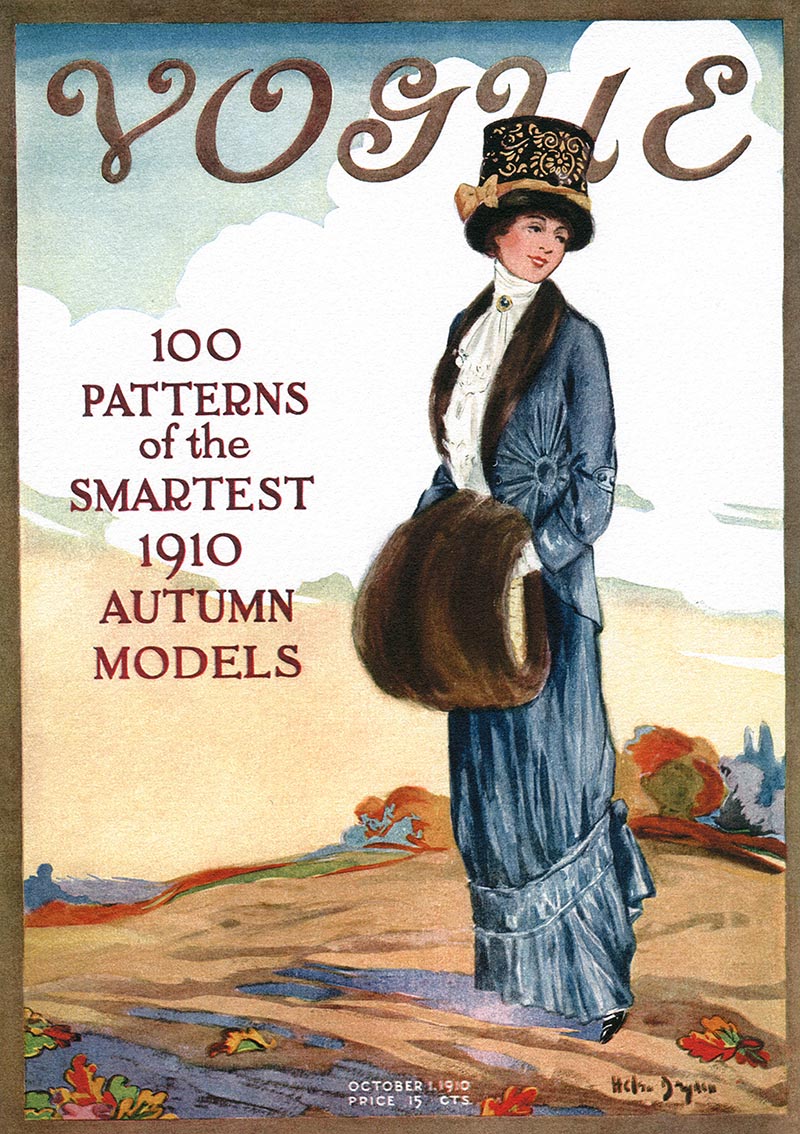
Vogue Magazine 1910 Autumn Models. Note the lovely muff she is holding. Muffs were a popular fashion item.

According to the article, Rosie Venck was born about 1886, and she lived with her parents and had at least one older sister and the family lived on John Street in Fort Wayne, Indiana. Her parents tell the newspaper that they have been unable to curb her wayward tendencies and are anxious that she be sent to the Industrial Home (in Indianapolis). I must assume that possibly the newspaper spelled her last name incorrectly. The Cole home was on Murray Street. The distance between Murray Street and John Street is less than a mile, so the girls lived near each other and spent time at each other’s homes.

More recently I was able to find a bit more about Rosie Venck. Firstly, she was born Rosa “Rosie” Ciernack/Charniak about 1895 in Poland (in an area also listed as Austria at that time). The surname spelling is taken from the 1910 Census, it may have been Cierniak or even Czerniak. According to the marriage record for her sister Anna S. Czarniak, they were the daughters of John Czarniak / Charniak and Mariana Sophia “Mary” Nadoshon/Nadospon/Niedospal. Her stepfather was Michel “Mike” Wnek, his surname is spelled various ways in different records as Venck, Vneck, Venck, Vnuk, Venck, and Vueck, but it appears the correct spelling was Wnek, later descendants spell it Wenk. She had an older stepbrother named Joseph Wnek, two full siblings: older sister Anna S. Ciernack/Czarniak and younger sister Stephanie Ciernack, and five half-siblings: Frank, Lewis, John Michael, Francis Agnes Wnek, and Michael A. Wnek. Some family trees also list an additional stepsister named Esther Lillian Wenk.

According to the 1910 US Census and the birth certificate for Francis Agnes Wnenk (who was born in February 1910), the family resided at 2005 John Street, Fort Wayne, Indiana. Her mother marries a third time on 23 November 1914 in Fort Wayne, Allen, Indiana, to Nicodemus/Nicholas Pogorzelsky. I find her with this husband in city directories in Fort Wayne for many years, and I find them in the 1920 census with her stepson Joseph Wneuk. I find them in the 1930 census living together with her son John Venck, he is spelling the surname as Wneuk. Rosie is not found living with them.

We can surmise that her older sister, mentioned, but not by name, in the newspaper article, was Anna Ciernak, who was eighteen in 1910. In the 1910 Census, I found the family with a date of census as April 1910. Interestingly, I do find Rosie in the 1910 Fort Wayne, Indiana, City Directory. She is listed by the name Rosie Ciernack, and is working as a clerk, and living at the same address as her mother, stepfather, and siblings. In the 1910 census she is listed as aged 15 and working as a bottle cleaner in the medical works industry. She could read and write and had a 4th grade education. I do not find any other records for Rosie Ciernack. Due to her being some years older than ten-year-old Goldie Cole, and already showing she could work, the court may have not sent her to The Indiana Industrial School for Girls, although the newspaper article does indicate that both girls were going to be sent there.

I discovered a snippet in the 1912 newspaper article above regarding her stepfather. It appears he raised her from a young age and considered her to be his daughter. It seems they did not send her off to The Indiana Industrial School for Girls, or if they did, it was for a short period of time. For as you can read above, her stepfather was distraught because his sixteen-year-old daughter (who could only have been Rosie) stayed away from home for two weeks, and friends told him that she was a “a bad girl”. Sadly, Mike Wnek committed suicide outside his grocery store in Fort Wayne.

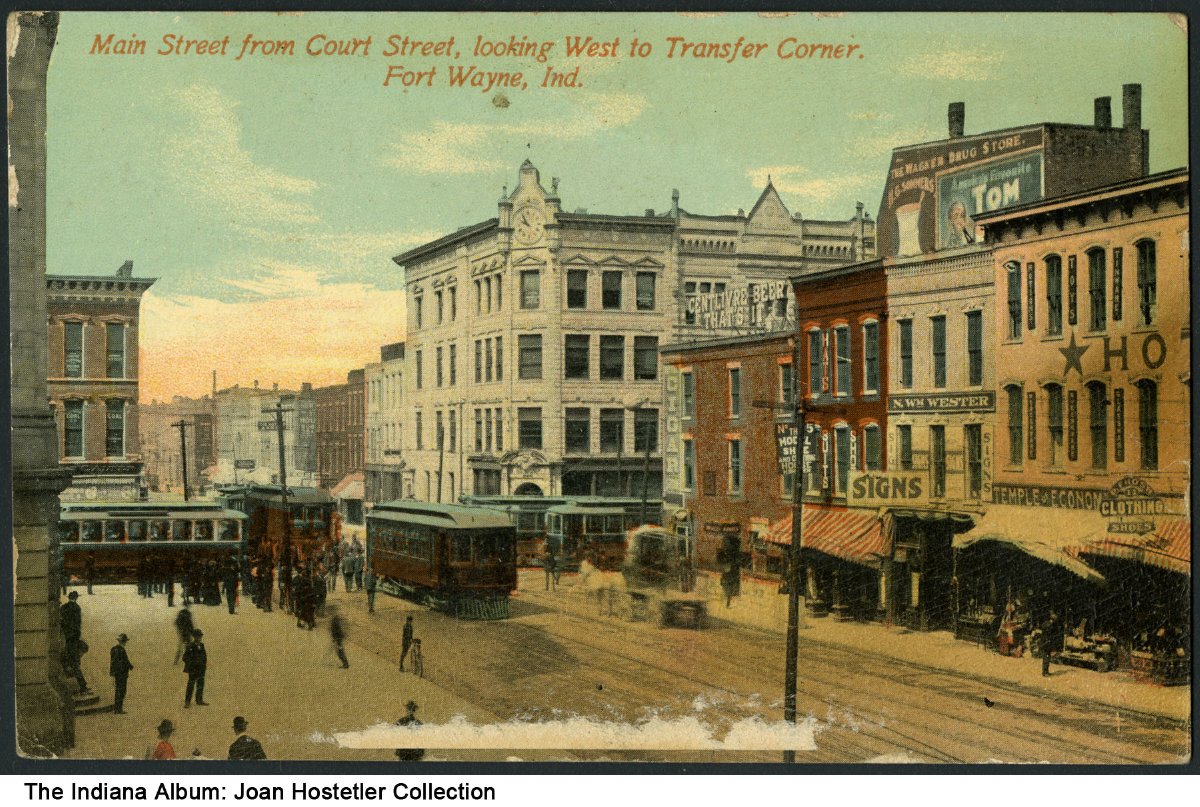
Downtown Fort Wayne, Indiana in 1910. It would have looked very much like this when the girls went into the shops during the Christmas holidays in 1910.

As stated in the newspaper, Goldie was only ten years old, but that in spite of her tender years is said to have been mixed up in several petty thieveries before. I must point out here that Goldie’s childhood was one wrought with poverty and parental alcohol abuse, along with lots of drama, which was often detailed in the very same newspaper. She was the daughter of Joseph Edward Cole and Anna Cora Prindle. Her parents had divorced by 1910. By the 1910 census, her father had already migrated to Detroit, Michigan. He is found there working as a laborer in an auto factory, living with him is found his son Jesse Cole, aged twenty-two, working as a tailor in a tailor shop. I am unable to locate Goldie or her mother Anna Cora Prindle Cole in the 1910 census, but from the newspaper article we know they were living on Murray Street in Fort Wayne. Goldie’s older brother Loren Richard “Dick” Cole, aged twenty-four was also already living in Detroit in 1910. Her nineteen-year-old brother Durward Edward Cole had been sent to the Indiana Boys School in Guilford, Indiana, where he is found living in 1910. Her sister Mabel R. Cole, aged fourteen, is found in 1910 living in Detroit with her aunt Ona Belle (Prindle) Danner. Also, her sister Gladys Cole had died earlier in the year at age seven. Her two siblings Ida Cole and Carl Cole did not live to adulthood but may have been alive at the time, and if so would have been aged four, and twenty months. So, it appears most of Goldie’s siblings, and her father, were not living with she and her mother in 1910.

Indiana State Industrial School for Girls, children playing, view of building, 1910.

Goldie Cole was sent to the Indiana Industrial School for Girls in Indianapolis. Her friend Rosie may have been sent there as well for a short time. Above is a photo taken in 1910 of girl’s playing in the yard of the school with the school building in the background.

Interestingly, this school was still in use as of 2003. The Indiana Girls’ Industrial School started off with just one building but as it changed to Indianapolis Girls’ School, as of 2003, there were a total of 7 housing cottages, a school, a clinic, a cafeteria, and a church also on campus. (1)

Although I do not know what became of Rosie Ciernack/Charniak Wnuk after 1912, I can tell you about the life that my grand-aunt Goldie Cole lived. How long she was at the Indiana Industrial School for Girls, I do not know. But it is known that ten years later, by the time she was nineteen, she had migrated to Detroit to join her father and siblings. Her mother had migrated by this time to Phoenix, Arizona. She married for the first time on 20 January 1919 in Detroit, Michigan to Manville Harold Dewing. He was the son of Frank E. Dewing and Florence Wills; he was born in Detroit. Her groom was only sixteen years old! The marriage ended with an annulment on 26 April 1920.

Annulment record of the marriage of Goldie Cole and Manville Dewing.

The marriage appears to have been very short-lived for on 13 January 1920 Goldie is found in the census living with her father Joseph, her brother Durward and his wife Glenna, and Glenna’s sister Marie D. (Kennedy) Alexander. Her occupation is listed as laundry presser. She is listed as married in the census, but from the above annulment record, her husband filed for an annulment on 26 May 1919, and it was uncontested and granted on 26 April 1920. Interestingly, in the annulment record it includes his mother as a party, and she is listed as “Florence DeWing, his next friend”. I am not sure why she is listed that way, but it makes sense his mother would have had an issue with the marriage. He went on to marry three more times and had luck with his last marriage and had two children in the 1930s.

Divorce record of the marriage of Goldie Cole and Albert Kaskeny.

She married second on 28 January 1921 in Detroit to Albert J. “Bertalan” “Click” Kaskeny. He was the son of Joseph “Jozsef” Keskeny and Elizabeth “Erzesbeth’ Pavel, and was born in Hungary. He immigrated to the USA at the age of six with his parents. This marriage lasted fifteen months before he filed for divorce on 25 April 1922 on the grounds of extreme cruelty. The divorce was granted on 5 September 1923. He married second in 1924 and had six children from this second marriage.

My grandmother Glenna Annette Kennedy Cole and her sister-in-law Goldie May Cole. Photo taken about 1920.

The above photo is of my grandmother Glenna Annette Kennedy Cole (wife of Durward Edward Cole) and her sister-in-law Goldie May Cole. The photo was taken some time around 1920. My grandparents left Michigan by 1926 where they are found in Phoenix, Arizona, visiting his mother Anna Cora Prindle Cole, she had migrated there prior. They migrated to Amarillo, Texas, then to Oklahoma, where they lived for ten years, before eventually ending up in San Diego, California in 1941. The father Joseph Cole died in 1924. Goldie and her brother Jesse remained in Detroit, Michigan. Sibling Loren Richard “Dick” Cole also stayed in Michigan until at least 1935 but lived in Pontiac. By 1940 he was living with his brother Durward and his family in Oklahoma, he lived near his mother in Phoenix briefly but then followed his brother Durward onto San Diego.

Goldie married a third time sometime after her divorce is final in September 1923 and before the 1930 census to Joseph Ventrallo/Vantrallo. He was the son of Peta Vantrallo and Annie Gurrio. He was born in Bari, Puglia, Italy and came to the USA at age fifteen, and was a baker by trade. This marriage lasted longer, they are found together in the 1930 and the 1940 censuses and in city directories. But the marriage ended in divorced after the 1940 census and by April 1943, for he marries to another in May 1943, and had at least one child from this second marriage.

Goldie married a fourth time before 1945 in Michigan to Rudolph H. Tolliver. His parentage is unknown, he was born in Germany about 1891. The only record I could locate about him was that he is found in the 1940 census living as a lodger in a household in Sterling, Macomb, County, Michigan. He is working as a farm helper. He is listed as a naturalized American citizen. By 1950 he either died or the marriage ended in divorce.

In 1950, she is listed as Goldie Tolliver and is found living in Port Huron, St. Clair, Michigan, and lists herself as widowed. She is working as a kitchen helper in a lunchroom. She is listed as a roomer. I do know that this was her last marriage. My second cousins that live in Michigan and remember her, told me her last name was still Tolliver in the 1960s. She eventually ends up living with her niece (daughter of Jesse Cole) and my cousins remember her living with them. They have fond memories of her; they did say she liked her drink! And that she fell down the stairs and that resulted in her death. I have been unable to locate her death record, but they remember it being around 1968. So, she would have died when she was in her late 60s.

What can be gathered about her life is that as a child, she had been a shoplifter on more than one occasion. She grew up poor, and I am sure that, along with her home life, added to her childhood penchant for thievery. She had a rough childhood and upbringing; she ended up in the Indiana Industrial School for Girls. She doesn’t appear she had any brushes with the law after she became an adult. Her emotional maladies from her childhood carried over into issues in her adulthood. There was a history of alcohol abuse on the Cole side, and according to family in Michigan, she did drink a lot. Her second marriage ended with her husband accusing her of extreme cruelty. I am sure that her drinking added to the reasons why she was married four times, but she did seem to find at least some happiness and marriage longevity in her third marriage.

Siblings Jesse and Goldie Cole. Taken in Michigan.

She had an 8th grade education according to the censuses and could read and write, and worked as a laundry presser, then was able to be a housewife for some years when married to the baker Joseph Ventrallo/Vantrallo, before she is found working as a kitchen helper in a lunchroom. She never had any children, it appears she was unable to have children, for her first three husbands all had children with other women in their later marriages. She was close to her brother Jesse. Family members in Michigan (children and grandchildren of her brother Jesse Cole) have fond memories of her and loved her, and she ended up living with family in the last years of her life.

References:

  1. Family Tree: The Indiana Girl’s School | Posted by Krystal Becker | Feb 2, 2013. historicindianapolis.com

Other than the short use of this reference above regarding The Indiana Girl’s School, the remainder was written based solely on my own research and experiences.

If you’d like to learn more about the 52 Ancestors in 52 Weeks project, please visit here:

52 Ancestors in 52 Weeks.

Or join the Facebook group Generations Cafe.

If you use any information from my blog posts as a reference or source, please give credit and provide a link back to my work that you are referencing. Unless otherwise noted, my work is © Anna A. Kasper 2011-2026. All rights reserved. Thank you.

Posted in 52 Ancestors in 52 Weeks, Genealogy | Tagged , , , , , , , , , , , , , , , , , , , , , , , , , , , , , , , , | 1 Comment

My Ancestor Capt. Humphrey Underhill of Clifford Chambers, Gloucestershire, England & Jamaica (Queens), New York & Rye, New York. War & Peace, 52 Ancestors, Week 45

In writing a response to this week’s 52 Ancestors writing prompt War and Peace, I considered writing about any of my numerous ancestors and their war service and stories, I have ancestors that served in all the wars in the United States, back when it was still a British Colony, all the way through the wars of the 20th century. Making for so very many ancestors, I could write about this week.

Then I considered looking at all the first names and surnames in my tree and seeing which ones have meanings tied to war, peace, and/or war and peace.

I found direct ancestors with first names and/or surnames with a meaning directly related to war: protecting army (Werner), famous warrior (Ludwig), warlike/warrior (Martin), renowned, famous battle/warrior (Lewis/Louis), strong fighter (Armstrong), warlike champion (Carroll), battle worthy (Harvey), brave as a bear (Barrett), ruler of the army (Wouter/Walter), and world rulers/rulers of the world (O’Donnell).

I also found direct ancestors with first names and/or surnames with a meaning directly related to peace: peaceful power (Fried), peace of God (Gottfried), pledge of peace (Geoffrey), dove/peaceful (Jemima), and peace (Solomon).

The first name Humphrey has a meaning of peaceful warrior, which I suppose due to its meaning could be listed under both the war and peace categories. It comes from the Middle English and Norman French personal name Humfrey from the ancient Germanic Hunfrid Humfrid composed of the elements hūn- ‘bear cub’ + frithu ‘peace’. The name was borne by a 9th-century Christian saint bishop of Therouanne who had a certain following in England among Norman settlers. (1)

I decided to write about my ancestor Humphrey Underhill this week because of the meaning of his first name, that he grew up in England during the time period of the English Civil War (1642-1651), as well as the fact he was designated with the title of Captain due to being in an early Colonial American militia.

The above photo is of the village of Clifford Chambers, taken in the 1950s. This photo image is located in the Warwickshire County Record Office.

Humphrey Underhill was born about 25 February 1632 in Clifford Chambers, Gloucestershire, England, and died 3 July 1722 in Rye, Westchester, New York, USA. He was the son of Humphrey Underhill and Margaret Hall. He married Sarah Rowlesson.

Clifford Chambers is a village two miles south of the Stratford-upon-Avon town center. It consists of 150 houses, and the population of the parish in the 2001 census was 418 people. Until 1 April 2004 the village was in its own parish, but it is now part of the parish of Clifford Chambers and Milcote. The village was in Gloucestershire until 1971, when it then became part of Warwickshire. The River Stor runs along the north-eastern edge of the village. (2)  The extended Underhill family were owners of many properties in Warwickshire. For example, Shakespeare’s final home, New Place, in Stratford-upon-Avon, was sold to him by William Underhill in 1597.

Humphrey Underhill grew up in Clifford Chambers and was living there throughout the period of the English Civil War (1642-1651), a time when the region was the scene of divided loyalties and several large battles. Living in England during this time period would have very much affected the Underhill children.

The English Civil War refers to a series of civil wars and political machinations between Royals and Parliamentarians in the Kingdom of England from 1642 to 1651. Part of the wider 1639 to 1653 Wars of the Three Kingdoms, the struggle consisted of the First English Civil War, the Second English Civil War and the Third English Civil War. The latter is also known as the Anglo-Scottish war, since most of the fighting took place in Scotland. (3 & 4)

Humphrey Underhill, father of Capt. Humphrey Underhill, was the son of John Underhill and Margaret Wylmer, and the grandson of John Underhill and Margaret Middlemore. It is this Middlemore line that goes quickly back to Sir Thomas Throckmorton and Margery Olney.

As young adults, Humphrey Underhill and his sister Mary came to New Amsterdam [New York] in the early 1660s to live with their maternal uncle Thomas Hall (Haal). Their uncle Thomas Hall married Anna Medford, but they had no children, and in Anna’s will she names Humphrey and Mary Underhill as Thomas Hall’s heirs. (5) The above artwork is capturing New Amsterdam becoming New York. Humphrey and Mary arrived a few years prior to this, but it gives an idea of what it looked like at the time.

There has been great confusion and various names given as to who was the mother of the siblings Humphrey and Mary Underhill. The name of the mother of Humphrey and Mary Underwood comes from recently published research, it is found in the January 2022 issue of New York Genealogical and Biographical Record (Volume 153 Issue 1, by Simon Parker-Galbreath). It has an article on Mary [Underwood Stites] and her origins. Based on the author’s research, Mary’s mother has been determined to be Margaret Hall, sister of Thomas Haal (Hall), both of whom were children of Rev. Stephen Hall, of Weston-on-Avon, Gloucestershire, England. In his will, Stephen named grandchildren George Underhill and Margaret Underhill, both children of his daughter Margaret Hall, who had married Humphrey Underhill. Stephen also named his son Thomas Hall, who had removed from England as of the date of Stephen’s will (1639).

There has also been some confusion with people connecting Capt. Humphrey Underwood to two men, both named Capt. John Underwood. From page 1 of the Underhill Genealogy: Almost 350 years ago, the first Underhill crossed the Atlantic to settle in the New World. From a Warwickshire family that traced its lineage to the 13th century farmstead of Underhill in Staffordshire, Capt. John Underhill arrived at Boston in 1630 and eventually settled on Long Island, New York. His descendants form the largest Underhill family of North America. A SECOND CAPT. JOHN UNDERHILL came from Warwickshire to Virginia in 1651, while CAPT. HUMPHREY UNDERHILL came from Gloucestershire to New York by 1666. Both these men have descendants, but none bearing the name Underhill in a male line.

There was a cousin kinship between Capt. Humphrey Underhill and the two men named Capt. John Underhill. Both are Warwickshire Underhill families. Humphrey Underhill is from Clifford Chambers, which at the time was in Gloucestershire but is now, as of the early 1970s, in Warwickshire. But neither of the Capt. John Underwood men were his father.

After arriving in New York with his sister Mary, Humphrey Underhill was living in Jamaica, Long Island, where he lived for the next six or seven years and was while there, he elected fence viewer and pounder. It was there that he married Sarah, widow of one of Jamaica’s ubiquitous Smiths. Neither her maiden name nor the first name of her Smith husband is known, but it has been strongly suspected that she was a sister of John Rowlesson, a Dutchman, to whom Humphrey sold his Jamaica house and some twenty acres, 14 September 1675. The last mention of Humphrey at Jamaica was 6 April 1676, when he sold his rights in the town’s undivided lands.

He removed to Rye, where in 1681 he purchased the “Vineyard Farm” for £700 in provisions. He also acquired land in the White Plains Patent of Rye and eventually settled in that section of the town. In 1705, he was to build a mill on the Mamaroneck River, where son-in-law Samuel Hunt would grind corn. Humphrey became a prominent citizen of Rye. The town’s records often call him Captain, presumably a militia rank. In 1689, he represented the town at a county meeting, and in 1696 was elected one of Westchester County’s delegates to the NY General Assembly. In this period Rye, as a border town, also sometimes gave its allegiance to Connecticut, and in 1692 and again in 1697/8, Capt. Humphrey was a Deputy to the Connecticut General Court at Hartford.

Mr. Underhill, as he was so called in 1715, was a man of high consideration among his fellow townsmen, who chose him in 1692 for a delicate mission to the government of Connecticut. He was also twice sent as deputy to Hartford during the revolt of the town to Connecticut, 1697-1700. He was living in 1725.

In his will, he wrote on 3 July 1722:

I, Humphrey Underhill, of Rye, in the County of Westchester, being sick. I leave to my wife, Sarah, all my estate during her life. I leave to my daughter Elizabeth, wife of Samuel Meritt, and to her heirs, all that my piece of land, which he has now within fence, on the south side of the highway, and so along by the said highway, as far as to the old Lots, and so along by the said Lots southerly, within a rod of the Great Swamp, as far as my land goes; and thence cross a white oak tree which stands marked, and thence to the corner by the road; Also the land where his house stands, from the place where the marked tree is, between that and Samuel Hunt’s land, as far as the fence now goes along the road, and then northerly a rod over the run, and thence to a heap of stones, to make it equal front and rear. To daughter Mary, wife of Samuel Hunt, 5 shillings. To grandchildren Underhill Barnes, Thomas Barnes, William Barnes, Elizabeth Clarke, Sarah Clarke, Hannah Clarke, repeating Elizabeth Clarke, 3 pounds 10 -. To daughters Sarah Budd and Elizabeth Merritt all household goods. To grandson Underhill Budd all the land except as above. To wife’s son Benjamin Smith 3 pounds. Wife Sarah, Samuel Merritt and Jonathan Haight as exe. Wits Jonathan Smith, Jonathan Purdy and John Carhart. Proved 22 Oct 1722. Calendar of NY Wills. (5)

My direct ancestor Sarah [Underhill] Budd is listed in her father’s will, as well as her son Underhill Budd. My 8th great-grandmother, Sarah Underhill, married Joseph L. Budd on 11 October 1695 in Rye, New York. He was the son of Lieut. John Budd (II) and Mary Horton.

With her marriage, the Underhill surname is lost, and the family name becomes Budd. It remained Budd for two generations, then becoming Palmer, it remained Palmer for three generations before becoming Kennedy.

This image has an empty alt attribute; its file name is decorative-2.png

Humphrey Underhill is a direct descendant of Alfred the Great and Charlemagne.

Famous direct descendants of Humphrey Underhill and Margaret Hall include:

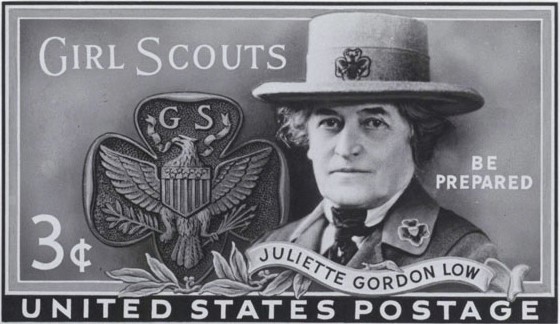
Juliette Gordon Low, Founder of the Girl Scouts, and American Business Tycoon Howard Hughes.

Humphrey Underhill is a direct descendant of Sir Thomas Throckmorton and Margaret Olney, and there is numerous famous cousin kinship that share these same Throckmorton ancestors.

My direct line:

  1. Humphrey Underhill and Margaret Hall
  2. Capt. Humphrey Underhill and Sarah Rowlesson
  3. Sarah Underhill and Joseph L. Budd
  4. Maj. John P. Budd and Mary Prudence Strang
  5. Elijah Budd and Ursula “Ursy” Sine
  6. Mary Budd and Solomon Palmer
  7. Floyd Palmer and Barbara Wolf
  8. John Palmer and Mary Ann Spotts (Spatz)
  9. Susan Palmer and Capt. John Davis Kennedy (my 2nd great-grandparents).
This image has an empty alt attribute; its file name is decorative-2.png

References:

  1. Humphrey Name Meaning. Ancestry.com
  2. Clifford Chambers, England. wikipedia.org
  3. Worden, Blair (2009). The English Civil Wars, 1640-1660. London: Weidenfeld & Nicolson. p. 2.
  4. English Civil Wars. Wikepedia.org
  5. Pelletreau, William S., Abstracts of Wills on File in the Surrogate’s Office, City of New York, pub. as Collections of the New York Historical Society (Vol. I, 1665-1707, pub. 1892), p. 41 (will of Anna Medford).

Additional Sources:

  1. Merritt, Douglas, Revised Merritt Records (New York, Tobias A. Wright, 1916).
  2. Budd, Lily Wright, John Budd, 1599-1670, and Some of His Descendants (Franktown,
    CO, 1992)

Further reading:

  1. Sir Hugh Underhill, served as Keeper of the Wardrobe under Queen Elizabeth I.
This image has an empty alt attribute; its file name is decorative-2.png

If you’d like to learn more about the 52 Ancestors in 52 Weeks project, please visit here:

52 Ancestors in 52 Weeks.

Or join the Facebook group Generations Cafe.

If you use any information from my blog posts as a reference or source, please give credit and provide a link back to my work that you are referencing. Unless otherwise noted, my work is © Anna A. Kasper 2011-2026. All rights reserved. Thank you.

Posted in 52 Ancestors in 52 Weeks, Genealogy | Tagged , , , , , , , , , , , , , , , , , , , , , | 1 Comment

Halloween Surnames. My Crackbone Ancestors from In and Around White Notley, Essex, England. Bones, Brooks, Ravens, and Crows. A Side Connection to Edgar Allan Poe.

I wrote this blog entry five days early, knowing the 52 Ancestors writing prompt coming up was going to be Spirits. To me, Crackbone is a perfect surname to write about at Halloween. It conjures up thoughts about cracking bones, graveyard bones, ghosts and spirits.

Well Halloween is quickly approaching, and whenever I ponder on my Crackbone ancestors, I think, wow, that would be an awesome surname to write about near Halloween! 🎃

The meaning of the Crackbone surname is not completely known, we can only glean the meaning of the surname by splitting it up into two elements. The second element of the surname may refer to legs rather than bones proper [From the Old English bán, bone, leg = Old Norse and German bein, bone, leg]. (1)

Crackbone, Crackbon. Another take on the second element of the surname is that it is from some local name compounded of bourn which means a brook, Anglo-Saxon bum. Hence, Smallbone, Collarbone, Crackbone, Fulborn, Kneebone, Newbone, Newborne, Stubborne, Whalebone. (2)

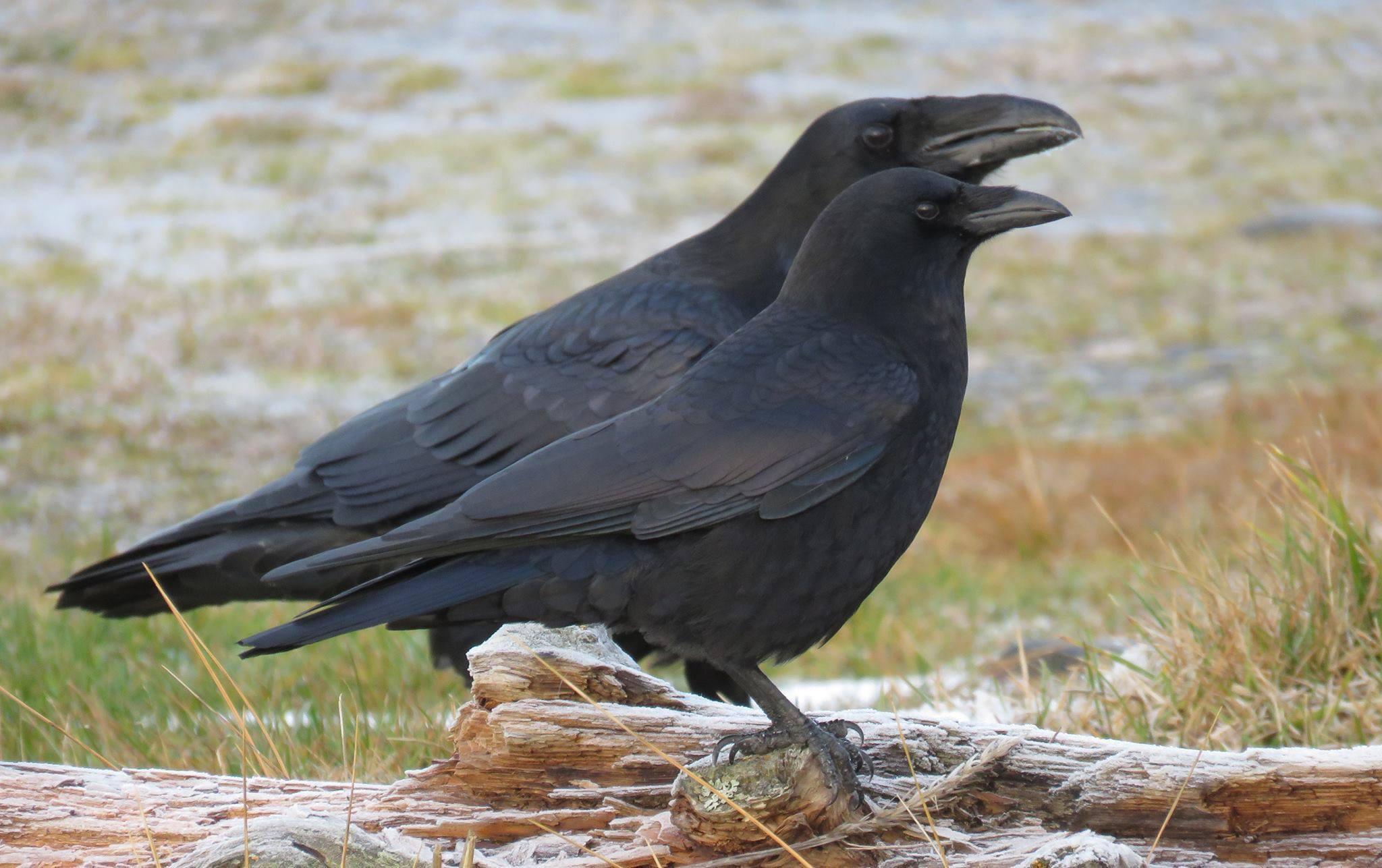
Side by side comparison of a raven and a crow. Photo by Randy Weisser.

The surname Crack, by itself, is thought to be a nickname surname from the Middle English word crak, crayke (Old Scandinavian krákr), meaning a crow [carrion crow] or raven, and hence a person with the characteristics of those birds. Sometimes voiced to sound like crag. (3)

Even if the surname does not have a meaning related to cracking bone(s), 🎃, the crow and raven are very much tied to the Halloween holiday and spooky stories.

The crow is a large black bird found in a variety of habitats worldwide, crows have long been associated with death and darkness, thanks to their coloring and certain behaviors—namely a fondness for the flesh of dead animals, including humans. During wartime, observers have reported crows swooping down to feed on fallen soldiers. The birds prefer soft tissue such as eyes or the meat inside an open wound. One superstition holds that if a crow lands on a roof, death or misfortune will befall the home’s inhabitants. (4)

The Raven by Edgar Allan Poe.

Like crows, which are close relatives, ravens have also been long viewed as symbols of evil or death. Just think of the creepy poem The Raven by Edgar Allan Poe. Also, carrion eaters, ravens are likewise highly intelligent birds that can learn to mimic other species, including humans. In Sweden, their harsh calls traditionally were considered to be voices of murdered people who were inappropriately buried. Germans believed that ravens could locate the souls of the dead and that witches hitched rides on the birds’ backs. (4)

Ravens are extremely intelligent, confident, and inquisitive birds often referenced to in lore and literature. Even though their appearance is often associated with bad omens and loss, they have sophisticated symbolism and messages attached to them. Ravens are considered mediator animals between life and death, and many cultures associate them with lost souls. (5)

Fun side note, I share English ancestors Edward Sale and Elizabeth Gifford with Edgar Allan Poe. My maternal line back to Elizabeth Sale (daughter of Edward Sale and Elizabeth Gifford) who married William Preston: Cole-Prindle-Canfield-Mallory-Preston-Sale. My Crackbone ancestors are also on my maternal side, on a related line: Cole-Prindle-Plumb-Crackbone.

Crackbone surname in England.

What is known is that the Crackbone surname is mostly found in historical records in Essex, England. Mostly in Chelmsford, Terling, Coggeshall, White Notley, and areas nearby, which are all close in distance to each other. The surname is found in records spelled as Crackbone, Crackbon, Crakeborne, and occasionally as Cragbone or Cracbone.

My 11th great-grandmother is Grace Crackbone, who was born 7 May 1564 in Terling, Essex, England, and died 22 July 1615 in Great Yeldham, Essex, England. She was the daughter of Robert Crackbone and Avis Avice ___. She married 14 December 1584 to Robert Plumb in East Hanningfield, Essex, England. He was the son of Robert Plumb and Elizabeth Purcas (Purchas).

All Saints Church and Churchyard in Terling, Essex, England. The Anglican church dedicated to All Saints is located on the village green. The body of the church is medieval, restored in the 19th century, while the brick-built tower dates from 1732.

Her father Robert Crackbone was born about 1525 in White Notley, Essex, England, and died 14 August 1599 in Terling, Essex, England. He married Avis Avice ____, she died November 1591 and is buried in the All Saints Churchyard in Terling, Essex, England.

Robert Crackbone was the son of Thomas Crackbone and Felis/Felyce/Phyllis ____ of White Notley.

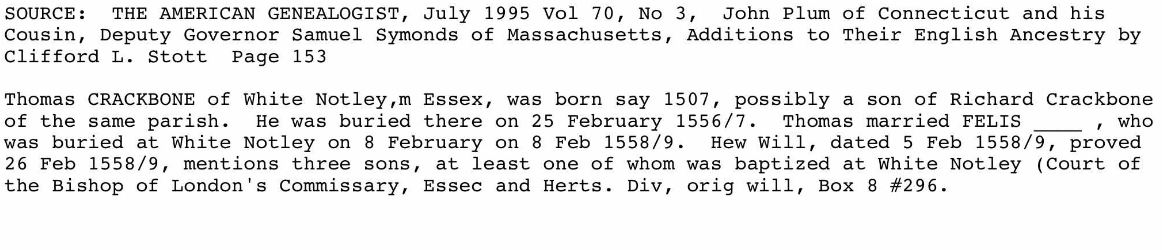
As referenced above in The American Genealogist, Thomas Crackbone is thought to be the son of Richard Crackbone of the same parish of White Notley in Essex, England.

The known Crackbone kin living in Coggeshall, Essex, England were Gilbert Crackbone born about 1596 in Coggeshall. He married first on 18 June 1627 in Coggeshall to Mary Eastwood. He married second to Elizabeth ____ Robbins on 17 June 1656 in Massachusetts, and he died 2 January 1672 in Cambridge, Middlesex, Massachusetts. The distance between Coggeshall and White Notley is 9.6 miles (15.4 km). Gilbert Crackbone’s parentage is unproven, but there appears to be at least a cousin kinship between the families.

With my ancestor Grace Crackbone’s marriage to Robert Plumb, the name is lost in my direct family line and becomes Plumb for the next four generations. Robert Plumb was a significant landowner in Essex and Suffolk, holding the manors of Yeldham Hall and Spaynes Hall in Great Yeldham and The Poole, also in Essex, as well as estates in Clare, in Suffolk. He is mentioned in the Visitation of Essex of 1634, indicating that he had been granted a coat of arms and was thus of the gentry class. (6 & 7)

My line continues with their son, John Plumb. He was born 28 July 1594 in Spaynes Hall, Great Yeldham Essex, England, and died 1 July 1648 in Branford, New Haven, Connecticut. John Plumb came from the minor gentry of Essex and received Ridgewell Hall from his father. He is known to have been living there in 1634 for he is listed in the Visitation of Essex of that year. He first appears in the records of Connecticut in Sep 1636, and it is known that he was a shipowner and did quite well in the Colonial British American Colonies. (6 & 7)

In 1637, he was a member of the General Court. He fought in the Pequot War, and it is likely that it was his ship that was used in the expedition. He traded regularly with the Indians up and down the Connecticut River, and owned more than one ship for that purpose. He was appointed to attend to the clearance of vessels at Weathersfield, because his house was near the water. In 1637, he was appointed to the commission designated by Massachusetts to govern Connecticut. He held several town offices in Weathersfield and was a member of the General Court, on and off, until 1644. (6 & 7)

In that year he moved to Branford and sold his land in Weathersfield, consisting of thirteen parcels from two to 204 acres in size. He was appointed town clerk of Branford and held that office until his death. He was married to Dorothy ____ (possibly Chaplin or Wood) about 1616. (6 & 7)

I will write in the future about my Plumb and related ancestors in more detail in a different blog post.

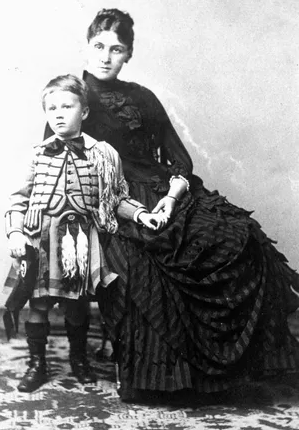
A young Franklin D. Roosevelt with his mother Sara Delano. Both descendants of John Plumb and Dorothy ____.

The list of famous kin of Grace Crackbone and Robert Plumb includes U.S. President Franklin D. Roosevelt, Author Ernest Hemingway, and Fashion Designer Gloria Vanderbilt.

My direct line:

  1. Richard Crackbone of White Notley, Essex, England.
  2. Thomas Crackbone and Felis/Felyce/Phyllis ____.
  3. Robert Crackbone and Avis/Avice ____.
  4. Grace Crackbone and Robert Plumb.
  5. John Plumb and Dorothy ____.
  6. Robert Plumb and Mary Baldwin.
  7. John Plumb and Elizabeth Norton.
  8. Dorothy Plumb and Samuel Prindle.

The name stays Prindle down to my great-grandmother Anna Cora Prindle Cole, when it then changes to Cole.

Happy Hallowtide / Halloweenmas season to all my Cole/Prindle kin. 🎃🐦‍⬛👻🦇⚰️🕷️🕸️🕯️🧙‍♀️🧹🎃

References:

  1. Harrison, Harry (1912). Surnames of the United Kingdom, a concise etymological dictionary. Eaton Press.
  2. Charnock, Richard Stephen (1868). Ludus Patronymicus: Or, The Etymology of Curious Surnames. Trübner & Co. pp. 21 & 100.
  3. Hanks et al. (2016). The Oxford Dictionary of Family Names in Britain and Ireland. Oxford University Press. via Ancestry.com
  4. This Halloween, Meet Four “Spooky” Birds Across many cultures, certain birds have been traditional symbols of bad luck or death. Here are four spooky species that inhabit North America. by Laura Tangley, Oct. 04, 2010. The National Wildlife Federation Magazine Online.
  5. Raven Spirit Animal Symbolism and Meaning by Niccoy Walker. A-Z Animals.com
  6. Ship Owner in Early Connecticut — John Plumb, Ancestor Biographies, STORIES OF THE PEOPLE ON MY PEDIGREE. Laura M., blogspot.com
  7.  The American Genealogist. Vol. 30 (1954), pp. 187-190.

Further Reading:

  1. Cultural depictions of ravens. en.wikipedia.org
  2. A Halloween Special — “The Raven” by Edgar Allan Poe OCTOBER 26, 2017 / JRMILSON.
  3. White Notley. wikipedia.org
  4. What’s the difference between a raven and a crow, according to experts. Although very similar, there are subtle differences that we can use to tell them apart, by Alexandru Micu by Alexandru Micu, May 4, 2023. zmescience.com
  5. Terling. wikipedia.org

If you’d like to learn more about the 52 Ancestors in 52 Weeks project, please visit here:

52 Ancestors in 52 Weeks.

Or join the Facebook group Generations Cafe.

If you use any information from my blog posts as a reference or source, please give credit and provide a link back to my work that you are referencing. Unless otherwise noted, my work is © Anna A. Kasper 2011-2026. All rights reserved. Thank you.

This image has an empty alt attribute; its file name is raven-line.png
Posted in Famous Kin, Genealogy | Tagged , , , , , , , , , , , , , , , , , , , , , , , , , , , , , , , , , , , , , , , , , , , , , , , , , , , , , , , , , , , , , , , , , | 3 Comments

My Baldwin Ancestors. The Name Means Bold, Brave Friend. 52 Ancestors, Week 42: Friends.

I considered writing about my numerous Quaker, Society of Friends, Friends Church, ancestors with this week’s writing prompt of Friends. But there are so many that I decided it was best to write about them in the future, individually, and as family units.

I opted instead to write about my English Baldwin ancestors.

Baldwin is an English and Germanic boy’s name and surname that means bold, brave friend, derived from the Old German elements bald meaning bold, brave and wini meaning friend. In the Middle Ages, this was a popular name in Flanders and among the Normans, who brought it to Britain. (1) I must assume at some point in the history of my Baldwin ancestors, they were given this surname because someone was a bold, brave friend. I very much like the meaning of this name.

The furthest I can take my Baldwin lines back with certainty is to Richard Baldwin and his wife Ellen Apuke. Ellen was probably the sister of John Apuke, referred to as brother in the will of her husband. Richard Baldwin was not the son of Sir John Baldwin, MP, but they do appear to have had a kinship, possibly as cousins, or even as uncle/nephew [see below re: Manor of Dundridge]. According to Jacobus, Richard Baldwin was the son of Robert Baldwin and Agnes Dolte. (2)

Later generations of Ellen Apuke’s kin, via her brother, adopted a new spelling of the surname Apuke and changed it to Pooke in the 1800s in England.

Richard Baldwin, who is listed as of Dundridge Manor, was born about 1503 in Buckinghamshire, England. He married Ellen Apuke about 1524 in the village of Aston Clinton, Buckinghamshire, England. He died in early 1533 in Aston Clinton, Buckinghamshire, England.

Abstract of the will of Richard Baldwin:

To be buried in the church-yard of Aston Clinton; to Alis my daughter, 20 marks when married; to Agnes my daughter £12 when 19 and to Cicelly and Letise my daughters each £10, when 19;to John my son, my farm at Dongrove in the parish of Chesham, when 23, but if he die before that age, then the same to Henry, my son; to Richard my son, my tenth in Cholsbury and the lands belonging thereto, when 23; to Ellyn my wife and Henry my son the rents of my said houses & lands towards bringing up my children; to Heughe Baldwin, my brothers son, £6. 13`4`; smalll bequests to godchildren, tenants & servants; Henry my son 10 silver spoons and a maser; the residue of all personalty to Ellyn my wife and Henry my son equally, & they to be my executors; overseers of my will, my brothers John Baldwyn & John Apuke

Above photo is of the Manor of Dundridge.

The Manor of Dundridge

As early as 1320, the manor was in the possession of the Montacutes; it descended to Margaret, Countess of Salisbury, who was beheaded in 1541, when under her attainder, it fell to the crown.

Shortly after, King Henry, VIII, bestowed it upon Sir John Baldwin, the Chief Justice, who held it at his death, 24 Oct 1545, when with other estate, it passed to his heirs, who were as stated in the inquisition postmortem, Thomas Pakington, son and heir of his daughter Agnes, and John Burlacy, son and heir of his daughter Petronilla.

In the subsequent division of the estate, Dundridge appears to have fallen in the sole possession of the Pakingtons, passing from Thomas Pakington, heir, to his son and heir, John Pakington, who on the 1st of March, 1577-8, according to Patent Roll, 20 Eliz., Part 5, alienated it, with other messuages, tenements, &c., in Aston Clinton, Chesham, and Wendover, co., Bucks, to “Henry and Richard Baldwin,” and it was they of course who paid the taxes upon it the following year, wrongly stated elsewhere, to have been paid by “Sylvester Baldwin, & his son Henry.”

As Joseph Chester states in his book, “Richard Baldwin, in his will, in 1552/3, described himself as of Dundridge, he could only have been the tenant of the manor, as the ownership did not pass from the Pakingtons until 1577-8.” (3)

Above photo is of St. Michael and All Angels Churchyard, Aston Clinton.

My line continues with the son Henry Baldwin, who is listed above in the abstract of his father’s will: to Ellyn my wife and Henry my son the rents of my said houses & lands towards bringing up my children.

Henry Baldwin was born after 1 Sept 1530 in Aston Clinton, Buckinghamshire, England, and died 1 June 1602 at Dundridge Manor, Aston Clinton, Buckinghamshire, England. He married 21 July 1555 in Aston Clinton, Buckinghamshire, England to Alice Kinge.

The will of Henry Baldwin was dated 2 January 1599/1600; titling himself Henry Baldwin of Dundridge Yeoman; of the parish of Aston Clinton, co., Bucks, Yeoman; he was buried at Aston Clinton on 1 June 1602; and his will proved at London, in the Prerogative Court of Canterbury, 2 July 1602, by Richard Baldwin, son and his named executor. (3)

Alice Kinge was born about 1533 in Aston Clinton, Buckinghamshire, England, and died 23 Nov 1626 at about 93 years of age at Dundridge Manor, Aston Clinton, Buckinghamshire, England. Alice is thought to be the daughter of William Kinge. Her mother may have been named Cecily.

Her will gives a great amount of family information. Her will was proven 14 Dec 1626, and it lists her sons Richard and John Baldwin as executors, and if unable she lists her son Sylvester Baldwin and her son-in-law Richard Salter.

Furthermore, her will lists her three sons: Richard, Sylvester, and John, and daughters: Mary Baldwin Salter, Jane Baldwin Bonas, and daughter Agnes Baldwin Stonehill is listed as deceased.

Her will lists the following grandchildren:

  1. Grandchildren by son Sylvester: John, Henry, Sylvester, Richard, William, Alice, and Jane Baldwin.
  2. Grandchildren by son John: Richard, John, Mary, Agnes, and Martha Baldwin.
  3. Grandchildren by daughter Mary (Baldwin) Salter; Richard, Thomas, John, David, Susanna, Mary, and Sarah Salter.
  4. Grandchildren by daughter Jane (Baldwin) Bonas: Richard, Thomas, John, Christian, Faith, Mary, and Jane Bonas.
  5. Grandchildren by deceased daughter Agnes (Stonehill) Baldwin, wife of Henry Stonehill: Henry, Jane, and Agnes Stonehill.
  6. Grandchild of Robert Baldwin, Anne Baldwin.

She also lists her brothers and her sister: Thomas and Robert King(e), and Marie (King/e) Montague. It mentions children, but only names one nephew, William King(e), son of Thomas.

Children of Henry Baldwin and Alice Kinge:

  1. Richard Baldwin, born before 1560 in Aston Clinton, Buckinghamshire, England and died 29 Nov 1636. He married Christian Towckfield. He died childless.
  2. Sylvester Baldwin (Sr.) born 28 Sept 1560 at Aston Clinton, Buckinghamshire, England, and died before 16 Feb 1632 at Cholesbury, Buckinghamshire, England. He married on 28 Sept 1590 at Cholesbury, Buckinghamshire, England, to Jane Wells. (my direct ancestors).
  3. Robert Baldwin, born about 1562 at Aston Clinton, Buckinghamshire, England, and died 1605 at Aston Clinton. He married Joane Robinson.
  4. John Baldwin born about 1565 at Aston Clinton, Buckinghamshire, England, and died Oct 1637 at Chesham, Buckinghamshire, England. He married about 1581to Hannah ____.
  5. Jane Baldwin, born about 1577 at Aston Clinton, Buckinghamshire, England, and died before 4 June 1622 at Aston Clinton. She married about 1599 to James Bonas.
  6. Mary Baldwin, born about 1578 at Aston Clinton, Buckinghamshire, England, and died 1637. She married 30 Jan 1598/9 at Aston Clinton to Richard Salter.
  7. Agnes Baldwin, born 1579 at Aston Clinton, Buckinghamshire, England, and died 1622. She married Henry Stonehill.

The Baldwin family has a long association with the village of Aston Clinton and many of my Baldwin ancestors and their kin are buried in the churchyard of St. Michael and All Angels Church, Aston Clinton, Buckinghamshire.

The above stained-glass window in found in the north aisle of St. Michael and All Angels
Church, in Aston Clinton, Buckinghamshire, England. The wording reads:

To the Glory of God and in memory of ROBERT BALDWIN and his descendants who lived at Dundridge Manor in this parish c. 1520 – 1638 And of those who emigrated to [immigrated to] New England with SILVESTER BALDWIN“.

The window was donated by American Baldwin descendants in the 1960s.

My line continues with the second son listed above, Sylvester Baldwin (Sr.), who married Jane Wells. The parentage of Jane Wells/Welles is unproven.

Sylvester Baldwin (Sr.) was mentioned in the will of his grandmother (Ellen Apuke) Baldwin in 1565/6, in his father’s will of 2 Jan 1599/1600, and in his mother’s will (Alice King(e) Baldwin) 4 June 1622.

The Church of St. Leonard founded circa 1278, which is about 3 3/4 miles southeast by south of the parish church of Aston Clinton was in 1586 in the tenure of Silvester Baldwin who held other lands in the same parish which Queen Elizabeth had granted to Sir Edward Stanley, Knight and his heirs.
He acquired property in 1592 in Flitwick, Bedfordshire, England, about 25 miles from the Church of St. Leonard. The document of conveyance identifies Sylvester as the son of Henry Baldwin of Dundridge. (3)

In 1603 and 1605 the Sylvester Baldwyn’s house was infected with the plague. (3) Today, the plague is best known as the Black Death or the bubonic plague. Medieval people called it “the blue sickness,” La pest (“the Pestilence”), and “the Great Mortality.” (4)

In 1628, his name appears on tax records in Flitwick. (3)

Regarding the burial record of Silvester Baldwin of 1 Jun 1632 at Flitwick.

From Rev. Canon Michael Bradley:

People will have been buried here [ancient burial ground in Flitwick] for centuries, including 1632, but churchyard burial plots will have been re-used and any wooden or stone memorials will have long perished.

Sylvester Baldwin (Sr.) and wife Jane Wells had the following children:

  1. George Baldwin, born about 1590, and died 21 Nov 1596, he is buried at Cholesbury.
  2. Richard Baldwin, born about 1591, and died before 1661 he married April 1607 at Aylesbury, to Philippa Corbman.
  3. Henry Baldwin, born about 1593 and died 14 Sept 1661 at Guildford, Surry. He married 10 May 1627 at London, to Mary Hurst.
  4. John Baldwin, born before 1599, and died 20 Feb 1631/32, and is buried at Bedfordshire. He likely died unmarried.
  5. Sylvester Baldwin (Jr.), born about 1599 and died 21 June 1638 at Sea on the ship Martin, on his way to British Colonial America. He married about 1620 to Sarah Bryan(t). His wife and children, who were also on the ship Martin, immigrated to the British Colonial Connecticut Colony. (my direct ancestors).
  6. William Baldwin, born 1601 and died after 1676.
  7. Jane Baldwin, born 1602 and died 2 July 1629. Named in the will of her grandmother Alice on 4 Jun 1622. Likely died unmarried.
  8. Alice Baldwin, born 4 May 1605. She married 4 May 1629 at Milton Ernest, England, to John Edwards as his first wife.

My line continues with the fifth son listed above, Sylvester Baldwin (Jr.) and his wife Sarah Bryan(t). The parentage of Sarah Bryan(t) is unproven. He with his wife and their five children, who were all baptized at Aston Clinton, Buckinghamshire, England, left England on the good ship, Martin. He made a nuncupative (oral) will at sea on 21 June 1638, and he died aboard the ship on the same day. It is assumed he was buried at sea, since the ship arrived in Boston three weeks later on 3 July 1638. His will was proved 4 July 1638, before Dep. Gov. Dudley in Boston making Sarah, his wife, and Richard, his son, executors of his estate.

Children of Sylvester Baldwin Jr. according to the Aston Clinton Registers:

  1. Sarah baptized 22 April 1621; she married Benjamin Fenn.
  2. Richard baptized 25 August 1622; he married Elizabeth Alsop.
  3. Mary baptized 28 February 1623/24; buried 3 Nov 1625.
  4. Mary baptized 19 February 1625/26; she married Robert Plumb of Milford. (my direct ancestors).
  5. Martha baptized 20 April 1628.
  6. Samuel baptized 1 July 1632; buried 4 January 1633.
  7. Elizabeth baptized 28 January 1633; buried 31 January 1633/34
  8. John (known as John Baldwin of Stonington), baptized 28 October 1635; he married Rebecca (Palmer) Chesebrough.
  9. Ruth – not shown on Aston Clinton church register but mentioned in her father’s nuncupative will in 1638 aboard the ship Martin.

Sarah Byran(t) Baldwin married second to Capt. John Astwood, one of the seven pillars and judges of Milford. Capt. Astwood went to London on business for the Colony and died there about 1653.

Photo above is Sarah’s Memorial on the bridge. The memorial stones of the founding families of Milford are incorporated into the bridge structure. Above her stone is her daughter Mary Baldwin and Mary’s husband Robert Plumb, they are also my direct ancestors.

In 1641, the “Widow” Baldwin was given a lot in the southwest square or Hertfordshire quarter of New Haven, which is now located at the corner of Chapel and York Streets in New Haven, Connecticut.
The family vacated their property in New Haven and moved with the group of founders to Milford. Her name is on one of the memorial stones on the Bridge over the Wepawaug River in Milford (pictured above).

My line continues with their daughter Mary Baldwin who married Robert Plumb, he was the son of John Plumb and Dorothy Chaplin. At this point, the family name changes from Baldwin to Plumb. In the will of her mother Sarah Byran(t) Baldwin Astwood, Mary (Baldwin) Plumb, wife of Robert Plumb, is given most of her mother’s goods and chattels as well as a book called The Soule’s Conflict

My direct line:

  1. Richard Baldwin and Ellen Apuke.
  2. Henry Baldwin and Alice Kinge.
  3. Sylvester Baldwin (Sr.) and Jane Wells.
  4. Sylvester Baldwin (Jr.) and Sarah Bryan(t).
  5. Mary Baldwin and Robert Plumb.
  6. Dorothy Plumb and Samuel Prindle (my 8th great-grandparents).

My Baldwin ancestors are on my maternal side and are the ancestors of my great-grandmother Anna Cora Prindle Cole.

Photo above is of First Lady Mary Geneva “Mamie” Doud Eisenhower.

There are many famous kin descended from my Baldwin ancestors. A few famous descendants of my direct ancestors Mary Baldwin and Robert Plumb are:

Ernest Hemingway, First Lady Mamie (Doud) Eisenhower, and Prior Prime Minister of the UK Boris Johnson.

Go here to view a full list of famous kin and direct descendants of Richard Baldwin and Ellen Apuke.

Last updated in December 2025.

References:

  1. Baldwin name meaning. Dictionary of American Family Names © Patrick Hanks 2003, 2006 via Behind the Name.com
  2. Jacobus, Donald Lines, ed., The Ancestry of Lorenzo Ackley and his Wife Emma Arabella Bosworth, Woodstock, Vermont: N. Grier Parke, II (1960), p 182.
  3. Chester, Joseph Lemuel, Investigations concerning the family of Baldwin, of Aston Clinton. Privately published and printed, Boston, MA, 1884.
  4. The Black Plague: The Least You Need to Know by Dr. Kip Wheeler, English Professor at Carson-Newman University.

Additional Sources:

  1. Wheeler, Richard. History of the Town of Stonington, County of New London, Connecticut (Day Publishing, Co., New London, Conn., 1900) Page 223

Further reading:

  1. Aston Clinton, Buckinghamshire, England, wikepedia.com.
  2. The Baldwins of England – Post Norman Generations. Complied by R. Mark Baldwin, Jr., wordpress.com.
  3. Milford Memorial Stone Bridge in Memoriam, The Historical Marker Database. HMdb.org.
  4. Milford Memorial Bridge & Tower, Milford Takes Nothing for Granite, July 2021. ctmq.org.
  5. 7 ‘missing’ Milford founders added to plaque, John Burgeson, Dec. 5, 2014. ctpost.com

If you’d like to learn more about the 52 Ancestors in 52 Weeks project, please visit here:

52 Ancestors in 52 Weeks.

Or join the Facebook group Generations Cafe.

If you use any information from my blog posts as a reference or source, please give credit and provide a link back to my work that you are referencing. Unless otherwise noted, my work is © Anna A. Kasper 2011-2026. All rights reserved. Thank you.

Posted in 52 Ancestors in 52 Weeks, Famous Kin, Genealogy, Religious | Tagged , , , , , , , , , , , , , , , , , , , , , , , , , , , , , , , , , , , , , , , , , , , , , , , , , , | 3 Comments

Three Interesting Tradesmen/Occupational Surnames in My Family Tree with Unique Meanings. Blower and Horne in England and Höerner/Hörner in Germany. 52 Ancestors, Week 36: Tradesman.

This week’s writing prompt is Tradesman. I considered writing about some of my ancestors and their trades and occupations but instead opted to write about three of the surnames of my ancestors that are derived from their trade/occupation, all three with very similar origins. I have a myriad of ancestors with surnames that are directly related to a trade, but I chose Blower, Horne, and Höerner/Hörner because I thought their meanings related to their occupation were quite interesting, and unique.

I will first write about the surname Blower, its origins, history, and meaning, and my Blower ancestors.

It is an English surname, an occupational name from the Middle English blouer ‘blower’ (Old English blāwere) and was someone who blew a bellows on a church organ, or a horn that was typically used to call workmen to work or as a huntsman. (1)

Large organs were built in churches from at least 1100. These instruments had many pipes and required several huge bellows to provide their wind. The job of a calcant, or bellows-pumper [the blower], was quite taxing. One got to rest during the sermon but then would be wakened by a bell rung by the organist when it was time to start pumping again. –  American Guild of Organist (2)

It is quite possible that my original ancestor, with the surname Blower, was named as such because they were one of these bellows-pumpers for a church organ. It sounds like quite the laborious job!

But it is also equally likely that the original ancestor given this surname blew a horn that was used to call workmen or was a horn blower of the hunt. (1)

Photo: Annie Rosén. Exploring the medieval hunt.

I find this second meaning to be more to my liking! A more interesting occupation, with a musical ability implied.

Although the surname blower is an occupational surname, there is a smaller chance that my ancestor was given the name as a nickname, established by the year 1300, for a loud or boastful person, to brag, boast, bluster, speak loudly, from the same Old English root word blāwere. This meaning of the name is not quite as appealing! (1)

My connection to the surname Blower is not a recent one. My maternal 10th great-grandmother was Alice Blower, born June 1615 and baptized the same month at St. Gregory’s in Sudbury, Suffolk, England, and died November 1690 in Braintree, Norfolk, Massachusetts. She was the daughter of Thomas Blower and Alice Frost. The Blower and Frost families are found in church records in Stanstead, Suffolk, England, and we can take these lines back a few more generations with them living in the Stanstead area. She married 6 January 1633/1634 at St. Katherine by the Tower, London, England, to Richard Brackett. Richard had returned to England from the Massachusetts Bay Colony to marry her and took her with him back to Boston by 1635. Alice’s parents and two of her brothers also immigrated to Massachusetts from England. (3)

The Blower line is on my maternal side. Cole – Merchant – French – Cummings – Kingsley – Brackett – Blower.

Medieval Blow Horn. Horn-Maker.com

Next, I will discuss the German surname Höerner/Hörner. Its origins, history, meaning, and my Höerner/Hörner ancestors.

Höerner is derived from the German name Hörner. Hörner means horn maker and/or horn blower.  In the Middle Ages, the horns of cattle were made into drinking cups or other tools. Musical instruments were also made from them and were called Hörner.

Drinking horns were made out of European bison, goat, cow, or ox horn. The first step that is needed is to remove the inner core. This is achieved by boiling or soaking the whole horn and then scraping out the softened marrow. Once the core has been removed from the horn, it’s then softened again using heat and pressed to form its desired shape. With the drinking horns of the Vikings, the animal horn is left in its natural shape. After the horn is formed, it was coated often in beeswax. It then could be fitted with metal or other details and/or carved with etchings. (4 & 5)

I have a closer connection to my Höerner/Hörner ancestors. My 4th great-grandmother was Anna Walpurgis Hoerner. She was baptized 8 April 1750 in Niklashausen, Main-Tauber-Kreis, Baden-Württemberg, Germany, and died in the USA, most likely in Maryland, but possibly in Pennsylvania. She was the daughter of Johann Georg Hoerner and Maria Barbara ____, and married 27 November 1770 in Niklashausen, Main-Tauber-Kreis, Baden-Württemberg, Germany to Johann Peter Albert. Their first two children were born in Niklashausen. They immigrated to the USA by 1788. Their next child was born in New York City. They migrated to Washington County, Maryland, where two daughters were born. I can take the Hoerner line back several generations, and they all lived in Niklashausen. The surname is found both as Hoerner and Horner in church records, although most often found as Hoerner, both with and without the Umlaut over the letter ö.

You can learn more about Niklashausen, and more about these ancestors in my blog entry about my ancestors named Walpurgas.

The Hoerner line is on my maternal side. Cole – Kennedy – Price – Albert – Hoerner.

Thirdly, I will discuss the Horne surname. The English surname Horne has a meaning similar to Blower and Hoerner. The name was taken on by someone who worked as a person who carved objects out of animal horn or made musical instruments. This name was also given to a person who was employed as a hornblower; in the Middle Ages, workmen were often summoned to work by the blowing of a horn, in this way, it has the same meaning as Blower. In addition to Horne initially being an occupational surname for someone who played the horn, it also could mean a person that lived near a horn-shaped geological site. (6 & 7) Pictured above is a replica of a horn mug from the Medieval-Tudor time period in English history.

My English Horne ancestor is my 7th great-grandmother Winifred Horne, born in Maryland and died in St. Mary’s County, Maryland. She married John Wheatley. She was the daughter of Edward Horne and Winifred ____. They arrived in Maryland in 1664. Although the family was from England, Edward Horne’s parentage is unproven.

My English Horne ancestry is on my paternal side. Armstrong – Norris – Wheatley – Horne.

Photo above from The Last Witch

The surname Horne also has some witchy connections. The witch association comes from Janet Horne, who was the last person legally executed for witchcraft in the British Isles. The Hornes were a mother and daughter accused of witchcraft by their neighbors. The daughter managed to escape, but the mother, Janet Horne, was killed by fire. Her story inspired the play The Last Witch by Rona Munro. (7)

A side note: The actual name of Janet Horne is unknown, “Janet Horne” or “Jenny Horne” was the generic name given to all witches in the north of Scotland at that time. (8 & 9)

References:

  1. BLOWER Name Meaning – familysearch.org
  2.  American Guild of Organist – A Young Person’s Guide to the Pipe Organ by Sandra Soderlund, 1994.
  3. Threlfall, John Brooks. The English Ancestry of Richard and Alice (Blower) Brackett of BraintreeThe American Genealogist (The American Genealogist, Barrington, RI, 1976) Vol. 52, Page 73-4.
  4. How do they make Viking Drinking Horns? by Gaurav Tiwari. Last updated: December 22, 2022. gauravtiwari.org
  5. All About Drinking Horns – AleHorn.com
  6. Horne Surname History in England – houseofnames.com
  7. 100 Powerful Witch Surnames by Chelsea Nelthropp. Updated August 28, 2023
  8. Janet Horne – The last witch in Scotland, written by Chris Thornton | 14th of September 2022. livebreathescotland.com
  9. Henderson, Lizanne. Witchcraft and Folk Belief in the Age of Enlightenment: Scotland 1670–1740. Palgrave McMillan, 2017.

Further reading:

  1. Photo History of Ancient Drinking Horns from Around the World – thevintagenews.com
  2. 10 Things to Know About Medieval Drinking Horns – medievalists.net
  3. A complete guide to German umlauts by Marie Schmoll, April 11, 2023. berlitz.com

To learn more about Janet Horne and her daughter:

  1. Janet Horne – wikipedia.org
  2. ‘Janet Horne’ by Edwin Morgan

If you’d like to learn more about the 52 Ancestors in 52 Weeks project, please visit here:

52 Ancestors in 52 Weeks.

Or join the Facebook group Generations Cafe.

If you use any information from my blog posts as a reference or source, please give credit and provide a link back to my work that you are referencing. Unless otherwise noted, my work is © Anna A. Kasper 2011-2026. All rights reserved. Thank you.

Posted in 52 Ancestors in 52 Weeks, Genealogy | Tagged , , , , , , , , , , , , , , , , , , , , , , , , , , , , , , , , , , , , , , , , , , , , , , , , , , , , , , , , , , , , , , , , , , , , , , , | 1 Comment

My Ancestor Phebe Fed Prindle and Her Correct Maiden Name. Colonial Records in Connecticut, the Various Ways the Capital Letters F, J, and T were Written in Colonial American Handwriting. Transcription Errors. Records Destroyed by the British. DNA. Surnames in Colonial America. 52 Ancestors, Week 49: Written.

This week’s 52 Ancestors writing prompt is Written. Suggestions for the prompt were writing about someone in my family that is a writer (besides me!), someone who had a habit of sending letters to the editor of newspapers, those that had lovely handwriting, etc. Of course, we are free to interpret the prompt as we wish. I had written prior about my ancestor Pheobe Fed Prindle, my maternal 6th great-grandmother, and felt this blog post was a perfect example of analyzing handwriting in old records, discovering transcription errors, and records being destroyed by the British. By doing so, I succeeded in discovering my ancestor’s true maiden name. By analyzing Colonial American handwriting of this time period, using DNA, and the records of related surnames that were mis-transcribed. Her maiden name was listed in the transcription of her marriage record was Fed, which is basically a non-existent surname in Colonial Connecticut and in Colonial America in general.

We have only this one record that lists her maiden name, the transcription of the marriage records of Colonial Connecticut, the above listing of Daniel Prindle of New Milford (Connecticut) marrying Phebe Fed, a transient person, on October 4, 1737, by John Bostwick, J.P. In a second transcription typed up of this same record they list her name as Phebie Fed.

Phebe being listed as a transient person meant that she was not of New Milford and had been there only a short time. It does not mean that she was not from another area of Connecticut, nor does it mean that she was poor or homeless.

She is listed as Phebie along with her husband Daniel Prindle in the birth records of several of their children, including their son, my ancestor, David Prindle.

I noticed that some (in their family trees) give her the middle name of Marie/Maria and list her as Phebe/Pheobe Marie/Maria Fed Prindle. There are no documentation, proof, or records that show she had a middle name, and I am not sure where this trend of giving her a middle name originated.

Some have incorrectly attached her to the death record of a Mrs. Phebe Prindle that died at age 84 in Connecticut. But if you research this death record further, you discover that this woman was born about 1754 and died in 1838. This is not my ancestor Phebe, for she died in 1782.

She is listed in the will of her husband:

Daniel Prindle of New Fairfield, Fairfield County, Connecticut; will 16 April 1774; probate 3 May 1774; inventory 24 May 1774. Wife Phebe; sons Aaron, David and Daniel; daughters Phebe, Hannah, Rachel, Elizabeth, Mary and Lois.

She and her husband Daniel Prindle are buried in Center Cemetery in Sherman, Fairfield County, Connecticut.

The surname is found only once in British Colonial American records of the 1600s, a John Fed born 1620-1629 that is listed in the book A Recd. of the Achievements of Her People in the Making of A Commonwealth and the Founding of A Nation. Ed. By Ezra S. Stearns. New York, 1908. I have been unable to discover any additional information about this John Fed.

In the 1700s in British Colonial America, the name is very uncommon, and quite rare. Below are the few instances it is found in records.

There is a John Fed listed on the US Revolutionary War Rolls of 1775-1783. He served July-August 1775-1783 in New Jersey. Nothing more is known about this person. There is not a man named John Fed found in any other New Jersey records, nor he is found in any family trees, which leads me to believe his surname was incorrectly listed or spelled in this record.

There is a John Fed found in the AGBI (American Genealogical-Biographical Index) born 1750-1759 and lived in Pennsylvania. In early census records of 1790, we find a John Fed living in Tinicum, Delaware County, Pennsylvania, and he is the same John Fed found in the AGBI record.

But this John Fed found above living in Pennsylvania and listed in the AGBI, was actually named John Fred and was a Quaker, he is found in many records with his correct surname of Fred, sometimes spelled Fredd. John Fred/Fredd emigrated from Ireland.

I have zero DNA matches or connections to this Quaker Fred/Fredd family of Ireland and Pennsylvania.

In Massachusetts U.S. Town and Vital Records, we find a Samuel Fed living in 1793 in Medford, Massachusetts. But is the only time this name is found in Medford or anywhere in Massachusetts records in this time period. His surname was actually Wade/Waide.

I have no DNA connections to this Wade/Waide family of Medford, Massachusetts.

In this same time period, the only other person found with this surname in records is my ancestor, who is listed in the AGBI and the Colonial Connecticut marriage records with the name Phebe/Phebie Fed Prindle.

The only DNA matches I have with the surname Fed in their trees, are to cousins that share Phebe Fed Prindle as their ancestor. I have no other Fed DNA matches.

That’s it! Just these very few instances of the surname being located in Colonial American records.

This surname Fed in my family tree has been a dead end, a tree stump, a brick wall. So, what was I to do? What was her true surname? Well after looking at records for the surname Ted/Tedd which looks very close to Fed/Fedd when viewing Colonial American cursive handwriting styles, I discovered that there were Jud/Judd families in Colonial Connecticut that sometimes had their surname incorrectly listed as Jed, Ted/Tedd and occasionally as Fed/Fedd.

In Colonial America, handwriting styles were not universal, as you will see in the below examples of capital letters. Also, not everyone had beautiful penmanship, some writings from the time are easier to read than others. I give you the examples below for the letters F, J, and T, because they are directly related to my research of this ancestral line.

Below is a comparison of the various ways that the capital letter F was written in Colonial America. As you can see, it was not uniform.

Below is a comparison of the various ways the capital letter J was written in Colonial America. Once again, it is not uniform, but does have similarities.

Below is a comparison of the various ways the capital letter T was written in Colonial America. It is a bit more uniform but with some variance.

I have been unable to actually view the marriage record of my ancestors Phebe Fed and Daniel Prindle, and analyze the original handwriting, all we have is what someone else read, transcribed, and typed up.

As you can see above, the capital letters F and T in some instances look very much alike, and the second and fifth example of the letter J also is somewhat similar to some of the F and T examples.

The surname Jud/Judd could look like Ted/Tedd or even Fed/Fedd.

After considering strongly that Phebe’s maiden name was actually Judd, and she was of a Judd family of a different town in Connecticut, DNA became quite helpful.

Firstly, I studied my DNA matches, and the DNA matches of my maternal half-sister, and matches of my niece (my maternal half-brother’s daughter). A DNA match came up that already shares with me David Prindle and Phebe Fed as ancestors, if Phebe’s maiden name was Judd, then he would have the same Judd ancestors, Philip Judd (Jr.) and his 1st wife, twice, and descend from two of their children, via different, but related lines. Philip Judd was the son of Philip Judd (Sr.) and Hannah Loomis. I did research into Philip Judd, his family, and my DNA matches. Numerous additional DNA matches came up, being descended from this same Judd family.

There is some confusion regarding the wives of Philip Judd (Jr). Many list him as married to Lydia Hall, but she was the wife of his 2nd cousin Nathaniel Judd. She died in 1749 and cannot be the same Lydia that is a member of the Bethel Church in 1760 and is known to be the 2nd wife of Philip Judd.

His last known child was born about 1722, and in all likelihood his children are all from his first marriage. The name of his first wife is unknown. The maiden name of his second wife Lydia or if she was married prior is also unknown.

The above picture is from a page in the book Philip Judd and His Descendants, by Caroline Judd McDowell. It was originally published in 1923.

What is known for sure is he had three sons: Philip (III), Thomas, and Samuel Judd. He had a daughter named Hannah Judd, whose name was confirmed by Deacon Eliel Taylor, and a second daughter, Rebecca Judd, whose name was confirmed by Russel Judd. Deacon Eliel Taylor thought that there was a total of five daughters. That leaves three unnamed daughters.

I do not find any marriage records for Hannah or Rebecca Judd, nor did I find any known descendants. Although, if they married in or near Danbury, the records were destroyed by the British, so none would be found. My Phebe marrying in New Milford is actually a blessing, since those records were not destroyed.

It states in Philip Judd and His Descendants, that the records of Danbury, Connecticut were destroyed by the British in April 1777 during the American Revolutionary War. The author visited Danbury in 1839, and depended upon Deacon Eliel Taylor, who was aged 82 at the time, as her primary source of information. The records for Bethel, which is a few miles from Danbury, would have been included in the records destroyed by the British.

It is believed that one of the unnamed daughters was Mary Judd, who married Judah Wright. I believe that my ancestor Phebe was also one of the unnamed daughters. Phebe Judd would have been born about 1718 in Bethel, Connecticut, which is near Danbury, and is 17.3 miles from where she married Daniel Prindle in New Milford.

I wanted to inject a little update here. Since originally writing this, I have discovered that Jerusha Judd (married Samuel Hoyt) is also believed to be one of the unknown named daughters of Philip Judd and his first wife. Also, some think Philip Judd’s daughter, Hannah Judd, was the wife of Deacon Eliel Taylor.

I have DNA matches to the descendants of the three Judd sons and the daughter, Mary Judd Wright.

Since we do not know the name of the first wife of Philip Judd (Jr.), or anything about his second wife Lydia, I have to go back to the next generation.

Philip Judd (Jr.) was the son of Philip Judd (Sr.) and Hannah Loomis. She was the daughter of Thomas Loomis Sr. and Hannah Fox/Fowkes.

Philip Judd (Sr.) was the son of Thomas Judd (who died 12 November 1688 in Northampton, Hampshire, Massachusetts) and Elizabeth ___.

I have several DNA matches to the descendants of Philip Judd, Sr. and Hannah Loomis.

I also have DNA matches to the descendants of Thomas Judd and Elizabeth ____.

Thomas Loomis, Sr. was born 3 December 1624 in Braintree, Essex, England, and died 28 August 1689. He married first on 1 November 1653 to Hannah Fox/Fowkes, the daughter of Henry Fox/Fowkes (of Windsor, Connecticut). After his first wife Hannah died, he married second on 1 January 1662/63 to Mary Judd, the daughter of Thomas Judd and Elizabeth ____.

I have DNA matches to the descendants of Thomas Loomis, Sr. and Hannah Fox/Fowkes.

Thomas Loomis, Sr. was the son of Joseph Loomis, a woolen draper from Braintree, Essex, England and his wife Mary White. Joseph Loomis sailed from London on 11 April 1638 on the ship Susan and Ellen. He arrived in Boston, 17 July 1638. He settled at Windsor, Connecticut.

Now, do I know 100% beyond a shadow of a doubt that Phebe Fed Prindle was born Phebe Judd? Well, no, not 100%. But by studying handwriting of the time and surnames that were mis-transcribed as Fed/Fedd/Ted/Tedd, the fact that the surname Fed is quite rare and nonexistent in Colonial Connecticut (or anywhere in Colonial America), also that we know Philip Judd (Jr.) had five daughters and that some of their names were lost to time and records being destroyed by the British, as well as my very strong DNA connection to these Judd and Loomis families, I strongly believe that it is a cogent hypothesis.

My direct line:

  1. Philip Judd, Jr. and his first wife.
  2. Phebe Judd and Daniel Prindle.
  3. David Prindle and Jemima Leach.
  4. Amos Prindle and Esther Canfield.
  5. David M. Prindle, Sr. and Hannah Elizabeth Greatsinger/Kritsinger.
  6. Daniel Prindle and Sarah Jane “Jennie” Doman.
  7. Anna Cora Prindle and Joseph Edward Cole (my great-grandparents).
Naomi Judd with daughters Wynonna and Ashley.

Famous kin of Thomas Judd and Elizabeth _____:

  1. Gilbert Clifford Nobel – Co-Founder of Barnes & Noble.
  2. O. Henry – Short Story Writer.
  3. Mark Hopkins, Jr. – Co-founder, Central Pacific Railroad.
  4. Frank Kellogg – 45th U.S. Secretary of State.
  5. Daniel Burnham – World’s Columbian Expo Architect.
  6. Horace Austin – 6th Governor of Minnesota.
  7. Bob Barker – TV Game Show Host.
  8. Nancy (Davis) Regan – First Lady of President Ronald Reagan.
  9. Henry Fonda – Movie Actor.
  10. Norman Rockwell – American Artist.
  11. Dan Quayle – 44th U.S. Vice-President.
  12. Jane Fonda – Movie Actress.
  13. Ted Danson – TV Actor.
  14. Sigourney Weaver – Movie Actress.
  15. Peter Fonda – TV and Movie Actor.
  16. Diana Ellen “Naomi” Judd – American country music singer, songwriter, and activist.
  17. Jodie Foster – Movie Actress.
  18. Christina Claire Ciminella “Wynonna” Judd – American country music singer.
  19. Ashley Tyler Ciminella Judd – American television and film actress. 
  20. Amy Adams – Movie Actress.
  21. Viggo Mortensen – Movie Actor.
  22. Bridget Fonda – Movie Actress.
  23. Tammy Duckworth – U.S. Senator from Illinois.

Numerous people on this above list, I also have other family connections with them on other different lines.

This list of famous kin of Thomas Loomis and Mary White is even longer. It includes some of the names above and many more. You may click here, to view the list.

If you’d like to learn more about the 52 Ancestors in 52 Weeks project, please visit here:

52 Ancestors in 52 Weeks.

Or join the Facebook group Generations Cafe.

If you use any information from my blog posts as a reference or source, please give credit and provide a link back to my work that you are referencing. Unless otherwise noted, my work is © Anna A. Kasper 2011-2026. All rights reserved. Thank you.

Posted in 52 Ancestors in 52 Weeks, Classic Hollywood Actors, Famous Kin, Genealogy | Tagged , , , , , , , , , , , , , , , , , , , , , , , , , , , , , , , , , , , , , , , , , , , , , , | 1 Comment

My McComas Cousin Actor Lindsay Wagner. 52 Ancestors, Week 25: Fast.

This week’s writing prompt for 52 Ancestors, Week 25 is Fast. A perfect week to write about my McComas cousin actor Lindsay Wagner. Fast, moving at bionic speed! Next Thursday, the 22nd of June, is her birthday, also making it the perfect week to write about her and our shared ancestors.

Lindsay Wagner. December 2022. From her Official Facebook.

First, I need to explain to you that I was a diehard fan of the television series The Bionic Woman. I was first introduced to the character on The Six Million Dollar Man TV series but was ecstatic when Jaime Sommers got her own series. I was a child when her character made its debut and became a tween on the edge of becoming a teen when the show was cancelled. I adored her apartment above the barn, and her brass bed. I tried to make my hair like her! Who else will admit that they pretended to be bionic when playing outside? I originally studied Elementary Education in college partly because she was a teacher. The character was a strong female role model for the time. I almost got to see Lindsay Wagner filming The Bionic Woman series when I was on the Universal Studios tour, but she had already left for the day. We did get to see her body double. I was quite sad when the show was cancelled. Even today, I will occasionally rewatch episodes of The Bionic Woman. I did continue to follow Lindsay Wagner’s career after the show ended. One of my all-time favorite TV movies is The Two Worlds of Jennie Logan. From that same time period, I remember the TV movies The Incredible Journey of Doctor Meg Laurel, I Want to Live! and the TV miniseries Scruples. A few years later, the TV movie and following series Jessie. The Six Million Dollar Man and The Bionic Woman TV films in the late 1980’s and 1994, and later TV films like Thicker than Water and her appearing in several episodes of Warehouse 13. She has many more acting credits, but those are the ones that come to mind.

Lindsay Wagner as Jaime Sommers, The Bionic Woman.

Lindsay Wagner and I are 7th cousins, one-time removed. Even though I am much younger than she, by many years, her father William Nowells ‘Billy’ Wagner was my actual direct 7th cousin. We share ancestors Alexander McComas and Elizabeth Day.

Alexander McComas was born 14 September 1692 in Anne Arundel County, Maryland, and died 4 February 1761 in Baltimore, Baltimore County, Maryland. He married first to Elizabeth Day on 19 November 1713 in St. John’s Parish, Baltimore, Baltimore County, Maryland. She was the daughter of Nicholas Day and Sarah Cox. Our Day and Cox ancestors have their roots in England and Wales. They had several children, including Lindsay’s and my ancestors. After the death of his wife Elizabeth, he married second to Hannah Whitaker on 23 August 1728 in St. John’s Parish, Baltimore, Baltimore County, Maryland. There were also children born from his second marriage.

Regarding the maiden name of our ancestor Sarah, wife of Nicholas Day, and mother of Elizabeth Day McComas. John Pearce gives her surname as Cox. Gertrude Stephens and others show no surname. The surname of Lowe comes from Gene Blair’s database from 1993. Her correct maiden name as of yet remains unproven. But I believe her maiden name was Cox and that she was an aunt to her daughter-in-law Elizabeth Cox (wife of Nicholas Day, Jr). Making her the daughter of Christopher Cox.

Alexander McComas was the son of Daniel McComas. He emigrated from Scotland and settled at the head of the Severn River (which is located in Anne Arundel County) by 1687. In 1693 the family then went to Harford County (Baltimore County).

Daniel McComas was born about 1662 in Scotland, and dies 4 April 1699 in Middle Neck Hundred, Anne Arundel County, Maryland. There are several stories floating around about his life in Scotland prior to coming to Colonial Maryland, but Scottish genealogists have been unable to verify these stories.

In the Dictionary of Scottish Emigrants to the USA, Vol. 1, his name is listed as Daniell Maccomus.

Daniel McComas married before 1687 in Anne Arundel County, Maryland to Elizabeth. Her maiden name is thought to be either McGill or Hubbert.

When Daniel died in 1699, he left his wife a widow in her 30’s with four sons aged 3 to 12. Court records show that Daniel McComas late of Anne Arundel, Maryland, deceased, and Elizabeth McComas, the wife and flower of Daniel had sons John, William, Alexander, and Daniel. Elizabeth, his wife, stated that it was the wish of Daniel that his children be free and if possible, Elizabeth should keep the land and care for the children until they reach the age of 17 years.

McComas researcher and descendant Robert McComas-Wood writes:

She had no wish to go against him, but she could not support the children. Elizabeth had to have the children bounded out until age 17, except if she should die, she wishes them to be free of indenture by age 16 years. John was 12 on July 14 last, William was 10 on October 16 last, Alexander was 7 on Sept 14 last, Daniel would be 3 on January 12 next. The date was October 17, 1699, in June court records of Anne Arundel County, it shows that John, Alexander and Daniel McComas, were orphans living at the home of Stephen Gill. Further research shows that the sons of Daniel and Elizabeth McComas went on to acquire land, raise families, and prosper in the colony of Maryland. So, the wishes of Daniel and Elizabeth were fulfilled. The strength and caring found in the words of Daniel, continues to connect all the various McComas branches of the family.

Alexander McComas and Elizabeth Day had numerous children: daughters Sarah McComas Rhodes, Elizabeth McComas Norris, Eleanor McComas Miles, and Mary McComas Whitaker, and sons Alexander, David, and Daniel McComas.

My line continues with daughter Elizabeth McComas who married Thomas Norris, the son of John Norris and Ann Wheatley. The family name stayed Norris for two generations until it became Armstrong. The family stayed in Maryland for a few generations before migrating to Indian Hill, Hamilton County, Ohio.

Lindsay Wagner’s line continues with son David McComas who married Catherine Burke. The family carries the name McComas until Lindsay’s 2nd great grandmother Louisa Josephine McComas marries Aaron John “A.J.” Cleveland, her father’s great-grandparents. Her McComas lines migrated from Maryland to Virginia and West Virginia, and ended up in Illinois, Indiana, and Kansas. Her Cleveland/Nowels great grandparents migrated from Kansas to Los Angeles, California.

Pictured above is Louisa Josephine McComas and husband Aaron John “A.J.” Cleveland.

Pictured above is Lindsay Wagner’s great-great grandparents Louisa Josephine McComas and Aaron John “A.J.” Cleveland. Her line continues with their daughter Verna Mabel Cleveland who married Ralph Oscar Wagner. They are her paternal great-grandparents.

Above are the MacThomas Clan Tartan and Crest Badge

The origins of the McComas surname are Scottish and northern Irish. It is an anglicized form of the Gaelic surname Mac Thómais (MacThomaidh) meaning ‘son of Thomas’. (1) The surname McColm is from MacThom and McComas is from MacThomas. McComas is one of the main sept names of Clan MacThomas. In the early part of the 17th century, there were a small number of MacThomases and MacComases living around the western end of Loch Tay in Perthshire.

The Clan MacThomas Society writes:

Despite this small group [in Loch Tay in Perthshire], the Clan MacThomas name is most unusual within Scotland, unlike other Clans, the main name has only been used rarely over the centuries. This is because the early MacThomases preferred to be called by one or other of the Gaelic variations on the name. Also, when some clansmen decided to leave Glenshire and Glen Isla, following the breakup of the Clan at the end of the 17th century, and move elsewhere, they generally adopted a variety of abbreviated anglicized versions, such as McComas.

Today the name McComas can be found mainly in the United States, as well as most English-speaking nations. (2)

Famous descendants of Alexander McComas and Elizabeth Day:

American Actress Lindsay Wagner; 37th U.S. President Richard Nixon; American stage, film, and television actress Carroll McComas; North Carolina Politician Daniel F. McComas; American space scientist David J. McComas; James Douglas McComas, former president of three U.S. universities; Elisha McComas, Brigadier General in the War of 1812; American child actor Kendall McComas; and American Actress and Playboy Model Lorissa McComas.

Famous descendants of Alexander McComas with second wife Hannah Whitaker:

American Politian and lawyer Walter R. McComas.

Famous descendants of Daniel McComas and wife Elizabeth McGill/Hubbert who are not through their son Alexander McComas and his wives Elizabeth Day and Hannah Whitaker:

American flying ace during World War II, Edward O. McComas; American attorney, politician, and jurist Louis E. McComas; American politician George W. McComas; and American science fiction editor J. Francis McComas.

Except in the case of Pres. Richard Nixon, the rest of the famous McComas kin and descendants listed above were all collected via my own research and genealogical work.

Lindsay Wagner at NorthEast ComicCon, November 2022. Photo from Lindsay Wagner’s Official Instagram.

In closing, I’ll like to wish my McComas cousin Lindsay Wagner a very 🎶🕯🎊🎈🌹Happy Birthday 🥳🤩🎂🎉🤍 on June 22nd.

References:

  1. Mccomas Surname Meaning. Ancestry.com
  2. The Septs of Clan MacThomas. McComas. Clan MacThomas Society.

If you’d like to learn more about the 52 Ancestors in 52 Weeks project, please visit here:

52 Ancestors in 52 Weeks.

Or join the Facebook group Generations Cafe.

If you use any information from my blog posts as a reference or source, please give credit and provide a link back to my work that you are referencing. Unless otherwise noted, my work is © Anna A. Kasper 2011-2026. All rights reserved. Thank you.
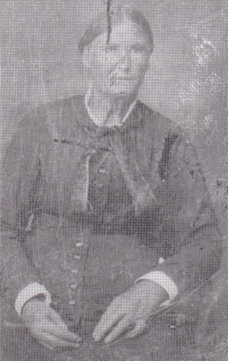
Posted in 52 Ancestors in 52 Weeks, Famous Kin, Genealogy | Tagged , , , , , , , , , , , , , , , , , , , , , , , , , , , , , , , , , , , , , , , , , , , , , , , , , , , , , , , , , , , , , , , , , , | 3 Comments